01Facts
The respondent-plaintiff filed OS No. 290 of 2018 before the IV Additional District Court, Tiruvallur at Ponneri, seeking declarations that certain documents (including a sale deed dated 31.03.1920 and documents of 1964) and a judgment and decree of 1952 were null and void and not binding on him, along with a permanent injunction.
¶ 3 · p. 2The defendants' application to reject the plaint as barred by limitation was dismissed, but without prejudice to limitation being decided at trial.
¶ 3 · pp. 2–3After issues were framed and trial was about to commence, the plaintiff filed IA No. 2 of 2026 under Order VI Rule 17 CPC seeking to: (i) add a prayer for declaration of absolute ownership of the suit property; (ii) add new paras 13(a) and 13(b) pleading that the cloud on title was created by the defendants' written statement; (iii) amend the cause of action to refer to the written statement dated 30.09.2024; and (iv) revise the court fee and valuation accordingly.
¶ 3 · pp. 3–6The defendants opposed the amendment as barred by limitation, being sought roughly eight years after institution of the suit.
¶ 4 · p. 6The trial court allowed the application, holding that a cloud had been created on the plaintiff's title and that the amendment would take effect from the date of the suit.
¶ 5 · p. 6The defendants filed this revision under Article 227 of the Constitution against the order dated 26.10.2026.
¶ 1 · p. 1 · ¶ 5 · p. 602Issues
i.1. Whether an amendment introducing a declaration of title, sought after the trial court had framed issues and roughly eight years after institution of the suit, must be confined to operate from the date of the amendment order rather than from the date of filing of the original plaint, given the defendants' limitation objection.
¶ 6 · pp. 6–7 · ¶ 7 · p. 7ii.2. Whether the trial court's order allowing the amendment warrants interference in exercise of supervisory jurisdiction under Article 227 of the Constitution.
¶ 7 · p. 7 · ¶ 9 · p. 803Law Applied
The Court's reasoning rests on Order VI Rule 17 CPC, under which the impugned amendment was sought and allowed.
¶ 3 · p. 3The Court's supervisory jurisdiction under Article 227 of the Constitution, under which the revision was filed.
¶ 1 · p. 1A plaintiff seeking a consequential declaration of title must first establish that the challenged documents are null and void and not binding; the title relief assumes significance only after that bridge is crossed.
¶ 7 · p. 7An issue framed on limitation governs the entire suit, so that a later-added relief dependent on the same challenged documents is subject to the same limitation issue.
¶ 7 · p. 7Provisions in the judgment · 1
the Act (alias, unresolved) Section 25
04Reasoning
The Court did not decide whether the amendment was time-barred, as that question was reserved for evidence at trial.
¶ 8 · p. 8The declaration of title is wholly dependent on the success of the challenge to the 1920, 1964 and 1952 documents, and limitation has already been framed as an issue for those challenges. Because the same issue necessarily extends to the new relief, the petitioners' concern that the amendment might be used to escape limitation by relation back is adequately protected, so it was immaterial whether the amendment took effect from the date of the order or the date of the original plaint.
¶ 7 · p. 7The Court preserved the defendants' procedural position by permitting them to file an additional written statement to the amended plaint.
¶ 7 · p. 7The Court's discretion under Article 227 was not found to have been exercised perversely, so no interference was warranted.
¶ 9 · p. 8The order does not analyse the eight-year delay as a separate factor in the discretionary exercise under Order VI Rule 17, nor does it engage with the "cloud on title" rationale beyond recording it.
¶ 5 · p. 605Holding
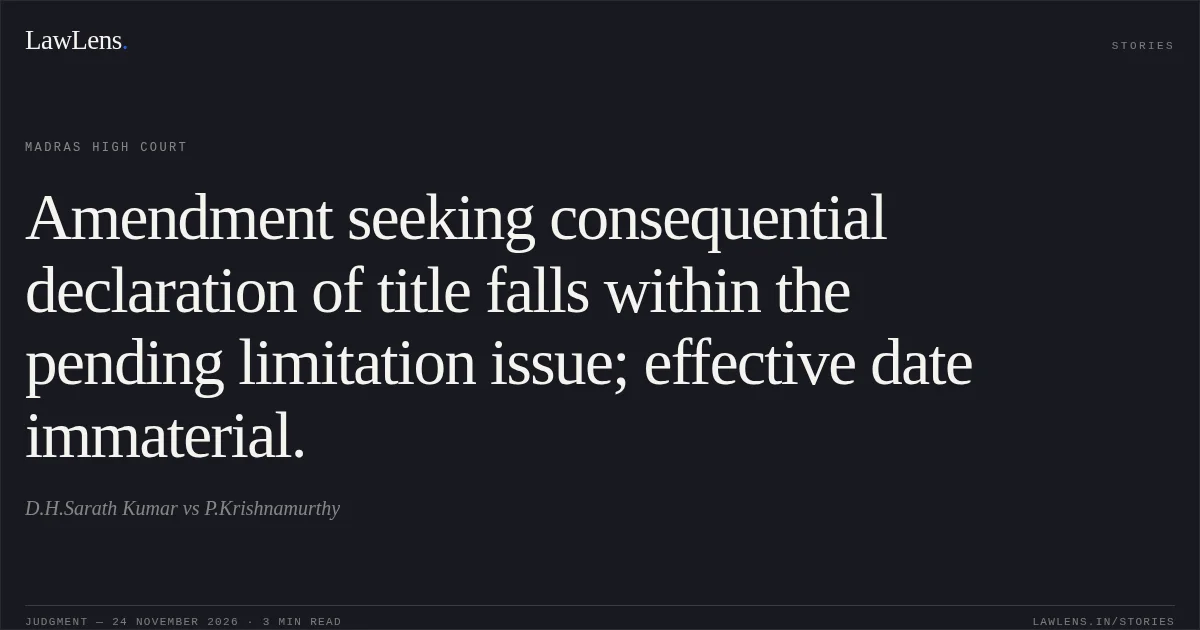
The question of the effective date of the amendment is academic, since limitation as framed in the suit extends to the declaration of title sought by amendment.
¶ 7 · p. 7The trial court's order allowing IA No. 2 of 2026 is sustained, and the CRP is disposed of without costs. The connected CMP is closed.
¶ 9 · p. 8The trial court is directed to keep these observations in mind while deciding limitation on the evidence led by both sides.
¶ 8 · p. 8The petitioners are granted liberty to file an additional written statement to the amended plaint.
¶ 7 · p. 7Original Court PDF
D.H.Sarath KumarvsP.Krishnamurthy
Click to open original judgment
Original judgment, available to read, download and summarize on LawLens.in