01Facts
The temple, through its Executive Officer, sought review under Order 47 Rule 1 read with Section 114 CPC of the judgment dated 02.07.2014 in S.A. No. 133 of 2011.
p. 1 · ¶ 1The Second Appeal, filed by the respondent-plaintiff, was allowed on the ground that a suit instituted by the Executive Officer was not maintainable, because the Executive Officer was not the competent person to sue.
p. 5 · ¶ 5The review applicant contended that maintainability was not pleaded in the written statement or raised before the trial or first appellate court, and was raised for the first time in the Second Appeal.
p. 2 · ¶ 2It further contended that the Court did not decide the case on merits, that a similarly placed order in favour of the temple was not considered, and that Sections 45(1) and (2) of the Tamil Nadu Hindu Religious and Charitable Endowments Act empower the Executive Officer to sue for the temple.
p. 3 · ¶ 2.1Reliance was placed on the Full Bench decision in Sankaranarayanan Iyer v. Sri Poovananathaswami Temple (1949) 2 MLJ 171, which, it was said, was not considered, while the Court had relied on Sri Arthanareeswarar of Tiruchengode v. T.M. Muthuswamy Padayachi (2003) 1 LW 386.
pp. 5–6 · ¶ 5The respondent opposed the review, contending that maintainability was a conscious determination, that no error apparent on the record existed, and that the review sought a rehearing.
pp. 3–5 · ¶ 3, 3.1The applicant also relied on several later decisions upholding Executive Officer suits.
p. 10 · ¶ 802Issues
i.1. Whether a review lies under Order 47 Rule 1 CPC where the maintainability objection to the suit was raised for the first time in the Second Appeal and was decided by the Court.
pp. 4–5 · ¶ 3.1 · p. 5 · ¶ 5ii.2. Whether the non-production or non-consideration of binding or relevant judgments (including the Full Bench decision and Supreme Court authorities) at the time of hearing constitutes an error apparent on the face of the record justifying review.
pp. 6–7 · ¶ 6 · pp. 10–11 · ¶ 8.1–9iii.3. Whether a subsequent change or reversal of the legal position furnishes a ground for review.
pp. 8–9 · ¶ 7.103Law Applied
The Court relied on Order 47 Rule 1 CPC and its Explanation, under which reversal or modification of a legal position by a subsequent decision is not a ground for review.
pp. 8–9 · ¶ 7, 7.1The Court drew on Article 137 of the Constitution, as explained in Government of NCT of Delhi v. K.L. Rathi Steels Ltd. (2023), that the power of review is confined to the grounds prescribed by law.
pp. 7–8 · ¶ 7The Court followed Subramanian Swamy v. State of Tamil Nadu (2014), which holds that the first requirement for review is an error apparent on the face of the order, and that an erroneous decision is not itself a ground for review, relying on Rajendra Kumar v. Rambhai (AIR 2003 SC 2095).
p. 8 · ¶ 7The Court noted that a legal objection to maintainability may be considered even absent a specific plea or issue.
p. 4 · ¶ 3.1The Court referred to the review applicant's authorities, which concerned the maintainability of Executive Officer suits rather than review jurisdiction.
p. 10 · ¶ 8.1Sections 45(1) and (2) of the TNHR&CE Act and the 1949 Full Bench decision were noted as the basis of the contention but not adjudicated as review grounds.
pp. 5–6 · ¶ 5Provisions in the judgment · 2 · Linked ones open on LawLens
Code of Civil Procedure, 1908 Section 114
TAMIL NADU HINDU RELIGIOUS AND CHARITABLE ENDOWMENTS ACT, 1959 Section 45
04Reasoning
The Court first examined the judgment of 02.07.2014 and found no patent error on its face.
p. 6 · ¶ 6The maintainability objection, though first taken in the Second Appeal, was a pure question of law capable of consideration without a specific pleading, so its consideration could not be treated as an error apparent on the record.
p. 4 · ¶ 3.1The judgment had in fact relied on Arthanareeswarar (2003), which the Court had considered and applied.
pp. 6–7 · ¶ 6The failure of counsel to cite the Full Bench decision or the Supreme Court authorities during argument was held not to be a ground for review; the remedy for such omissions lies in appeal, not review.
p. 7 · ¶ 6Since the review applicant's contentions, including the legal effect of Sections 45(1) and (2) and the Full Bench ruling, sought a fresh consideration of the same question, the application amounted to a rehearing, which Order 47 does not permit.
pp. 8–9 · ¶ 7.1The later authorities relied upon by the applicant addressed the merits of Executive Officer suits, not the scope of review, and therefore did not furnish a ground for review.
p. 10 · ¶ 8.1Any subsequent development in the law thus cannot disturb the earlier decision in review proceedings.
p. 9 · ¶ 7.105Holding
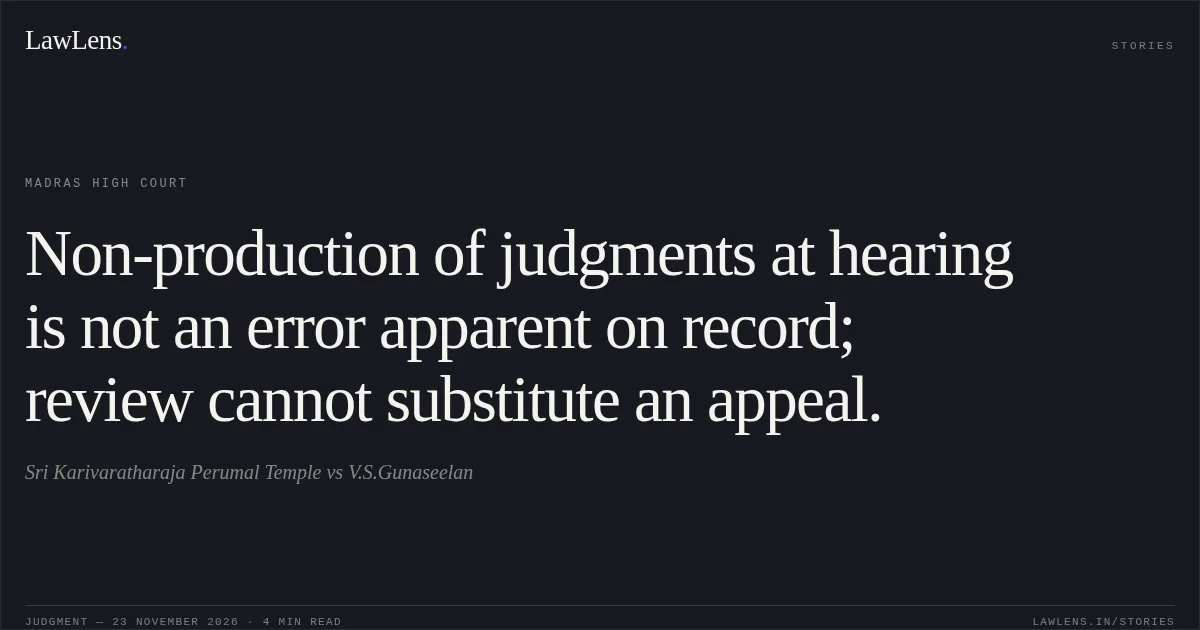
The review application did not disclose any error apparent on the face of the record, non-production of judgments at the hearing is not a ground for review, and the review was in substance an attempt to re-argue the Second Appeal.
pp. 10–11 · ¶ 8.1, 9The Review Application was dismissed with no order as to costs. The judgment dated 02.07.2014 in S.A. No. 133 of 2011, including its holding on the maintainability of the Executive Officer's suit, stands undisturbed.
p. 11 · ¶ 9Original Court PDF
Sri Karivaratharaja Perumal TemplevsV.S.Gunaseelan
Click to open original judgment
Original judgment, available to read, download and summarize on LawLens.in