01Facts
The petitioner-plaintiff filed O.S. No. 1697 of 2023 seeking a decree of permanent injunction.
¶ 3The plaint pleaded that the plaintiff and his family were permitted to reside in the suit property by his mother, had long been in possession, and were threatened with eviction.
¶ 3 · ¶ 7The relief sought was an injunction restraining eviction except by due process of law.
¶ 7The defendant's written statement, filed in 2023, asserted ownership under a Settlement Deed dated 04.10.1995 (Ex. B1) and counterclaimed for ejectment of the plaintiff.
¶ 8 · ¶ 10Issues were framed, evidence was recorded, and the suit reached final hearing.
¶ 3At that stage, the plaintiff filed I.A. No. 2 of 2026, which sought a declaration that the plaintiff is the owner of the suit property.
¶ 3The plaintiff also filed I.A. No. 3 of 2026, which sought to plead that Ex. B1 wrongly names the defendant's father as "V. Raji Naicker" when he is actually the son of "Elumalai," and to declare the settlement deed null and void and not binding on the plaintiff.
¶ 4The defendant opposed both applications on the ground that they changed the character of the suit and could not be sought at the final-argument stage.
¶ 5The trial court dismissed both applications by common order dated 11.08.2026, holding that the amendments changed the character of the suit and that the plaintiff had not shown due diligence.
¶ 6The plaintiff attributed the delay to a change of counsel.
¶ 902Issues
i.1. Whether the proposed amendments, seeking a declaration of title and the cancellation of the 1995 Settlement Deed at the final-argument stage, alter the basis and character of the suit.
¶ 10 · ¶ 11ii.2. Whether the plaintiff satisfied the proviso to Order VI Rule 17 CPC by showing due diligence, such that the amendments could not have been sought before commencement of trial.
¶ 6 · ¶ 11iii.3. Whether the trial court's dismissal warrants interference in revisional jurisdiction under Article 227 of the Constitution.
¶ 11iv.4. Whether leave may be granted to the plaintiff to file a substantive suit.
¶ 1303Law Applied
Order VI Rule 17 CPC, whose proviso bars amendments after commencement of trial unless the court is satisfied that, despite due diligence, the party could not have raised the matter earlier.
¶ 11An amendment that alters the nature and character of the suit is impermissible at a late stage.
¶ 10 · ¶ 11Supervisory jurisdiction under Article 227 of the Constitution, which is exercised only where the lower court's reasoning suffers from perversity.
¶ 11The judgment cites no precedent for the propositions on amendment or Article 227 jurisdiction.
On the question of a fresh suit, the court left any remedy open "if the law otherwise permits" without citing a specific provision.
¶ 1304Reasoning
The plaint sought only a permanent injunction against eviction without due process, and never claimed title or exclusive right.
¶ 10The proposed amendments would introduce an entirely new cause of action, a declaration of title and a challenge to Ex. B1, and would change the very basis of the suit.
¶ 10The defendant had asserted ownership under the 1995 Settlement Deed in its 2023 written statement, so the plaintiff was on notice from the outset yet waited until final arguments to seek the amendments.
¶ 10The reason offered, a change of counsel, did not satisfy the due diligence requirement of the proviso.
¶ 9 · ¶ 11Because the trial court's reasoning was neither perverse nor otherwise illegal, the High Court declined to interfere under Article 227.
¶ 11The court declined to grant leave to file a fresh suit, as that was outside its power to grant in these proceedings.
¶ 1305Holding
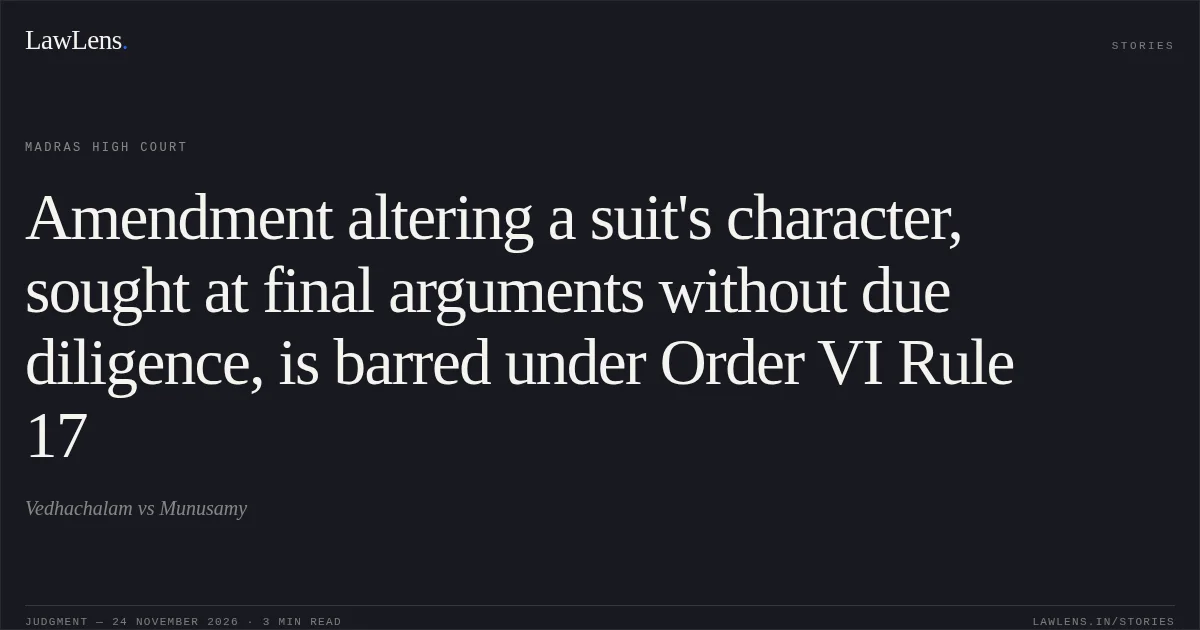
The proposed amendments changed the nature and character of the suit and were sought at the post-trial stage without satisfying the proviso to Order VI Rule 17 CPC.
¶ 11The order dated 11.08.2026 in I.A. Nos. 2 and 3 of 2026 in O.S. No. 1697 of 2023 was sustained, and both Civil Revision Petitions were dismissed without costs, with the connected miscellaneous petitions closed.
¶ 12 · ¶ 14The plaintiff's request for leave to file a substantive suit was refused, with any such remedy left open under law.
¶ 13Original Court PDF
VedhachalamvsMunusamy
Click to open original judgment
Original judgment, available to read, download and summarize on LawLens.in