01Facts
The plaintiffs (respondents 1–7) filed O.S. No. 44 of 2016 before the Principal Sub-Court, Puducherry. They seek a declaration that the judgment and decree in O.S. No. 18 of 1993, dated 28.10.1993, is non est, along with a permanent injunction.
¶ 4 · p. 2The suit reached final arguments. Evidence of DW-1 was reopened for cross-examination.
¶ 4 · pp. 2–3The petitioner then filed I.A. No. 16 of 2026 to implead himself as a proposed defendant, contending that he is a proper and necessary party and holds rights over the property.
¶ 4 · p. 3The petitioner's case is that O.S. No. 18 of 1993 was filed by his sister and that 27 items of property, including the suit property, form part of a compromise decree dated 29.04.1970 in O.S. No. 6 of 1968. Under that compromise, the B schedule property was allotted to him.
¶ 6 · pp. 3–4The compromise was challenged in C.S. No. 149 of 1980, where his rights were upheld up to the Supreme Court.
¶ 6 · pp. 3–4The trial court dismissed the impleadment application on two grounds: (i) exorbitant delay in filing, with the suit at the final-hearing stage; and (ii) failure to place any material substantiating his rights under the compromise decree in O.S. No. 6 of 1968.
¶ 5, 7 · p. 2, 4The supporting affidavit does not state how the petitioner learnt of the suit.
¶ 9 · p. 5Before the High Court, the petitioner produced a voluminous set of documents not placed before the trial court.
¶ 8 · p. 402Issues
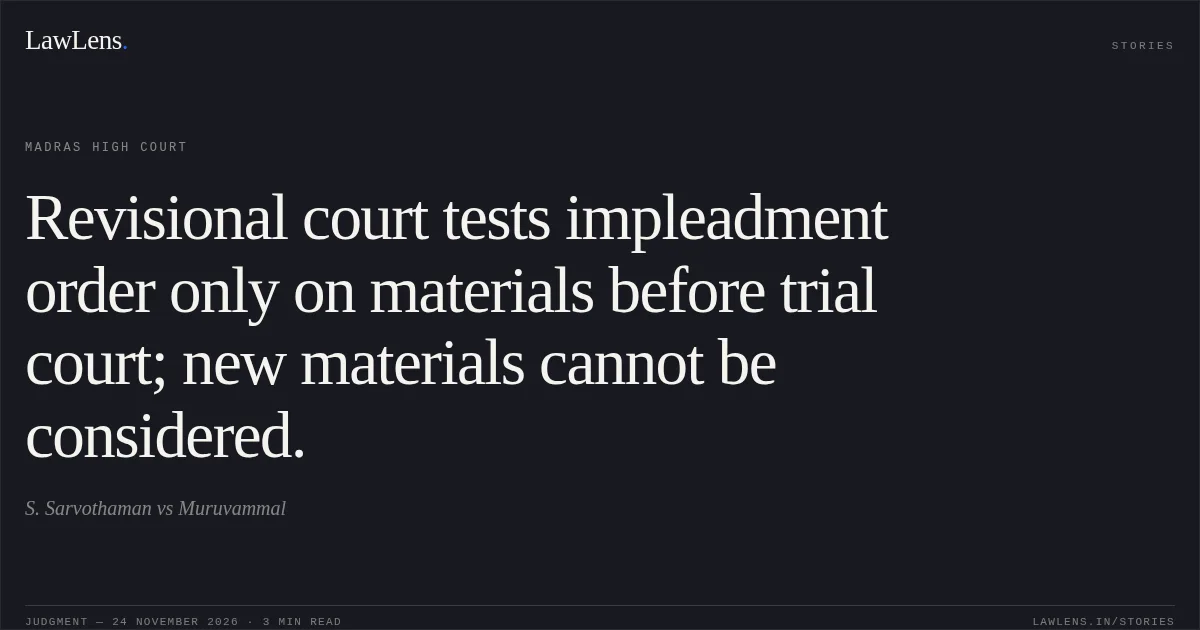
i.1. Whether the trial court's dismissal of the impleadment application, on grounds of delay and absence of supporting material, is perverse so as to warrant interference under Article 227 of the Constitution.
¶ 7 · p. 4 · ¶ 11 · p. 5ii.2. Whether documents not placed before the trial court may be considered by the High Court in exercising supervisory jurisdiction.
¶ 10 · p. 5iii.3. Whether the petitioner may be permitted to file a fresh impleadment application with the supporting materials, where the omission is attributed to his advocate.
¶ 12 · pp. 5–603Law Applied
The judgment does not cite any statutory provision or precedent expressly. The Court's jurisdiction under Article 227 is supervisory, and an order is interfered with only where it suffers from perversity.
¶ 11 · p. 5The correctness of an impugned order is tested only on the material that was available to the court below; materials produced for the first time in revision cannot be considered.
¶ 10 · p. 5A party whose application failed for want of proper material may be given liberty to refile with that material, so that the court below can decide on the merits in accordance with law.
¶ 12 · pp. 5–604Reasoning
The Court held that the trial court's reasoning was not perverse. The petitioner's affidavit was silent on how he came to know of the suit. Given that the application was filed at the fag end of a 2016 suit, after final arguments and reopening of DW-1's evidence, the timing was questionable and the delay unexplained.
¶ 9 · p. 5Since the trial court had no access to the voluminous documents produced before the High Court, those documents could not be examined for the first time in revision to fault the trial court's order. Once the two grounds were found to be sustainable on the record before the trial court, no ground for interference under Article 227 existed.
¶ 8, 10, 11 · pp. 4–505Holding
The trial court's order is not perverse and does not warrant interference under Article 227. Documents not before the trial court cannot be considered in revision for the first time. The petitioner's contention that the lapse was his advocate's was accepted only to the extent of granting liberty to refile, and the petitioner may file a fresh impleadment application with all supporting materials, which the trial court must consider on merits and decide in accordance with law. The Court left the merits of impleadment, including the right claimed under the compromise decree, to the trial court.
¶ 10, 11, 12 · pp. 5–6The CRP is disposed of without costs, and the connected CMP is closed. Considering that the suit was filed in 2016, the Court directed the Principal Sub-Court, Puducherry, to dispose of O.S. No. 44 of 2016 within three months from receipt of a copy of the order.
¶ 13, 14 · p. 6Original Court PDF
S. SarvothamanvsMuruvammal
Click to open original judgment
Original judgment, available to read, download and summarize on LawLens.in