Facts
The petitioners/plaintiffs instituted a suit seeking declaration of title to the suit land, contending that respondent no. 1, Bhagatram, was not part of their genealogical tree and therefore had no right in the property.
Source reference: p.1, para. 2According to the plaintiffs, Ram Sevak Lodhi died two months after marrying Dharampurwali, who thereafter cohabited with or married Ghansua Lodhi, from whom Bhagatram was born. Bhagatram disputed this account and asserted that he was the son of Ram Sevak and Dharampurwali, and that Dharampurwali married Ghansua only after Ram Sevak’s death.
Source reference: p.1, para. 3After issues were framed, the plaintiffs applied under Order 26 Rule 10(a) of the Code of Civil Procedure, 1908, seeking a DNA test of Bhagatram. The trial court rejected the application on the ground that a DNA test of Bhagatram could not determine whether he was born during Ram Sevak’s lifetime or after his death.
Source reference: p.2, para. 4The plaintiffs challenged that order under Article 227 of the Constitution.
Source reference: p.1, para. 1Issues
1. Whether the trial court erred in rejecting the plaintiffs’ application for conducting a DNA test of respondent no. 1 to determine whether he was the son of Ram Sevak or Ghansua Lodhi?
Source reference: p.2, paras. 4–52. Whether, before the parties had led evidence, a DNA test was necessary or permissible for resolving the disputed question of parentage and inheritance?
Source reference: pp. 4–5, paras. 8–93. Whether the circumstances satisfied the judicial safeguards and the “eminent need” standard governing orders for DNA testing?
Source reference: pp. 3–5, paras. 6–9Law Applied
The Court considered the plaintiffs’ application under Order 26 Rule 10(a) CPC and its supervisory jurisdiction under Article 227 of the Constitution.
Source reference: p.1, para. 1It applied the principle that DNA or blood testing cannot be ordered routinely or for conducting a roving inquiry, and that such testing must be directed only where a strong prima facie case and the interests of justice justify the intrusive procedure, as stated in Goutam Kundu v. State of West Bengal, (1993) 3 SCC 418.
Source reference: p.3, para. 6It further relied on Bhabani Prasad Jena v. Convenor Secretary, Orissa State Commission for Women, (2010) 8 SCC 633, which requires the court to balance the right to privacy and protection of legitimacy against the duty to discover the truth, and to determine whether a DNA test is “eminently needed”.
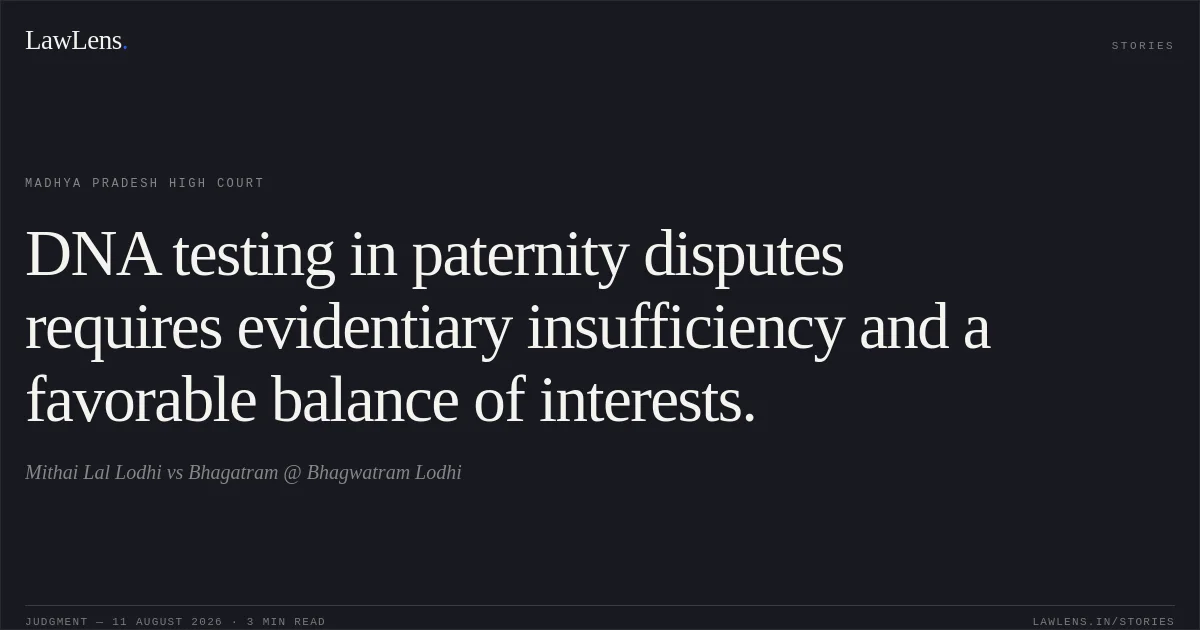
Source reference: pp. 3–4, para. 7The Court also applied Ivan Rathinam v. Milan Joseph, 2025 SCC OnLine SC 175, which prescribes two conditions before ordering a DNA test: insufficiency of the existing evidence and a positive balance of interests in favour of testing.
Source reference: p.4, para. 8The presumption concerning legitimacy under Section 112 of the Indian Evidence Act, 1872, was also recognised as a relevant safeguard.
Source reference: p.3, para. 6Reasoning
The Court held that the real dispute was not capable of being resolved merely by testing Bhagatram’s DNA.
Source reference: p.2, para. 5The parties gave conflicting accounts regarding the date of Ram Sevak’s death, the period of cohabitation, and the timing of Dharampurwali’s subsequent relationship or marriage with Ghansua.
Source reference: p.2, para. 5Those matters had to be established through oral and documentary evidence, and a DNA test would not prove the date of Ram Sevak’s death or the timing of Dharampurwali’s remarriage.
Source reference: p.2, para. 5Applying Ivan Rathinam, the Court found that the first threshold—insufficiency of existing evidence—had not been met because the parties’ evidence had not yet been recorded.
Source reference: p.5, para. 9The Court also held that the balance of interests could be assessed only after the evidence was led and the court determined whether DNA testing remained necessary.
Source reference: p.5, para. 9In the absence of such circumstances, ordering the test at that stage would be premature and inconsistent with the safeguards laid down in Goutam Kundu and Bhabani Prasad Jena.
Source reference: pp. 3–5, paras. 6–9Holding
The High Court held that the trial court committed no error in rejecting the application for DNA testing.
Since the evidence had not yet been adduced and the disputed questions could be examined through oral and documentary evidence, there was no demonstrated “eminent need” for the test at that stage.
Source reference: p.5, paras. 9–10The impugned order dated 8 July 2026 was affirmed, and the petition under Article 227 was disposed of.
Source reference: p.5, paras. 10–11The trial court was directed to proceed in accordance with the observations in the judgment and the Supreme Court’s guidelines governing DNA testing.
Source reference: p.5, paras. 10–11Acts & Sections Cited
1 provisions across 1 statute referred to in this judgment. Linked provisions open on LawLens.
Indian Evidence Act, 18721
Original Court PDF
Mithai Lal LodhivsBhagatram @ Bhagwatram Lodhi
Click to open original judgment
Original judgment, available to read, download and summarize on LawLens.in