Facts
FIR No. 400/2019 was registered at P.S. Saket under Sections 376, 313, 506 and 34 IPC and Section 6 of the POCSO Act on the complaint of the prosecutrix, who alleged that she had been sexually assaulted and had consequently become pregnant.
Source reference: para. 11On 26 July 2019, the prosecutrix, accompanied by co-accused Anita, approached Bhatia Medical Centre, where the petitioner examined her, found her approximately six weeks pregnant, and referred her to Talwar Medical Centre, where the petitioner performed a medical termination of pregnancy.
Source reference: para. 12Although the prosecutrix was in fact sixteen years old, her age was allegedly recorded as twenty years. Her initial statements and medico-legal examination did not implicate the petitioner; she later alleged during further investigation that she had written her actual date of birth on an admission slip and that the petitioner instructed hospital staff to record her age as twenty years.
Source reference: paras. 13, 17, 45The petitioner admitted that no identity, residence or age proof had been obtained and that Form I under the MTP framework had not been completed.
Source reference: para. 18The original chargesheet did not array the petitioner as an accused. However, on the prosecutrix’s protest petition, the Trial Court directed further investigation into whether the doctors had unlawfully terminated the pregnancy of a minor and failed to report the matter under Section 19 of the POCSO Act.
Source reference: paras. 14–16The supplementary chargesheet subsequently arrayed the petitioner under Sections 313 and 201 IPC and Section 7 of the MTP Act; the Trial Court later took cognizance and additionally invoked Section 21 of the POCSO Act.
Source reference: para. 19The petitioner challenged the order directing further investigation and the order taking cognizance under Section 482 CrPC.
Source reference: no citationIssues
1. Whether the Magistrate or Special Court could direct further investigation under Sections 156(3) and 173(8) CrPC after cognizance had been taken and process issued.
Source reference: paras. 26–362. Whether the materials collected during further investigation disclosed a prima facie case against the petitioner for terminating a minor’s pregnancy without the statutorily required guardian consent and without complying with the MTP documentation requirements.
Source reference: paras. 51–593. Whether the allegation that the petitioner was informed of the prosecutrix’s actual age and nevertheless failed to report the matter disclosed a prima facie offence under Sections 19 and 21 of the POCSO Act.
Source reference: paras. 37–50, 60–624. Whether the proceedings against the petitioner were liable to be quashed under Section 482 CrPC at the threshold.
Source reference: paras. 44, 61–65Law Applied
The Court applied Section 3 of the Medical Termination of Pregnancy Act, 1971, under which termination is protected only when the statutory conditions and prescribed procedure are satisfied; Section 3(4)(a), which requires the written consent of the guardian for termination of a minor’s pregnancy, and Section 3(4)(b), which separately requires the pregnant woman’s consent.
Source reference: paras. 1–4, 51, 57–59It relied on the MTP Rules/Regulations, including Form I for recording the registered medical practitioner’s statutory opinion and Form C for recording guardian consent in the case of a minor.
Source reference: paras. 5–8, 51–54Under Sections 19 and 21 of the POCSO Act, any person having knowledge that a POCSO offence has been committed must report it to the Special Juvenile Police Unit or local police, and failure to report is punishable.
Source reference: paras. 9–10, 38–43The Court further applied Sections 156(3) and 173(8) CrPC, holding that the power to direct further investigation does not terminate upon cognizance or issuance of process, relying on Ram Lal Narang v. State (Delhi Administration) and Vinubhai Haribhai Malaviya v. State of Gujarat.
Source reference: paras. 26–28It also relied on Nirmal Singh Kahlon v. State of Punjab regarding the investigating officer’s continuing statutory power to conduct further investigation, and on State of Maharashtra v. Dr. Maroti, Dr. Ditto Tom P. v. State of Kerala and George P.O. v. State of Kerala regarding the mandatory and prompt reporting obligation under Section 19 of the POCSO Act.
Source reference: paras. 31, 40–43At the Section 482 stage, the Court’s function was limited to determining whether the prosecution material disclosed a prima facie case, without weighing evidence or deciding guilt.
Source reference: paras. 44, 65Reasoning
The Court held that the Trial Court’s direction for further investigation was legally sustainable. Sections 156(3) and 173(8) CrPC permit further investigation even after cognizance has been taken, provided the Court does not dictate the result or micromanage the investigation.
Source reference: paras. 26–32The impugned order identified specific matters requiring investigation but expressly preserved the investigating officer’s independence; the subsequent investigation in fact found no evidence of collusion between the petitioner and the principal accused, demonstrating that the inquiry was not predetermined.
Source reference: paras. 30–36On the merits, the Court treated the absence of age and identity verification, the non-completion of Form I, and the absence of Form C and guardian consent as material statutory defaults.
Source reference: paras. 51–59A minor’s own signature or apparent cooperation could not substitute for the independent guardian consent required by Section 3(4)(a) of the MTP Act; even a genuine signature would not, by itself, constitute legally sufficient consent.
Source reference: paras. 51–59The allegation that the petitioner was shown the prosecutrix’s actual date of birth and responded by directing that her age be recorded as twenty years constituted specific material suggesting actual knowledge, rather than mere constructive knowledge or failure to investigate.
Source reference: paras. 44–49Consequently, the petitioner’s alleged failure to report the matter between 26 July 2019 and the registration of the FIR on 4 October 2019 disclosed a prima facie case under Section 21 of the POCSO Act.
Source reference: paras. 42, 47–50, 60–62Whether the allegation was credible and whether the omissions were deliberate remained matters for trial and could not be adjudicated in a petition under Section 482 CrPC.
Source reference: paras. 44, 53, 61, 65Holding
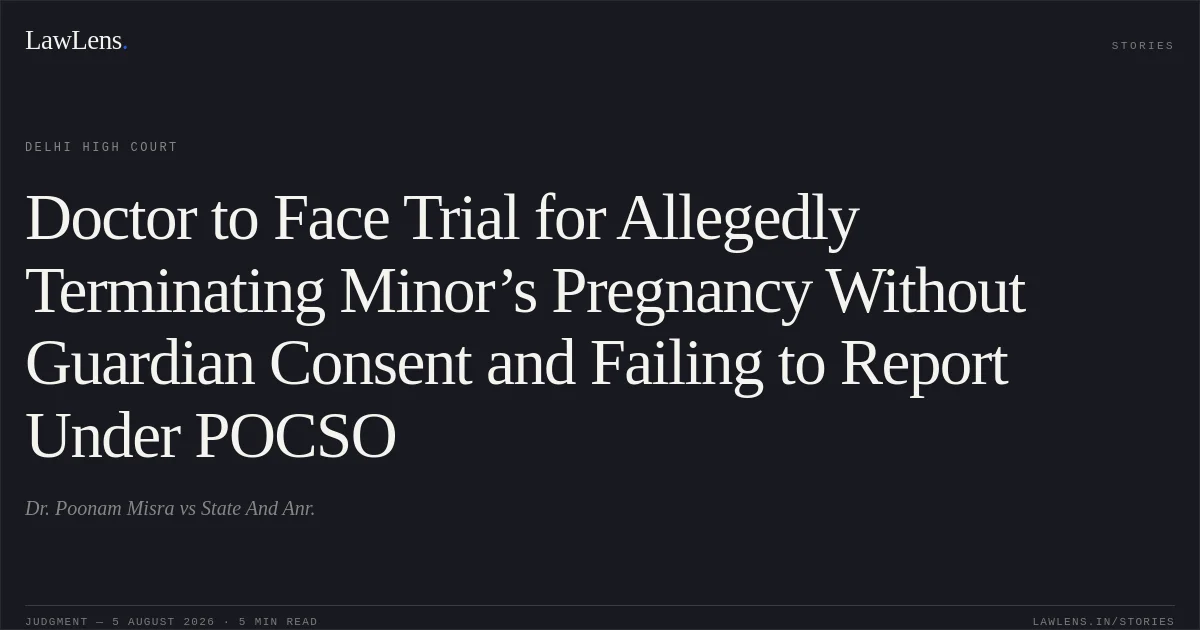
The Delhi High Court dismissed the petition under Section 482 CrPC and declined to interfere with either the order dated 29 September 2020 directing further investigation or the order dated 31 July 2021 taking cognizance and summoning the petitioner.
It held that further investigation after cognizance was permissible and that the prosecution material disclosed a prima facie case concerning unlawful termination of a minor’s pregnancy, absence of guardian consent and statutory documentation, and failure to report a suspected POCSO offence.
Source reference: paras. 51–62The Court clarified that its observations were confined to the existence of a prima facie case and would not influence the Trial Court, which was directed to decide the matter independently on the evidence led at trial.
Source reference: para. 65Original Court PDF
Dr. Poonam MisravsState And Anr.
Click to open original judgment
Original judgment, available to read, download and summarize on LawLens.in