Facts
The petitioner filed the contempt petition alleging non-compliance with the order dated 18 July 2018 in CWJC No. 6738 of 2016. In that order, the High Court had directed the respondents to restore the petitioner’s late husband as an absorbed teacher with all consequential benefits, pursuant to the principles governing absorption of employees of fourth-phase colleges.
Source reference: p.2, para. 2During the contempt proceedings, the University stated that the matter had been pursued through LPA No. 1556 of 2018, review proceedings, and ultimately Special Leave Petition (Civil) Nos. 29618–29619 of 2024 before the Supreme Court. The Supreme Court disposed of the proceedings on 19 November 2025 with directions concerning consideration of the employees’ claims by the University. Thereafter, the Vice-Chancellor passed an order dated 19 June 2026 rejecting the petitioner’s claim. The petitioner contended that this did not amount to compliance with the original order, whereas the University argued that the contempt order had been complied with by taking a final decision.
Source reference: pp.3–4, paras. 3–4; pp.7–10, paras. 5–6; p.4, para. 4Issues
Whether the University’s rejection of the petitioner’s claim constituted compliance with the direction to restore her late husband as an absorbed teacher with consequential benefits.
Source reference: p.4, paras. 3–4Whether, in view of the Supreme Court’s order dated 19 November 2025, the earlier orders of the Single Judge, Division Bench, and review court had merged into the Supreme Court’s order, thereby making contempt proceedings before the High Court maintainable or not.
Source reference: pp.10–11, paras. 7–8; pp.26–27, para. 12Whether any alleged non-compliance with the operative directions, as modified or superseded by the Supreme Court, could be examined in contempt jurisdiction by the High Court.
Source reference: pp.26–27, paras. 12–13Law Applied
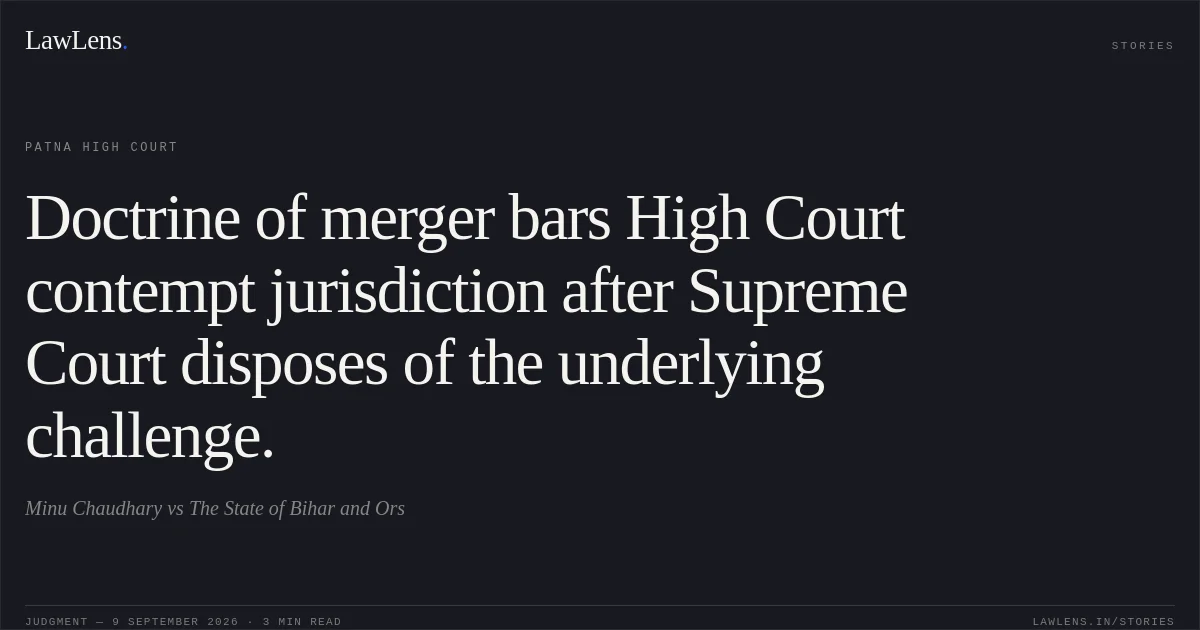
The Court applied the doctrine of merger, under which an order challenged before and affirmed, modified, or reversed by a superior forum merges into the superior forum’s order, which thereafter remains operative and enforceable.
Source reference: pp.11–13, para. 8It relied principally on Kunhayammed v. State of Kerala, (2000) 6 SCC 359, which distinguishes between dismissal of an SLP before grant of leave and an appellate decision after leave is granted; once leave is granted and appellate jurisdiction is exercised, merger follows.
Source reference: pp.11–13, para. 8The Court also relied on Gangadhara Palo v. Revenue Divisional Officer, (2011) 4 SCC 602, and Balbir Singh v. Baldev Singh, (2025) 3 SCC 543, reiterating that an appellate order supersedes the subordinate order even where it merely affirms it.
Source reference: pp.14–17, para. 9; pp.22–26, para. 11Reasoning
The High Court noted that its earlier order directed restoration of the petitioner’s husband as an absorbed teacher, but the dispute concerning absorption had subsequently travelled through the appellate and review hierarchy and reached the Supreme Court. The Supreme Court considered the prior orders and issued directions requiring the University to proceed in accordance with law after consultation with the concerned parties, while preserving the parties’ liberty to challenge any adverse decision.
Source reference: pp.4–10, paras. 5–6; pp.7–10, para. 5Treating the SLP proceedings as having invoked the Supreme Court’s appellate jurisdiction, the High Court held that its earlier orders, including the order in CWJC No. 6738 of 2016, the Division Bench’s order in LPA No. 1556 of 2018, and the review order, had merged into the Supreme Court’s order. Consequently, the High Court could not independently enforce the earlier order through contempt jurisdiction; the appropriate forum for any alleged breach was the Supreme Court.
Source reference: pp.10–11, para. 7; pp.26–27, para. 12Holding
The Court held that, following the Supreme Court’s order dated 19 November 2025 and the operation of the doctrine of merger, the earlier High Court orders no longer constituted the independently operative orders for purposes of contempt. Any grievance regarding non-compliance was required to be pursued before the Supreme Court.
Accordingly, the contempt petition was dismissed, and all pending applications were also disposed of.
Source reference: p.27, paras. 12–14Acts & Sections Cited
1 provisions across 1 statute referred to in this judgment. Linked provisions open on LawLens.
the Act referred to earlier (alias, unresolved)1
Original Court PDF
Minu ChaudharyvsThe State of Bihar and Ors
Click to open original judgment
Original judgment, available to read, download and summarize on LawLens.in