Facts
The petitioner, the de facto complainant, challenged the Sessions Court’s order dated 4 May 2026 granting bail to Accused Nos. 1–3 in a case arising from an alleged assault in which the complainant’s brother died.
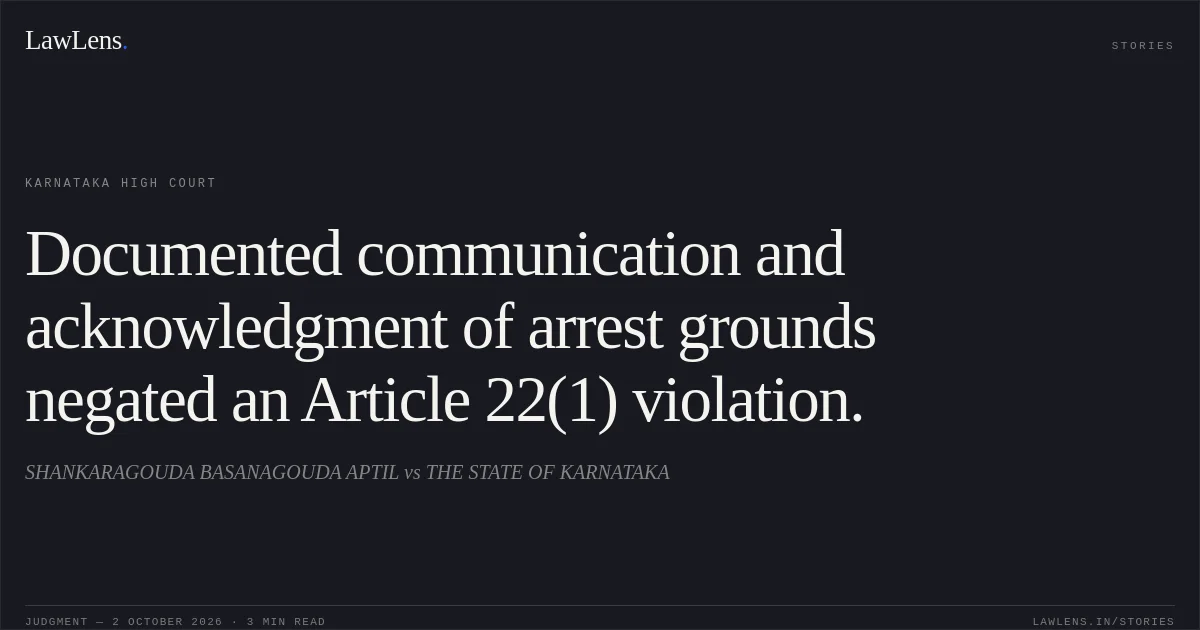
Source reference: para. 1–8The petitioner argued that the Sessions Court wrongly found a breach of Article 22(1), because the accused had been given and had acknowledged the grounds of arrest.
Source reference: para. 1–8The accused maintained that the Sessions Court had correctly assessed whether those grounds were meaningfully communicated.
Source reference: para. 1–8Issues
Whether the Sessions Court was justified in granting bail on the ground that the grounds of arrest had not been communicated to the accused in compliance with Article 22(1) of the Constitution.
Source reference: para. 9Whether the Sessions Court’s bail order warranted interference because it failed to properly assess the material concerning communication of the grounds of arrest and other relevant bail considerations.
Source reference: para. 19–24Law Applied
Article 22(1) of the Constitution requires an arrested person to be informed, as soon as may be, of the grounds of arrest; the communication must be meaningful enough to enable the person to understand broadly why they have been arrested.
Source reference: para. 10–13Relying on Vihaan Kumar v. State of Haryana, (2025) 5 SCC 799, and Kasireddy Upender Reddy v. State of Andhra Pradesh, 2025 SCC OnLine SC 1228, the Court distinguished complete failure to communicate grounds from cases in which grounds were supplied but their sufficiency was questioned; the inquiry is whether the constitutional purpose was substantially fulfilled.
Source reference: para. 11–13The Court also relied on State of Karnataka v. Sri Darshan, 2025 SCC OnLine SC 1702, for the proposition that compliance is assessed on the facts and that the Court should consider whether the arrested person was made aware, in substance, of the reasons for arrest and whether demonstrable prejudice resulted.
Source reference: para. 17–19In deciding bail, the Court stated that relevant considerations include prima facie material, the nature and gravity of the accusation, the manner of commission, the punishment prescribed, and the risk of interference with witnesses, investigation, or trial.
Source reference: para. 21Reasoning
The record contained signed documents acknowledging receipt of the grounds of arrest, the investigating agency’s assertion that they were communicated in a language known to the accused, and the Magistrate’s contemporaneous record that the accused said they had been informed of and understood the grounds.
Source reference: para. 14–16The Court considered that material inconsistent with a finding of complete failure to communicate the grounds; it noted that a signature alone would not establish compliance if the document were vague or unrelated, but found no such circumstance established here.
Source reference: para. 16It concluded that the Sessions Court had treated the alleged deficiency as sufficient to grant bail without properly examining whether Article 22(1) had actually been breached or whether prejudice had resulted, and had not adequately considered other relevant bail factors.
Source reference: para. 19–24Holding
The High Court held that the Sessions Court’s finding of an Article 22(1) violation was not supported by the contemporaneous material and that its exercise of discretion was erroneous.
It allowed the petition, set aside the bail order dated 4 May 2026, cancelled the bail granted to Accused Nos. 1–3, and directed them to surrender before the jurisdictional court on or before 12 October 2026.
Source reference: para. 25Acts & Sections Cited
10 provisions across 3 statutes referred to in this judgment. Each provision opens on LawLens.
Bharatiya Nagarik Suraksha Sanhita, 20231
Bharatiya Nyaya Sanhita, 20238
Code of Criminal Procedure, 19731
Original Court PDF
SHANKARAGOUDA BASANAGOUDA APTILvsTHE STATE OF KARNATAKA
Click to open original judgment
Original judgment, available to read, download and summarize on LawLens.in