01Facts
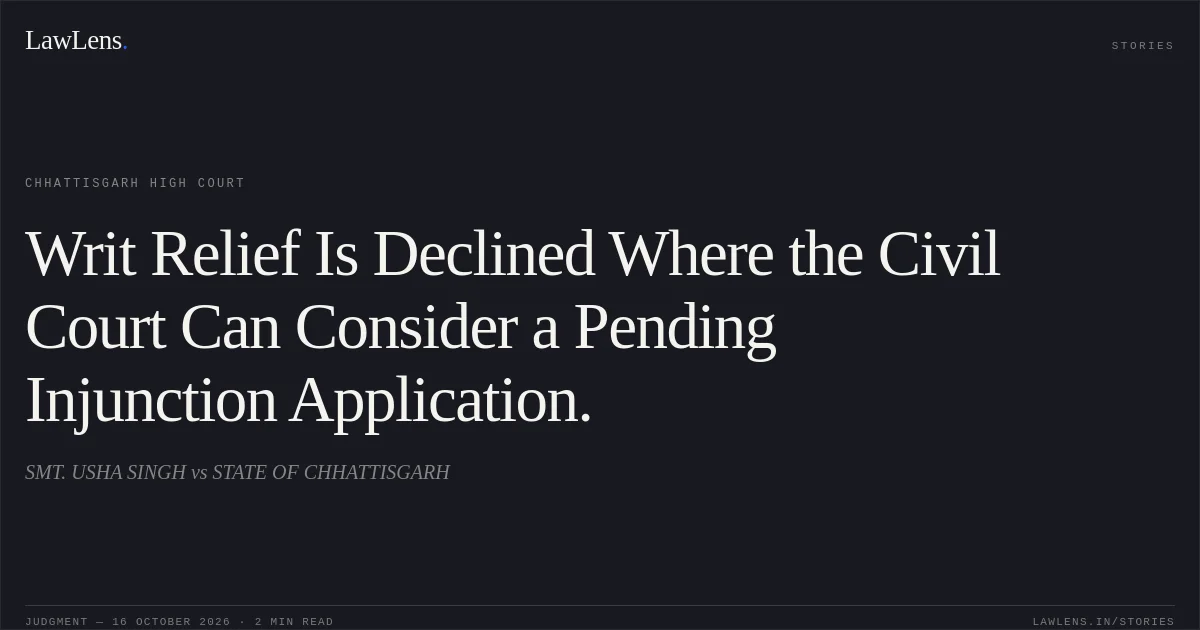
The petitioner, plaintiff in Civil Suit No. 95-A/2011 pending before the IInd Civil Judge (Senior Division), Ambikapur, instituted a suit for permanent injunction.
¶ 1–2After the plaintiff’s evidence had been closed and the defendant’s evidence had been recorded, the matter was fixed for final hearing.
¶ 1–2On 29.07.2026, the petitioner filed an application under Order XIII Rule 10(1) CPC seeking summoning of the original record of Succession Case No. 17/2017, decided on 12.02.2019.
¶ 1–2On the same day, he filed an application under Order VII Rule 14 CPC seeking to place on record copies of the succession order, appellate order, a statement recorded by the Naib Tehsildar, and a MACT award.
¶ 1–2The trial court rejected both applications by order dated 30.07.2026.
¶ 1–2The petitioner challenged that order under Article 227 of the Constitution.
¶ 1–202Issues
i.1. Whether the trial court erred in refusing to summon the original record of Succession Case No. 17/2017 under Order XIII Rule 10(1) CPC?
¶ 4ii.2. Whether the petitioner should have been permitted under Order VII Rule 14 CPC to produce additional documents after closure of the parties’ evidence and at the stage of final hearing?
¶ 5iii.3. Whether the trial court’s order disclosed perversity or jurisdictional error warranting interference under Article 227 of the Constitution?
¶ 603Law Applied
The Court applied Order XIII Rule 10(1) CPC, which permits a court to call for the record of another court where such record is necessary for adjudicating the matter; the provision does not justify summoning a record when the applicant already possesses the relevant document or fails to establish its necessity.
¶ 4The Court also applied Order VII Rule 14 CPC, governing production of documents relied upon by a plaintiff, and held that documents cannot ordinarily be introduced at the fag end of the trial after the parties’ evidence has been completed, particularly where the party had sufficient earlier opportunity to produce them.
¶ 5The Court further applied the limited supervisory jurisdiction under Article 227 of the Constitution, under which interference is warranted only in cases of jurisdictional error, perversity, or grave procedural illegality.
¶ 604Reasoning
The High Court held that the application under Order XIII Rule 10(1) CPC was rightly rejected because the petitioner had already filed a copy of the succession order along with his application under Order VII Rule 14 CPC.
¶ 4Consequently, summoning the original record was not shown to be necessary.
¶ 4The petitioner had also failed to satisfactorily explain why the document could not have been obtained and produced earlier, particularly since the suit had been pending since 2011.
¶ 4Regarding the documents sought to be produced under Order VII Rule 14 CPC, the Court noted that the plaintiff’s evidence had been closed, the defendant’s evidence had been recorded and closed, and the suit had reached the stage of final hearing.
¶ 5Permitting the documents at that stage, despite the petitioner having had sufficient opportunity earlier, would effectively reopen the trial and enable him to fill lacunae in his case.
¶ 5Since the trial court’s view was neither perverse nor jurisdictionally erroneous, no interference under Article 227 was warranted.
¶ 605Holding
The High Court answered both issues against the petitioner.
¶ 6It held that the trial court correctly refused to summon the succession-case record under Order XIII Rule 10(1) CPC and correctly rejected the belated production of documents under Order VII Rule 14 CPC.
¶ 6Finding no perversity or jurisdictional error in the impugned order dated 30.07.2026, the Court dismissed the writ petition.
¶ 6–7Original Court PDF
KANHAIYALAL @ PINTUvsGHARBHARAN
Click to open original judgment
Original judgment, available to read, download and summarize on LawLens.in