Facts
The petitioner (plaintiff) filed a suit for declaration of title and possession regarding a property, alleging that the respondent (defendant) had fraudulently registered the sale deed in her name despite the petitioner paying the consideration.
Source reference: p. 3-4During proceedings, the petitioner produced the original sale deed but did not tender it in evidence.
Source reference: p. 3-4On 16.01.2017, the suit was dismissed as "not pressed" following an alleged settlement.
Source reference: p. 3In 2022, the respondent filed an application under Section 151 of the Code of Civil Procedure (CPC) seeking the return of the original sale deed to her, as she was the named owner.
Source reference: p. 4The trial court allowed the application, concluding that dismissal of the suit as "not pressed" decided the matter in favor of the defendant and that mere production by the plaintiff did not grant him superior rights over the document.
Source reference: p. 5The petitioner challenged this before the High Court, leading to this intra-court reference to settle the conflict regarding the application of Section 151 in such matters.
Source reference: p. 5Issues
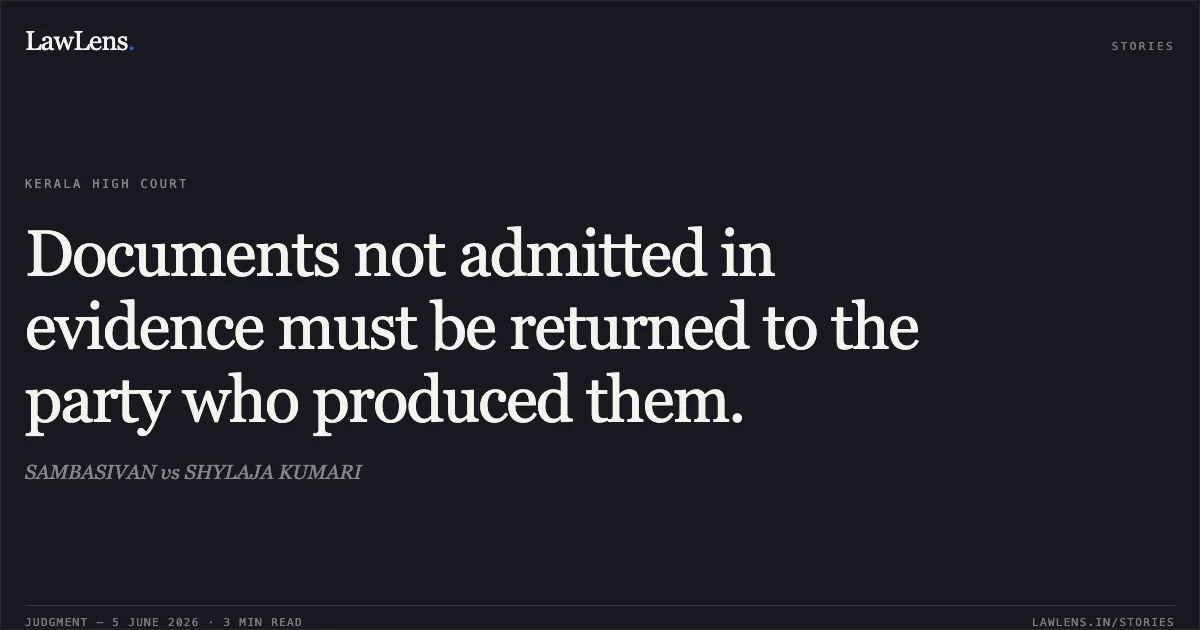
1. Whether a document produced in Court by one party but not admitted in evidence can be returned to the opposite party upon an application under Section 151 of the CPC?
Source reference: p. 3 / para. 12. Whether the inherent powers under Section 151 of the CPC can be invoked in a manner that overrides or contradicts express procedural provisions regarding the return of documents?
Source reference: p. 10 / para. 14Law Applied
Order XIII Rule 7(2) of the CPC, which mandates that documents not admitted in evidence shall be returned to the person producing them.
Source reference: p. 6Rule 132 of the Civil Rules of Practice, Kerala, which stipulates that documents neither admitted nor rejected shall be returned to the producer as early as possible without the need for a formal application.
Source reference: p. 7The Supreme Court precedents in Ram Chand and Sons Sugar Mills Pvt. Ltd. v. Kanhayalal Bhargava and GLAS Trust Company LLC v. BYJU Raveendran established that inherent powers under Section 151 CPC cannot be exercised in conflict with express statutory provisions or where the Code exhaustively covers a particular procedure.
Source reference: p. 10, 12Reasoning
The Court reasoned that the statutory framework provided under Order XIII Rule 7 of the CPC and Rule 132 of the Civil Rules of Practice is exhaustive and unambiguous: documents not admitted in evidence must be returned to the party who produced them.
Source reference: p. 7, 9The trial court erred by treating the dismissal of the suit as "not pressed" as a merits-based adjudication of ownership of the document, misapplying the principles in Muhammed Master and Philomina Joseph.
Source reference: p. 8The High Court clarified that once a suit is disposed of, the court is generally functus officio, and its inquiry into the return of documents is limited to the procedural mandates of the Code.
Source reference: p. 7Since the Code expressly directs the return of such documents to the "person producing them," the trial court could not invoke the inherent powers of Section 151 to deliver the document to the opposite party, as such an act would directly contradict the express legislative intent and procedural requirements.
Source reference: p. 12-13Holding
The Court answered the reference by holding that inherent powers under Section 151 cannot be used to return a document to the opposite party if it contradicts the express provisions of Order XIII Rule 7(2) of the CPC and Rule 132 of the Civil Rules of Practice.
The High Court set aside the trial court's order and dismissed the respondent’s application for the return of the document, leaving the respondent free to pursue other legal remedies for the recovery of the deed.
Source reference: p. 14Acts & Sections Cited
1 provisions across 1 statute referred to in this judgment. Each provision opens on LawLens.
Code of Civil Procedure, 19081
Original Court PDF
SAMBASIVANvsSHYLAJA KUMARI
Click to open original judgment
Original judgment, available to read, download and summarize on LawLens.in