Facts
Respondent No. 1, an employee of the Petitioner since 1990, was accused of sexually harassing and physically assaulting a lady colleague in February 2011
Source reference: para. 2The Petitioner initiated a domestic enquiry under the Bombay Industrial Employment (Standing Orders) Rules, 1959, appointing Dr. U.S. Kharote as the Enquiry Officer
Source reference: para. 3-4Following an enquiry conducted between June and November 2011, the Petitioner terminated Respondent No. 1’s services on December 7, 2012, based on the Enquiry Officer’s report finding him guilty
Source reference: para. 4-5An industrial dispute was raised (Reference (IT) No. 3 of 2013) before the Industrial Tribunal at Nashik
Source reference: para. 6On December 9, 2025, the Tribunal passed a Part I Award vitiating the enquiry on the grounds that it was not conducted by a "Complaints Committee" as mandated by Vishaka v. State of Rajasthan and holding that the findings were perverse
Source reference: para. 1, 7Issues
1. Whether a domestic enquiry into sexual harassment, conducted under statutory Model Standing Orders rather than a Vishaka-style Complaints Committee, is automatically illegal and void.
Source reference: para. 8, 132. Whether the Industrial Tribunal erred in declaring the enquiry findings "perverse" without independently assessing the evidence or the substance of fairness in the procedure.
Source reference: para. 10, 32Law Applied
The Court applied the principles from Vishaka v. State of Rajasthan (1997), which established binding guidelines for sexual harassment at workplaces to operate as law under Article 141 until the enactment of "suitable legislation"
Source reference: para. 14It further recognized the statutory force of the Industrial Employment (Standing Orders) Act and the Model Standing Orders as delegated legislation
Source reference: para. 16The Court referenced Medha Kotwal Lele v. Union of India (2013) regarding the role of Complaints Committees as inquiry authorities
Source reference: para. 21The Court referenced Aureliano Fernandes v. State of Goa (2024), which emphasizes that while procedure must be fair, the phrase "as far as practicable" allows for flexibility provided principles of natural justice are met
Source reference: para. 22The Sexual Harassment of Women at Workplace (Prevention, Prohibition and Redressal) Act, 2013 (POSH Act) was identified as the comprehensive legislation that now occupies the field, effective from December 9, 2013
Source reference: para. 11, 19Reasoning
The Court reasoned that Vishaka was intended to fill a legislative vacuum and its guidelines functioned as a temporary arrangement
Source reference: para. 14, 17Since the enquiry in question took place in 2011, prior to the POSH Act’s enforcement, the Petitioner was bound by the legal framework existing at that time, which included the Model Standing Orders
Source reference: para. 30-31The Court found that the Industrial Tribunal erred by focusing on the form of the enquiry body (the lack of a Vishaka committee) rather than the substance of the proceedings
Source reference: para. 23-24It held that if the employee was provided with notice, the complaint, the opportunity to cross-examine witnesses, and the assistance of a representative, the requirement of fairness was substantially met
Source reference: para. 25, 28The Court further noted that the Tribunal failed to demonstrate how the lack of a specific committee caused actual "prejudice" to the workman
Source reference: para. 28Finally, the Court criticized the Tribunal for labeling the findings "perverse" in a routine manner without demonstrating that the findings were based on no evidence or were completely unreasonable
Source reference: para. 32Holding
The High Court allowed the writ petition and quashed the Part I Award dated December 9, 2025
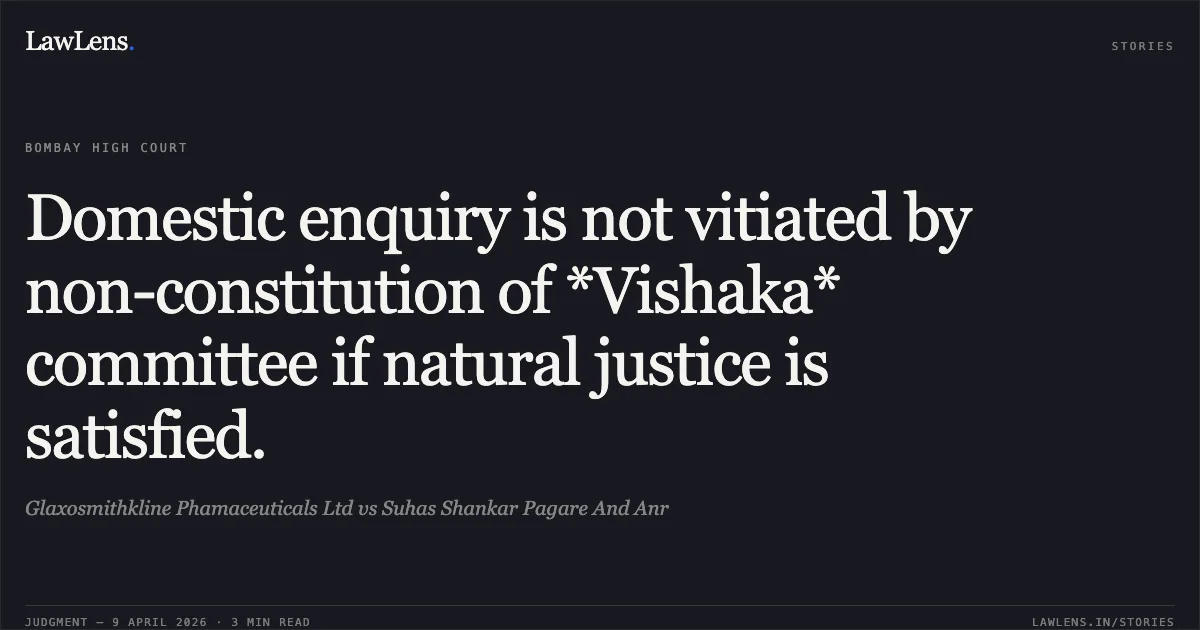
The Court held that an enquiry cannot be set aside solely for failing to follow the exact format of a Vishaka committee if the substance of natural justice was observed
Source reference: para. 25, 33The matter was remanded to the Industrial Tribunal for fresh consideration to determine whether the enquiry was fair, whether any real prejudice was caused to the workman, and whether the findings were supported by evidence
Source reference: para. 34The Tribunal was directed to dispose of the reference within six months
Source reference: para. 34Original Court PDF
Glaxosmithkline Phamaceuticals LtdvsSuhas Shankar Pagare And Anr
Click to open original judgment
Original judgment, available to read, download and summarize on LawLens.in