01Facts
The petitioner was appointed as a Constable in 1985
¶ 2Following a joint charge-sheet and subsequent inquiry regarding allegations of intoxication while on duty and and failure to prevent a physical altercation involving the snatching of rifles
¶ 5the Disciplinary Authority passed an order on 20.12.2012 imposing the penalty of compulsory retirement
¶ 2The petitioner challenged this on several grounds: that the Enquiry Officer acted as the prosecutor by cross-examining witnesses; that the punishment was discriminatory compared to higher-ranking officers; and that both the punishment and appellate orders were non-speaking
¶ 2During the pendency of the petition, the original petitioner was substituted by his legal heir
Case Title02Issues
i.1. Whether the departmental inquiry was vitiated due to the Enquiry Officer assuming the role of the prosecutor by cross-examining the delinquent employee
¶ 13-14ii.2. Whether the impugned orders passed by the Disciplinary and Appellate Authorities were legally sustainable as "speaking orders"
¶ 6, 803Law Applied
the principles of natural justice and Rule 14(5)(c) of the M.P. Civil Services (Classification, Control and Appeal) Rules, 1966
¶ 16Union of India v. Ram Lakhan Sharma (2018), which establishes that an Enquiry Officer must be an impartial adjudicator and cannot act as a prosecutor
¶ 13Kranti Associates Pvt. Ltd. v. Masood Ahmed Khan (2010), which mandates that quasi-judicial and administrative orders affecting rights must contain clear, reasoned justifications to satisfy the "lifeblood of judicial decision-making"
¶ 12Union of India v. Mohd. Naseem Siddiqui (2004) regarding the presumption of bias when an Enquiry Officer conducts examination-in-chief or cross-examination
¶ 1304Reasoning
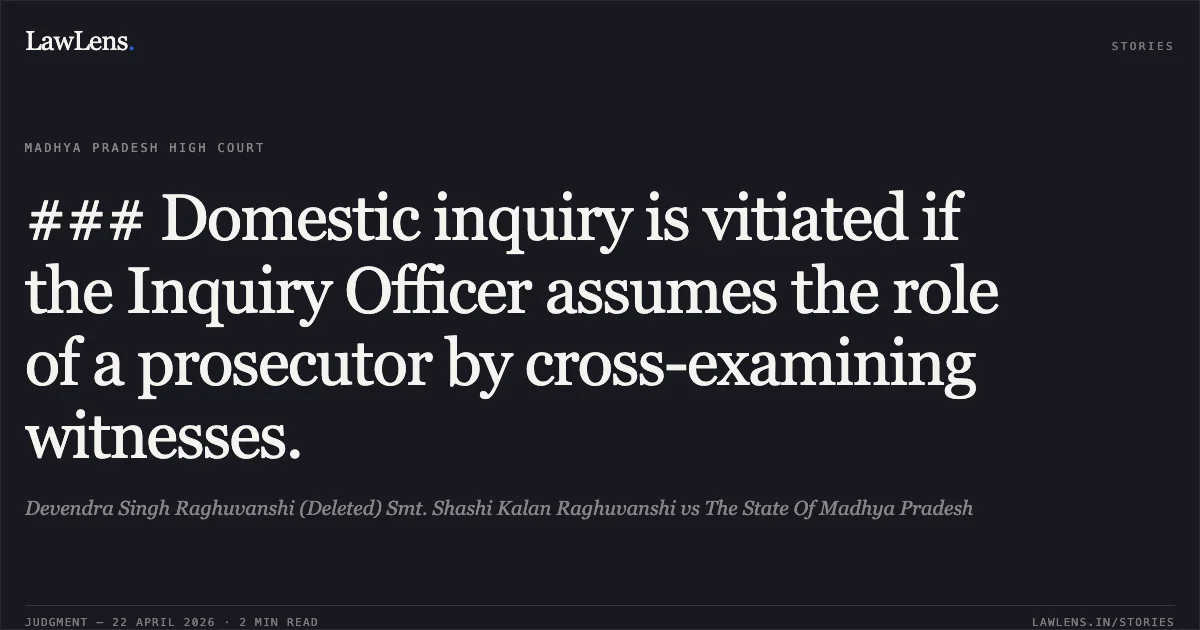
The Court found that although a Presenting Officer was appointed, the Enquiry Officer stepped beyond his quasi-judicial role by actively cross-examining the petitioner and other witnesses
¶ 2, 14, 16Under the settled law in Ram Lakhan Sharma, such conduct causes the adjudicator to lose the capacity of an independent arbiter, thereby vitiating the inquiry due to bias
¶ 13the Court scrutinized the punishment order dated 20.12.2012 and the appellate order dated 14.03.2013, concluding that they were "non-speaking" and "unreasoned"
¶ 6, 8The authorities failed to address the petitioner's specific defenses or the procedural irregularities, rendering the orders arbitrary and in violation of the "doctrine of fairness" as established in State of Punjab v. Bandip Singh
¶ 9-1105Holding
The Court answered the issues in the affirmative, holding that the inquiry was illegal and the subsequent orders were unsustainable.
The Court quashed the punishment order (20.12.2012), the appellate order (14.03.2013), and the mercy appeal rejection (12.07.2013)
¶ 19(i)The respondents were directed to reinstate the petitioner (notionally, as he had since retired) and provide all consequential benefits, including annual increments, arrears of pension, and revised PPO/GPO, within three months
¶ 19(ii)-(iv)Failure to comply within the stipulated period attracts interest at 6% per annum
¶ 19(v)Original Court PDF
Devendra Singh Raghuvanshi (Deleted) Smt. Shashi Kalan RaghuvanshivsThe State Of Madhya Pradesh
Click to open original judgment
Original judgment, available to read, download and summarize on LawLens.in