Facts
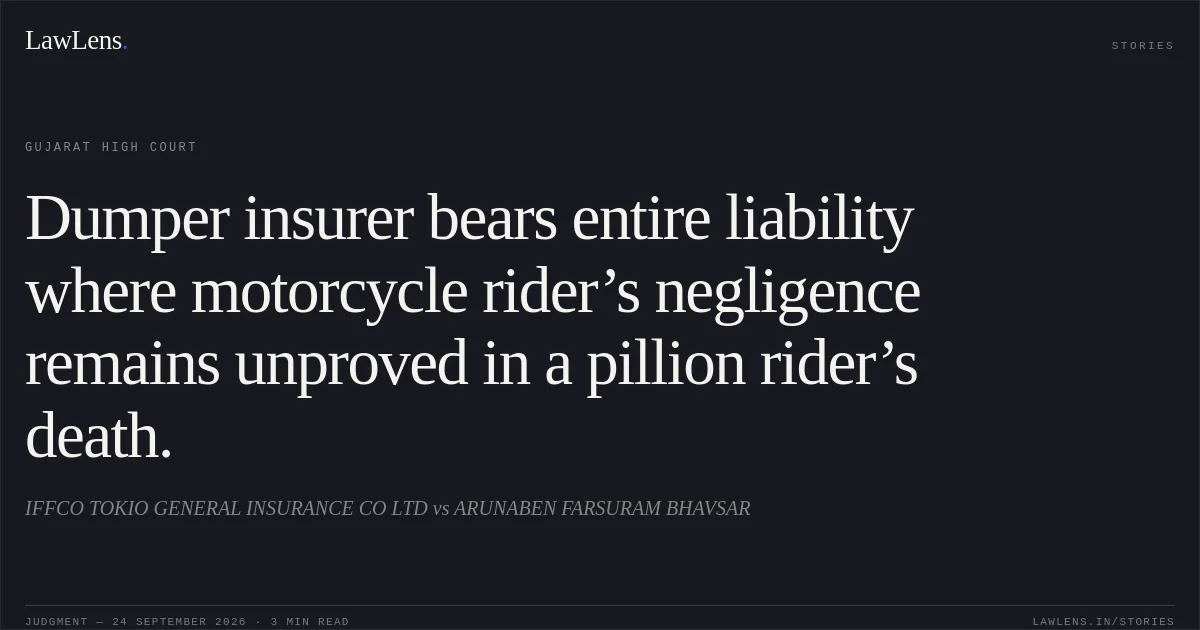
On 20 December 2007, a dumper truck collided with a motorcycle on which the deceased, Farsuram Bhavsar, aged 56 years and employed as a Manager with ABG Shipyard, was travelling as a pillion rider. He died in the accident.
Source reference: para. 1–2The occurrence of the accident and the liability of the dumper truck’s insurer to satisfy the compensation were undisputed.
Source reference: para. 1–2The Motor Accident Claims Tribunal held both the dumper-truck driver and the motorcycle rider negligent, apportioning negligence at 85% and 15%, respectively, and awarded ₹35,17,072 by applying a multiplier of 9.
Source reference: para. 3–4The insurer challenged the finding on negligence and the quantum of compensation, while the claimants sought enhancement, including future prospects and correction of the income calculation.
Source reference: para. 5–7Issues
Whether the Tribunal was justified in attributing 15% contributory negligence to the motorcycle rider and limiting the dumper-truck insurer’s liability to 85%?
Source reference: para. 6–9Whether the deceased’s monthly income had been correctly assessed for determining loss of dependency?
Source reference: para. 6–7, 10Whether the claimants were entitled to future prospects and enhanced compensation under the applicable principles governing motor accident claims?
Source reference: para. 7, 10–12Law Applied
In proceedings under the Motor Vehicles Act, negligence may be determined on the basis of the material emerging from the police investigation, and the Supreme Court’s decision in Mangla Ram v. Oriental Insurance Co. Ltd., (2018) 5 SCC 656, was relied upon for the principle that the police charge-sheet is a relevant circumstance in assessing responsibility for the accident.
Source reference: para. 8Since the deceased was a pillion rider, negligence could not be attributed to him merely because of the motorcycle rider’s alleged conduct.
Source reference: para. 9For computation of compensation, the Court applied National Insurance Co. Ltd. v. Pranay Sethi, (2017) 16 SCC 680, under which future prospects are to be added to the income of a permanently employed deceased; the Court applied a 15% addition and a multiplier of 9.
Source reference: para. 11Reimbursement towards petrol and driver expenses was excluded from income, and income tax was deducted before assessing loss of dependency.
Source reference: para. 10–12Reasoning
The Court set aside the finding of 15% negligence against the motorcycle rider.
Source reference: para. 8–9It noted that the deceased was only a pillion rider, that the dumper-truck driver had not entered the witness box to establish negligence on the part of the motorcycle rider, and that the police investigation supported fastening responsibility for the accident on the dumper truck’s driver.
Source reference: para. 8–9Accordingly, the insurer of the dumper truck was held liable for the entire compensation.
Source reference: para. 9On quantum, the Court treated the deceased’s salary as ₹61,000 per month after excluding ₹700 towards petrol reimbursement and ₹3,000 towards driver’s salary from the gross salary of ₹64,700.
Source reference: para. 10After deducting 10% income tax, the monthly income was fixed at ₹54,900.
Source reference: para. 10Applying 15% future prospects, a one-third personal-expense deduction, and the multiplier of 9, the Court calculated loss of dependency at ₹45,45,720.
Source reference: para. 11It further awarded ₹1,56,000 towards consortium for the widow and two children, ₹19,500 towards loss of estate, and ₹19,500 towards funeral expenses, resulting in total compensation of ₹47,40,720.
Source reference: para. 11–12Holding
The insurer’s appeal was dismissed and the claimants’ cross-objections were partly allowed.
The Court held that the insurer of the dumper truck alone was liable for the entire compensation and enhanced the award from ₹35,17,072 to ₹47,40,720, granting an additional ₹12,23,648.
Source reference: para. 9, 12The enhanced amount was directed to carry interest at 9% per annum from the date of filing of the claim petition until realization.
Source reference: para. 14–15The insurance company was directed to deposit the enhanced amount within ten weeks, after which it was to be disbursed to the claimants through NEFT/RTGS upon verification.
Source reference: para. 14–15Original Court PDF
IFFCO TOKIO GENERAL INSURANCE CO LTDvsARUNABEN FARSURAM BHAVSAR
Click to open original judgment
Original judgment, available to read, download and summarize on LawLens.in