Facts
The petitioner, a retired Assistant Block Education Officer, had served as a Headmaster from 1981 and was promoted to the Elementary Cadre in 2013.
Source reference: pp. 2–3He remained absent from duty during the period 1 January 2016 to 17 March 2016 and later sought regularisation of the period and payment of duty salary, claiming that he had applied for leave on medical grounds for part of that period.
Source reference: pp. 2–3, 8–9The authorities alleged that he had remained unauthorisedly absent and that he had secured employment and promotion by producing allegedly forged B.A. and B.Ed. certificates.
Source reference: pp. 4–5A criminal case under Sections 420, 468 and 471 IPC and departmental proceedings were initiated against him.
Source reference: pp. 18–23The departmental proceeding was stayed pending conclusion of the criminal case pursuant to an earlier order of the High Court.
Source reference: pp. 3–7The Director of Elementary Education rejected the petitioner’s representation for regularisation and duty pay salary, principally because the criminal and departmental proceedings remained pending.
Source reference: pp. 3–7The petitioner challenged that rejection under Articles 226 and 227 of the Constitution.
Source reference: no citationIssues
Whether the petitioner was entitled to regularisation of the period from 1 January 2016 to 17 March 2016 and payment of duty salary despite the absence of proof that leave had been applied for or sanctioned.
Source reference: paras. 7, 9–9.9Whether the pendency of the criminal case and departmental proceeding concerning the alleged use of forged educational certificates justified withholding consideration of the petitioner’s claim for duty pay salary.
Source reference: paras. 8–8.9Whether the impugned order dated 16 May 2023 suffered from illegality, non-application of mind, or any other defect warranting interference under Articles 226 and 227.
Source reference: paras. 8.9–10Law Applied
The Court applied the Odisha Leave Rules, 1966, particularly Rules 13 and 17, and the Odisha Service Code, including Rules 130, 131, 140 and 144, holding that leave is not claimable as of right, must be sanctioned by the competent authority, and that unauthorised absence ordinarily does not entitle an employee to salary.
Source reference: pp. 39–44Under State of Punjab v. Dr. P.L. Singla, unauthorised absence may be condoned and regularised if the employer accepts the explanation and sanctions leave, but the employee must establish sufficient justification.
Source reference: pp. 46–47The Court also relied on the principles that a litigant invoking writ jurisdiction must disclose all material facts and approach the Court with clean hands, as stated in Badami v. Bhali, Kishore Samrite v. State of U.P. and Kusa Duruka v. State of Odisha.
Source reference: pp. 9–18, 25–29The doctrine of approbate and reprobate, explained in Union of India v. N. Murugesan, prevents a party from seeking inconsistent benefits after accepting an order or position favourable to him.
Source reference: pp. 48–54The Court further recognised that proceedings involving alleged use of forged certificates are serious and that the consequences of such misconduct may be determined in the criminal and departmental proceedings, relying on Indian Oil Corporation v. Rajendra D. Harmalkar.
Source reference: pp. 30–33Rule 66 of the Odisha Civil Services (Pension) Rules, 1992 was treated as governing provisional pension during the pendency of judicial or departmental proceedings, not as conferring an immediate right to duty salary for an unregularised absence.
Source reference: p. 47Reasoning
The Court found that the petitioner had produced no leave application, medical certificate, sanction order, or other contemporaneous material proving that leave had been sought or granted for the entire period from 1 January to 17 March 2016.
Source reference: paras. 7, 7.4, 9, 9.3, 9.13His pleadings were also internally inconsistent: while the writ petition claimed duty salary for the entire period, the representation referred only to absence from 20 January to 14 February and 11 March to 17 March 2016.
Source reference: para. 7.6The petitioner did not explain the remaining periods of absence or rebut the department’s assertion that he had absconded apprehending criminal action.
Source reference: paras. 7.4–7.5Since leave had neither been shown to have been sanctioned nor supported by the documents required under the applicable service rules, the Court held that the claim for salary could not succeed.
Source reference: no citationThe Court further held that the petitioner had concealed earlier proceedings concerning the criminal case and departmental proceeding, including the order staying the departmental proceeding, and had thereby failed to approach the Court with clean hands.
Source reference: paras. 8.4–8.6The Director’s refusal to regularise the absence pending determination of the serious allegations regarding forged certificates was therefore neither arbitrary nor legally flawed.
Source reference: paras. 8.7–8.9The petitioner could not simultaneously rely on the stay of the departmental proceeding and seek immediate service benefits connected with the same disputed period, attracting the doctrine of approbate and reprobate.
Source reference: paras. 9.10–9.12Holding
The High Court dismissed the writ petition and upheld the Director’s order dated 16 May 2023 rejecting the petitioner’s claim for regularisation of absence and duty pay salary for 1 January to 17 March 2016.
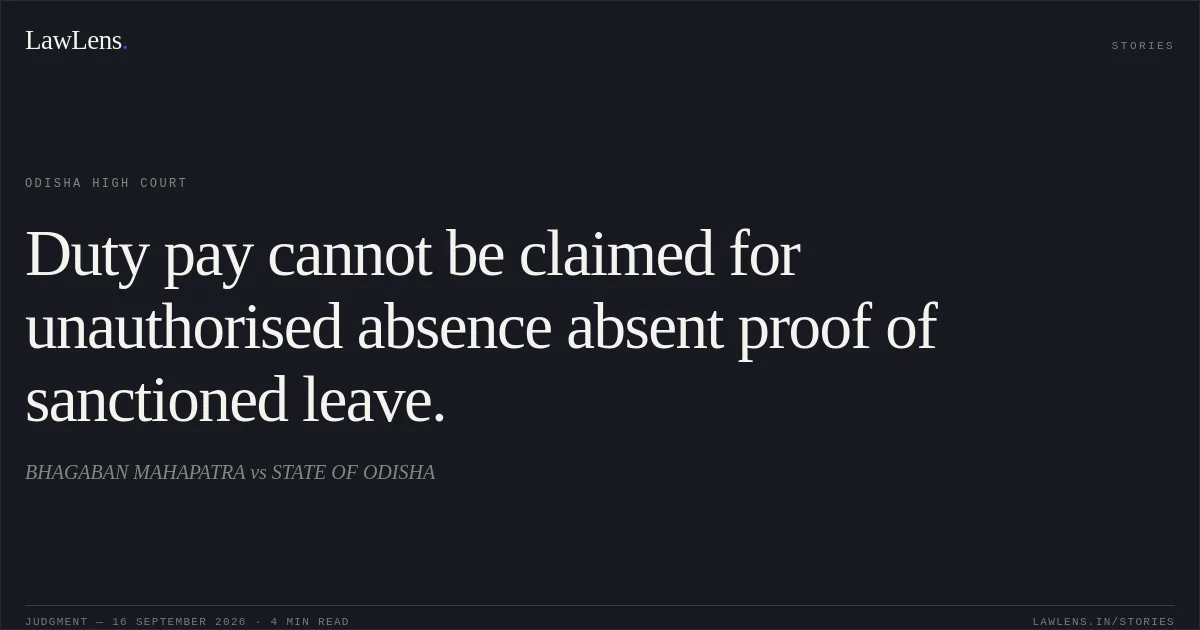
The Court held that, in the absence of proof of a duly submitted and sanctioned leave application, the petitioner was not entitled to salary for the period of unauthorised absence.
Source reference: para. 9.13It further held that the claim could not be granted while the criminal case and departmental proceeding concerning the alleged forged certificates remained pending, subject to any later consideration warranted after their conclusion.
Source reference: para. 9.13The Court directed that the earlier order requiring expeditious disposal of the criminal case be enforced and expected the petitioner to cooperate with the criminal and subsequent departmental proceedings.
Source reference: p. 56No order as to costs was made.
Source reference: para. 11Acts & Sections Cited
4 provisions across 2 statutes referred to in this judgment. Each provision opens on LawLens.
Indian Penal Code, 18603
Administrative Tribunals Act, 19851
Original Court PDF
BHAGABAN MAHAPATRAvsSTATE OF ODISHA
Click to open original judgment
Original judgment, available to read, download and summarize on LawLens.in