Facts
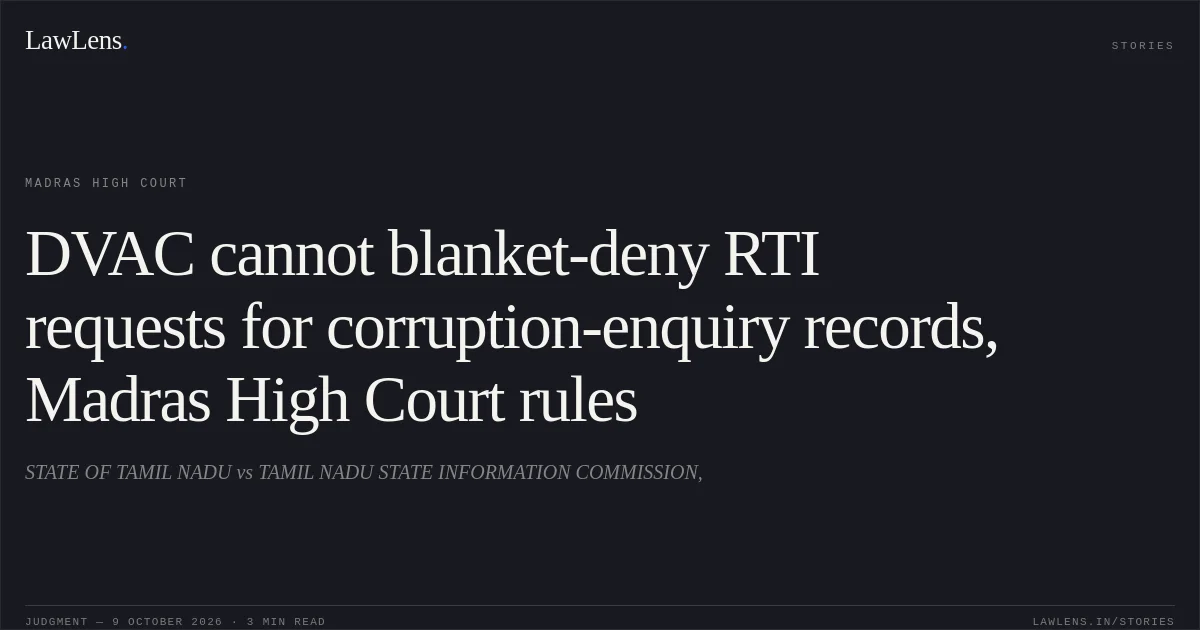
The second respondent, a retired DGP who had been the subject of a DVAC detailed enquiry, applied under Section 6(1) of the Right to Information Act, 2005, for the enquiry reports, government queries, recorded statements and related documents
Source reference: pp. 2–3, paras. 2–3The Public Information Officer (PIO) rejected the request under Section 8(1)(g), and the first appeal was also rejected.
Source reference: p. 3, para. 4On second appeal, the Tamil Nadu State Information Commission directed disclosure, with the names and particulars of other officers masked.
Source reference: p. 3, para. 4The State challenged that order, relying on Section 8(1)(g), the Section 11 procedure, Rule 29 of the DVAC Manual, privilege asserted in pending civil proceedings, and the difficulty of masking voluminous records.
Source reference: pp. 3–4, para. 5Issues
1. Whether DVAC’s exemption under Section 24(4) barred disclosure of records concerning an enquiry into allegations of corruption
Source reference: p. 5, paras. 9–102. Whether disclosure of the enquiry records was exempt under Sections 8(1)(g) or 8(1)(j), including whether witness or source information could be withheld
Source reference: pp. 5–7, paras. 11–173. Whether Section 11, Rule 29 of the DVAC Manual, claimed privilege in the civil proceedings, or the burden of masking voluminous records justified withholding the records
Source reference: pp. 8–10, paras. 20–23Law Applied
Section 24(4) of the RTI Act does not exempt information relating to allegations of corruption from disclosure; such requests must be assessed under the Act’s applicable exemptions.
Source reference: p. 5, paras. 9–10Section 8(1)(g) protects information where disclosure would endanger a person’s life or physical safety, or reveal a confidential source or assistance given for law-enforcement purposes; a general apprehension is insufficient.
Source reference: pp. 5–6, paras. 11–14The Court referred to Girish Ramchandra Deshpande v. Central Information Commissioner, (2013) 1 SCC 212, and Canara Bank v. C.S. Shyam, (2018) 11 SCC 426, for the principle that service and disciplinary information may constitute personal information, while distinguishing a request by the person who was himself the subject of the enquiry.
Source reference: p. 7, paras. 15–16Section 8(1)(j) may protect genuinely private information about unrelated third parties, but Section 10 requires severance and disclosure of reasonably separable, non-exempt material.
Source reference: pp. 7–8, paras. 17–18Section 11 prescribes a third-party consultation procedure where its conditions are met; it is not an independent exemption.
Source reference: pp. 9–10, para. 23Reasoning
The enquiry concerned allegations of corruption, so Section 24(4) did not provide a complete bar to the request.
Source reference: p. 5, paras. 9–10The State produced no specific material showing that disclosure would endanger anyone’s safety, or that disclosure of each third party’s identity would reveal a confidential law-enforcement source; Section 8(1)(g) therefore could not justify blanket withholding.
Source reference: pp. 6–7, paras. 12–14Because the applicant was the subject of the enquiry, the Court held that the cited service-record cases did not justify withholding the entire file, while recognising that genuinely private third-party information could be redacted under Section 8(1)(j) and Section 10.
Source reference: pp. 7–8, paras. 15–18The DVAC Manual, the asserted privilege in the civil proceedings, and the administrative burden of masking could not displace the RTI Act’s disclosure and severability framework; Section 11 was to be followed for any information meeting its conditions, without withholding the remaining disclosable material.
Source reference: pp. 8–10, paras. 20–23, 26Holding
The Court held that the State had not established grounds to withhold the entire enquiry record under Section 24(4) or Section 8(1)(g), and confirmed the Information Commission’s order.
The writ petition was dismissed without costs; the enquiry records were to be furnished in accordance with the Commission’s order, with the names and particulars of the other officers masked, and the Section 11 procedure followed where applicable.
Source reference: pp. 10–11, paras. 25–28Acts & Sections Cited
6 provisions across 1 statute referred to in this judgment. Each provision opens on LawLens.
Right to Information Act, 20056
Original Court PDF
STATE OF TAMIL NADUvsTAMIL NADU STATE INFORMATION COMMISSION,
Click to open original judgment
Original judgment, available to read, download and summarize on LawLens.in