Facts
The appellant, Manish, married the deceased, Ruchi, in 2007.
Source reference: no citationthe appellant took the deceased (who was eight months pregnant) to a house in Kashiram Colony, Sitapur, where he assaulted her, poured kerosene, and set her ablaze
Source reference: para. 5, 17the deceased alleged in her dying declaration that the appellant bolted the door from the outside to prevent her escape
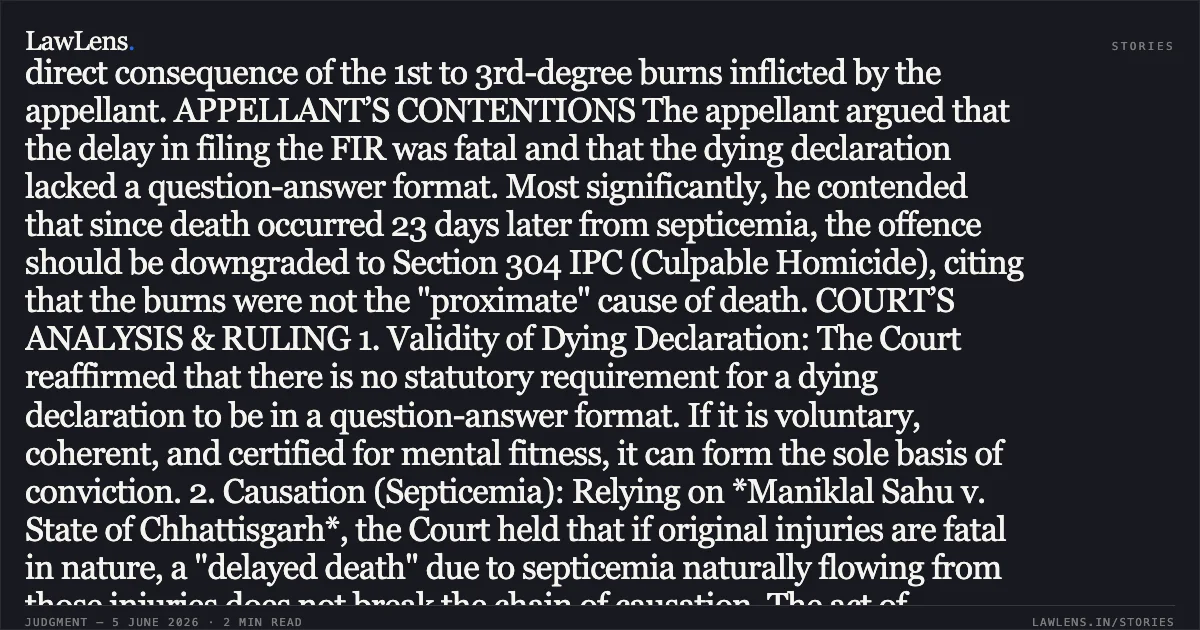
Source reference: para. 27The deceased succumbed to septicemia resulting from 1st to 3rd-degree burns on 21.12.2010, after 23 days of treatment
Source reference: para. 6, 23The Trial Court convicted the appellant under Section 302 IPC (Murder) while acquitting him of dowry death (304-B) and cruelty (498-A) charges
Source reference: para. 2, 99Issues
1. Whether the dying declaration recorded by the Executive Magistrate inspires sufficient confidence to form the sole basis of conviction
Source reference: para. 41, 1032. Whether a death caused by septicemia 23 days after the burn incident constitutes 'Murder' under Section 300 IPC or 'Culpable Homicide' under Section 304 IPC
Source reference: para. 67, 803. Whether the High Court has the power to commute a life sentence to a fixed-term imprisonment of more than 14 years
Source reference: para. 128, 132Law Applied
The Court applied Section 32(1) of the Indian Evidence Act, holding that a truthful dying declaration can be the sole basis for conviction
Source reference: para. 29, 119It relied on Laxman v. State of Maharashtra to establish that a doctor’s fitness certificate is a rule of caution, not a mandatory requirement if the recorder is satisfied with the declarant's mental state
Source reference: para. 57, 105Regarding the cause of death, the Court applied Section 299 (Explanation 2) and Section 300 IPC, following Patel Hiralal Joitaram v. State of Gujarat, which holds that if the original injury is fatal, the supervention of septicemia does not break the chain of causation
Source reference: para. 60, 62On sentencing, the Court followed the Constitution Bench ruling in Union of India v. V. Sriharan, authorizing High Courts to impose fixed-term sentences exceeding 14 years as an alternative to life imprisonment
Source reference: para. 128, 129Reasoning
The Court found the dying declaration (Exhibit Ka-10) unimpeachable, as it was recorded by an Executive Magistrate and certified by a physician
Source reference: para. 108, 121the Court reasoned that bolting the door from the outside after setting a pregnant woman on fire demonstrated a clear, direct intention to cause death under Section 300 "firstly"
Source reference: para. 107, 124The Court rejected the application of Exception 4 (sudden fight), noting the assault was unilateral and the act of bolting the door was "cruel and unusual"
Source reference: para. 76, 79Applying the "primary effect" test from State of Haryana v. Pala, the Court determined that the septicemia was a natural consequence of the 1st to 3rd-degree burns, and thus the appellant was legally deemed to have caused the death
Source reference: para. 85, 125Holding
The Court affirmed the conviction under Section 302 IPC, holding that the intentional inflicting of fatal burn injuries followed by locking the victim inside constitutes murder
The Court partly allowed the appeal by maintaining the conviction but commuting the sentence from life imprisonment to a fixed-term rigorous imprisonment of 20 years without remission
Source reference: para. 141, 142Acts & Sections Cited
16 provisions across 3 statutes referred to in this judgment. Each provision opens on LawLens.
Indian Penal Code, 18607
Code of Criminal Procedure, 19737
Original Court PDF
ManishvsState Of U.P.
Click to open original judgment
Original judgment, available to read, download and summarize on LawLens.in


