01Facts
On 16.04.2015 at about 11:00 a.m., at the deceased's house in Elebichhali village, the deceased Hussainappa allegedly poured kerosene over himself to threaten his wife, Accused No. 1. Accused No. 1 then allegedly lit a match and set him on fire with intent to kill. Accused Nos. 2 to 5 (her brothers, mother-in-law and another relative) were alleged to have abetted the act.
¶ 2The deceased was taken to RIMS Hospital, Raichur, and his statement was recorded. Charges were framed under ss. 302 and 109 r/w s. 34 IPC, which the accused denied.
¶ 2The prosecution examined 16 witnesses and marked Exs. P1–P15 and MOs. 1–4; Ex. D1 was marked for the defence.
¶ 3PW-1 to PW-3 turned hostile.
¶ 14PW-4 (mother) deposed to the incident; her earlier police statement (Ex. D1) was confronted to her.
¶ 15–16PW-5 (father) and PW-6 (sister) deposed in similar terms.
¶ 16The deceased's dying declaration (Ex. P3) was recorded by PW-7, a Tahsildar, in the presence of PW-11, a doctor, who left before recording was completed.
¶ 16–17The postmortem (Ex. P8) recorded 80–90% burns with both upper limbs burnt, and the declaration bears only a thumb impression.
¶ 18The trial court answered both points in the negative and acquitted all accused.
¶ 6–7The State filed this appeal under s. 378(1) and (3) Cr.P.C.
¶ 802Issues
i.1. Whether the prosecution proved that the trial court's judgment of acquittal is arbitrary and erroneous, and was passed without appreciation of evidence.
¶ 13(i)ii.2. Whether the dying declaration (Ex. P3) is genuine, reliable and fit to found a conviction under s. 302 IPC and abetment under s. 109 IPC, such that the acquittal should be disturbed.
¶ 17–19, 21 (issue derived from the discussion)03Law Applied
The court applied ss. 302, 109 and 34 IPC as the substantive offences charged.
¶ 2Atbir v. Govt. of NCT of Delhi (2010) 9 SCC 1 holds that a dying declaration may be the sole basis of conviction only if it inspires full confidence. The court must be satisfied that the deceased was fit and conscious, and that the statement was not the product of tutoring, prompting or imagination. Where it is suspicious, corroboration is required as a rule of prudence.
¶ 19–20H.D. Sundara v. State of Karnataka (2023) 9 SCC 581 provides that the appellate court must determine whether the trial court's view is a possible one; acquittal cannot be reversed merely because another view is possible.
¶ 23Sharad Birdhichand Sarda (1984) 4 SCC 116, Umedbhai Jadavbhai (1978 SCC (Cri) 108), Chandrappa v. State of Karnataka (2007) 4 SCC 415, Tota Singh v. State of Punjab (1987) 2 SCC 529, State of Rajasthan v. Raja Ram (2003) 8 SCC 180, Surajpal Singh (1951 SCC 1207), Ramanand Yadav (2003) 12 SCC 606 and C.K. Dase Gowda (2014) 13 SCC 119 establish that the appellate court may re-appreciate evidence but should interfere with acquittal only for compelling reasons, and that where two views are possible, the one favouring the accused must prevail.
¶ 22–30Provisions in the judgment · 9 · Linked ones open on LawLens
Code of Criminal Procedure, 1973 Section 378Section 207Section 313Section 161
Indian Penal Code, 1860 Section 302Section 109Section 34Section 149Section 307
04Reasoning
The court first tested PW-4's testimony against her earlier police statement (Ex. D1). In Ex. D1 she said only that the son "got poured kerosene to threaten." At trial she asserted that Accused No. 1 poured kerosene and set him alight. The court held this to be an improvement and found the two accounts inconsistent.
¶ 17The court then examined the dying declaration, on which the entire prosecution case depended. It identified several defects. PW-7 admitted making no entry in the case sheet and the prosecution did not produce the case sheet. The requisition bearing a fitness endorsement was not signed by PW-11, and no opinion from the doctor on the deceased's fitness was produced.
¶ 17, 31The deceased had 80–90% burns with both upper limbs burnt, yet the prosecution did not explain how he could affix a thumb impression on Ex. P3.
¶ 18Applying Atbir, the court held that the absence of a fitness certificate meant the prosecution failed to establish that the deceased was in a fit state of mind.
¶ 19Because Ex. P3 was not reliable, the court held that the conviction for murder could not rest on it, and that PW-5 to PW-7 did not inspire confidence on abetment.
¶ 21Applying the H.D. Sundara test, the court held that the trial court's acquittal was a possible view on the evidence and that the prosecution's failure to prove Ex. P3 meant the trial court's reasoning could not be called perverse.
¶ 22–31In the court's view, the presumption of innocence, reinforced by acquittal, and the benefit of doubt under Sharad Birdhichand Sarda and Raja Ram required that the acquittal not be disturbed.
¶ 24, 28, 3005Holding
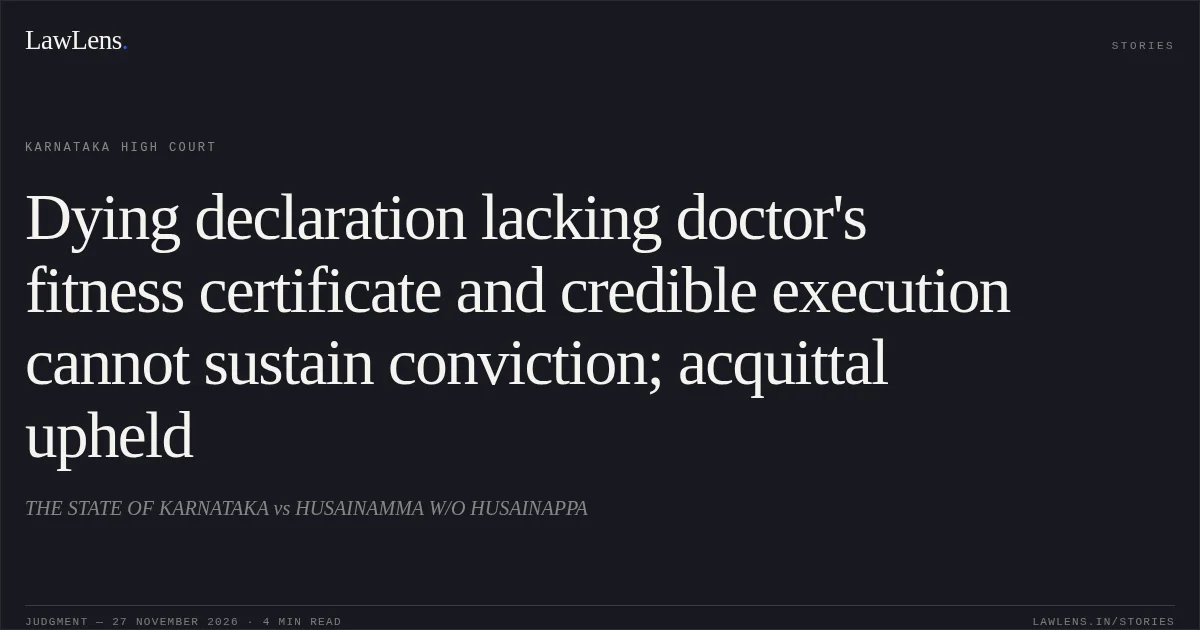
The High Court answered Point No. 1 in the negative: the prosecution failed to show that the acquittal was arbitrary or erroneous.
¶ 32The trial court's acquittal was a possible view and was rightly passed, given that the entire case rested on the unreliable Ex. P3.
¶ 31The appeal is dismissed and the acquittal of Accused Nos. 1 to 5 under ss. 302 and 109 r/w s. 34 IPC is upheld.
¶ 33(i)Original Court PDF
THE STATE OF KARNATAKAvsHUSAINAMMA W/O HUSAINAPPA
Click to open original judgment
Original judgment, available to read, download and summarize on LawLens.in