01Facts
On 05.05.2013, at about 2:15 p.m., the deceased Andiyappan was assaulted near Sivagangai Railway Station.
¶ 2The prosecution alleged that Accused 1 (Veeramani) demanded Rs.2,000, struck the deceased on the left side of the neck with a key, and that Accused 2 (Viji), sharing common intention, assaulted him with a stick and threatened him.
¶ 2The deceased was taken to Sivagangai Government Hospital and later to Rajaji Government Hospital, Madurai, where he died on 12.05.2013.
¶ 3On the basis of a statement attributed to the deceased (Ex.P10), Crime No.415 of 2013 was registered, and after investigation the case was committed to the Additional Sessions Court, Sivagangai, as S.C.No.105 of 2015.
¶ 3Charges were framed under Sections 294(b), 506(ii) and 302 IPC (with Section 34 against Accused 2).
¶ 4The prosecution examined nine witnesses and marked 14 exhibits; the defence led no evidence.
¶ 5The Trial Court convicted both accused under Section 294(b) IPC (two months' RI) and Section 304 Part I IPC (seven years' RI and Rs.5,000 fine).
¶ 5The appellants contended that PW1 and PW2, the deceased's brothers, were not present at the scene; that no independent witness was examined; that Ex.P2 (Accident Register) records assault by an "unknown person"; and that Ex.P10 was not duly proved.
¶ 7–9The State supported conviction, relying on the eyewitnesses and the dying declaration.
¶ 1002Issues
i.1. Whether PW1 and PW2 were present at the place of occurrence, and whether their evidence can be believed.
¶ 11(i) · ¶ 12–16ii.2. Whether Ex.P10, treated as the deceased's dying declaration, can be relied upon.
¶ 11(ii) · ¶ 17–22iii.3. Whether the convictions under Section 304 Part I and Section 294(b) IPC, and the sentences imposed, are sustainable in law.
¶ 11(iii) · ¶ 2303Law Applied
Section 32(1) of the Indian Evidence Act, 1872 makes a statement recorded from an injured person who later dies admissible if it relates to the cause or circumstances of death. Where such a statement is the sole basis of conviction, it must be true, voluntary, and made by a person fit to make it, and must inspire the full confidence of the court.
¶ 17Laxman v. State of Maharashtra (2002) 6 SCC 710: although a certificate of fitness is not mandatory, the court must look for medical or other proof of fitness where the declarant's condition is in doubt.
¶ 21Section 114(g) of the Indian Evidence Act, 1872 permits an adverse inference where a material witness is withheld without satisfactory explanation.
¶ 20Under the criminal standard, the prosecution must prove guilt beyond reasonable doubt, failing which the accused is entitled to acquittal.
¶ 23Provisions in the judgment · 7 · Linked ones open on LawLens
Code of Criminal Procedure, 1973 Section 374Section 207
Indian Penal Code, 1860 Section 294Section 506Section 302Section 34Section 304
04Reasoning
PW1 and PW2 were not present at the scene. Their accounts of how they reached the spot, and their conduct in not accompanying the critically injured brother to hospital, were inconsistent and unnatural.
¶ 12–13Ex.P2 recorded that the deceased was found under a banyan tree and had been assaulted by unknown persons, with no mention of the brothers.
¶ 14Both witnesses admitted in cross-examination that they did not know the accused's names until told by the police.
¶ 15The court read PW2's Tamil testimony ("would have" sustained injury) as showing that PW1 was speculating, not describing what he saw.
¶ 19Their evidence was rejected as introduced to strengthen the prosecution case.
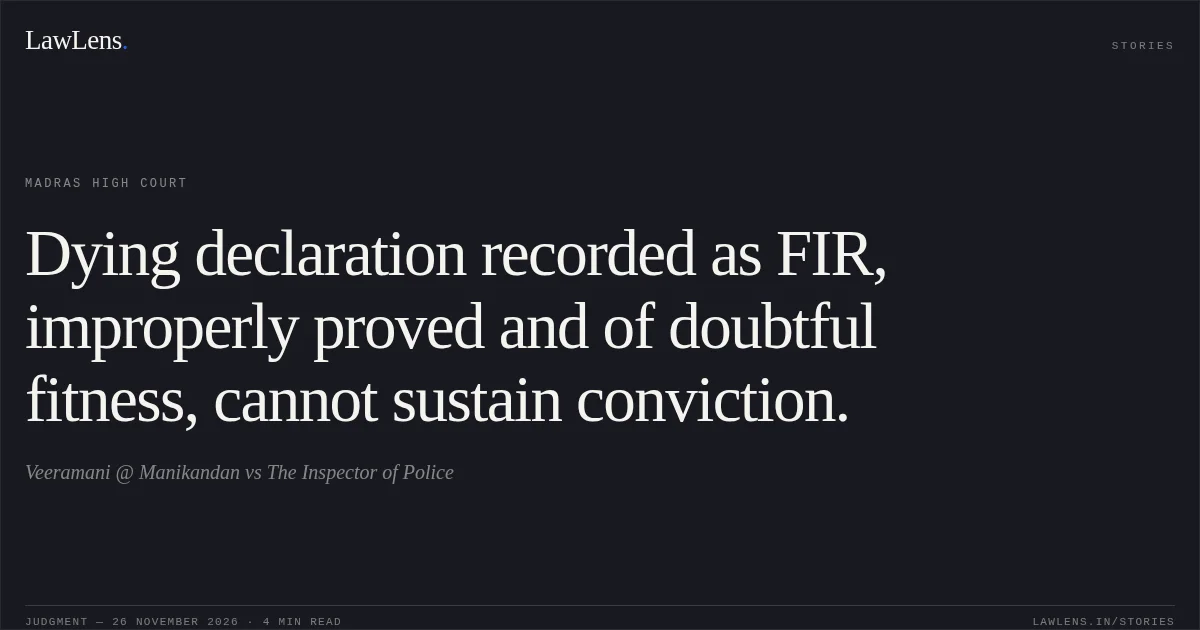
¶ 16Ex.P10 was found unreliable. The recording time was unproved, and the record was silent on it.
¶ 18The deceased's consciousness was doubtful, as the case sheets from both hospitals were not produced and no doctor certified fitness.
¶ 19, 21The Sub-Inspector who recorded the statement was not examined, and the signature of the deceased was not proved, although PW1–PW3 could have identified it. The court drew an adverse inference under Section 114(g).
¶ 20The deceased had initially described an unknown assailant, and no explanation was offered for his later naming of the accused.
¶ 21Having rejected both the eyewitness and dying declaration evidence, the court held that no admissible evidence connected the appellants with the offence. Issue 3 followed as a consequence: the convictions could not stand.
¶ 2305Holding
1. PW1 and PW2 were not present at the scene. 2. Ex.P10 is not reliable as a dying declaration.
¶ 16, 22The prosecution failed to prove guilt beyond reasonable doubt. The appellants are acquitted of the charges under Section 294(b) and Section 304 Part I IPC. The judgment of the Additional Sessions Court, Sivagangai, in S.C.No.105 of 2015 dated 17.02.2020 is set aside, the bail bonds are discharged, and both Criminal Appeals are allowed.
¶ 23–24Original Court PDF
Veeramani @ ManikandanvsThe Inspector of Police
Click to open original judgment
Original judgment, available to read, download and summarize on LawLens.in