01Facts
The appellant was convicted under Section 366 IPC by the Sessions (Fast Track Mahila) Judge, Namakkal, in Spl.C.C. No. 17 of 2017, and sentenced to seven years' rigorous imprisonment and a fine of Rs. 1,000.
¶ 1 · pp. 1-2The prosecution case is that the appellant and the victim were in a relationship, that he took her to his relatives' house in Bangalore on a promise of marriage, and that he sexually assaulted her there.
¶ 2 · p. 2The victim's mother (P.W.1) lodged a complaint (Ex.P1) on 07.06.2016 alleging that her daughter, then about 17, had been kidnapped by the appellant.
¶ 3 · p. 2The victim was traced with the appellant on 14.06.2016 near a bus stand. The Investigating Officer later filed an alteration report (Ex.P12) and a final report. The judgment describes the alteration as moving from Section 366(A) IPC to "Section 366(A) IPC and Sections 3 and 4 of the POCSO Act," which is internally inconsistent.
¶ 3 · pp. 2-3The prosecution examined 17 witnesses and marked 15 exhibits. The appellant did not lead defence evidence.
¶ 4 · p. 3The trial court acquitted the appellant under Section 9 of the Prohibition of Child Marriage Act and Section 5(l) r/w Section 6 of the POCSO Act, but convicted him under Section 366 IPC.
¶ 5 · p. 3The school certificate (Ex.P5), proved through the Headmaster (P.W.13), records the victim's date of birth as 24.06.2000.
¶ 9-10 · pp. 5-6The appellant was in custody from 14.06.2016 to 14.10.2016 and from 17.12.2018 to 05.03.2020. Sentence was suspended on 08.04.2022.
¶ 13 · p. 7The acquittal on the PCMA and POCSO charges was not challenged by the prosecution.
¶ 11 · p. 602Issues
i.1. Whether the prosecution proved that the victim was a minor (under 18) at the time of occurrence.
¶ 9-10 · pp. 5-6ii.2. Whether the victim's apparent consent to accompany the appellant bars a conviction under Section 366 IPC.
¶ 12-13 · pp. 6-7iii.3. Whether non-examination of the persons with whom the couple stayed at Bangalore is fatal to the prosecution case. (Raised by the appellant; not expressly decided by the Court.)
¶ 6 · p. 4iv.4. Whether the sentence of imprisonment should be modified in light of the mitigating circumstances.
¶ 13-14 · pp. 7-803Law Applied
The Court relied on Section 361 IPC, which defines kidnapping from lawful guardianship and treats the taking of a female under 18 out of the keeping of her lawful guardian, without the guardian's consent, as kidnapping.
¶ 13 · pp. 6-7It applied Section 366 IPC, which penalises kidnapping or inducing a woman to compel marriage or to be forced into illicit intercourse, to the extent the trial court's conviction rested on it.
¶ 13 · p. 7The Court treated the victim's consent as legally immaterial where minority is established, following the statutory framework of Section 361 IPC.
¶ 12 · p. 6No precedent is cited for the proposition that the victim's consent is immaterial where minority is established.
Age was proved on the basis of the school certificate and the Headmaster's testimony, as the appellant did not dispute age.
¶ 10 · p. 6The Court also treated the victim's consent and the period of incarceration as mitigating factors in sentencing.
¶ 13-14 · pp. 7-8No authority for the sentencing principle is cited.
Provisions in the judgment · 9 · Linked ones open on LawLens
Indian Penal Code, 1860 Section 366Section 361
Prohibition of Child Marriage Act, 2006 Section 9
Protection of Children from Sexual Offences Act, 2012 Section 5Section 6Section 3Section 4
Code of Criminal Procedure, 1973 Section 164Section 313
04Reasoning
The Court first found that the victim went missing on 06.06.2016, that the complaint named the appellant, and that the victim admitted in her deposition that she accompanied him. Relatives' testimony (P.W.3, P.W.4, P.W.5) corroborated the timeline.
¶ 10 · pp. 5-6Age was established by Ex.P5 and P.W.13's evidence, and the appellant did not contest it. The victim was therefore under 18 when she was taken out of her guardian's keeping.
¶ 10 · p. 6Because the victim was a minor, her consent was immaterial under Section 361 IPC, although the Court accepted that consent could be inferred from the evidence.
¶ 12-13 · pp. 6-7The Court therefore found no basis to interfere with the trial court's finding under Section 366 IPC.
¶ 13 · p. 7The Court did not address the appellant's argument about the non-examination of Bangalore witnesses, nor did it discuss whether the acquittal on the POCSO and PCMA charges affected the Section 366 conviction.
¶ 6 · p. 4As to sentence, the Court treated the victim's near-majority and voluntary departure as mitigating, together with nearly three years of total incarceration. It held that the period undergone met the ends of justice.
¶ 13-14 · pp. 7-805Holding
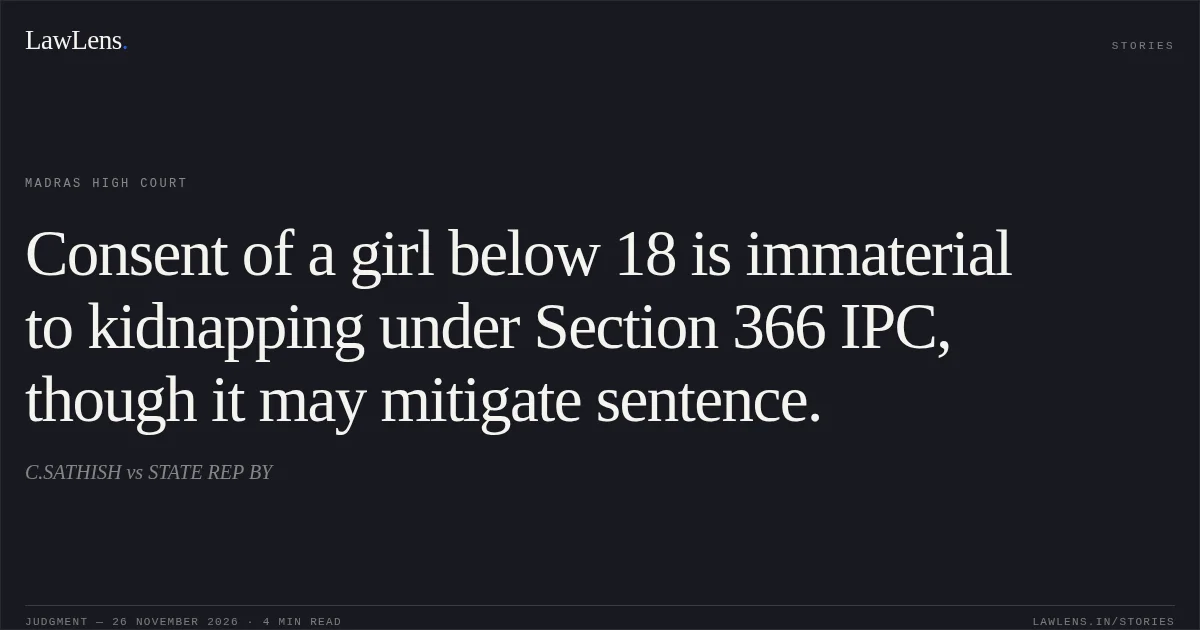
The Court held that the victim's minority was proved and that her consent did not preclude a conviction under Section 366 IPC. The conviction under Section 366 IPC was confirmed.
¶ 12-13 · pp. 6-7The sentence of seven years' rigorous imprisonment was modified to the period already undergone, given the mitigating circumstances and the total incarceration of nearly three years.
¶ 13-14 · pp. 7-8The fine of Rs. 1,000 was confirmed, and any bail bonds stood discharged.
¶ 14 · p. 8The appeal was therefore partly allowed.
¶ 15 · p. 8Original Court PDF
C.SATHISHvsSTATE REP BY
Click to open original judgment
Original judgment, available to read, download and summarize on LawLens.in