01Facts
The appellant, V. Kadamban, challenged the Single Judge's order dated 19.06.2024 in W.P. No. 11512 of 2024 by filing a writ appeal under Clause 15 of the Letters Patent.
p. 2The appeal was filed 741 days late.
p. 2He filed CMP No. 29670 of 2026 under Section 5 of the Limitation Act seeking condonation of that delay.
p. 2The supporting affidavit states that the delay is "neither wilful nor wanton, but solely due to the bona fide reasons stated above," but it does not set out any specific reasons.
p. 3 · ¶ 2The affidavit also refers to a delay of "1660 days," which is inconsistent with the 741 days in the prayer.
p. 2 · p. 3 · ¶ 2The respondents were the State, the DGP, the Commissioner of Police and the Investigating Officer, and the Additional Government Pleader appeared for R-1.
p. 202Issues
i.1. Whether the appellant has shown sufficient cause to condone a delay of 741 days in filing the writ appeal against the order in W.P. No. 11512 of 2024.
p. 3 · ¶ 1–2 · p. 6 · ¶ 403Law Applied
The Court considered the prayer under Section 5 of the Limitation Act, which permits condonation of delay on sufficient cause, and the Clause 15 Letters Patent appeal route.
p. 2In Karnataka Power Corporation Ltd. v. K. Thangappan (2006) 4 SCC 322, delay and laches are relevant to the exercise of writ jurisdiction, and a court may refuse relief where unexplained delay causes prejudice, though discretion must be exercised judicially.
p. 4 · ¶ 3(i)In Shivamma v. Karnataka Housing Board 2025 INSC 1104, long delay cannot be condoned as a matter of course, and the court must first test the bona fides of the explanation before considering the merits.
pp. 4–5 · ¶ 3(ii)In Thirunagalingam v. Lingeswaran 2025 INSC 672, the first duty of the court is to examine the bona fides of the explanation, and condonation is not to be granted as an act of generosity or at the cost of prejudice to the other side.
pp. 5–6 · ¶ 3(iii)Provisions in the judgment · 1 · Linked ones open on LawLens
Limitation Act, 1963 Section 5
04Reasoning
The Court applied the sequence set out in Shivamma and Thirunagalingam. It did not begin with the merits of the writ appeal. It examined the affidavit and found that it offered no reasons, "much less valid and cogent reasons," for the delay.
p. 6 · ¶ 4The explanation was therefore not bona fide or specific enough to be weighed against the respondents' position. Because the explanation was absent, the Court did not reach the question of whether the two sides were equally balanced, and it had no basis to consider the merits. The unexplained discrepancy between 741 and 1660 days further weakened the affidavit, although the Court did not expressly rely on it. The length of delay, together with the absence of any explanation, led the Court to hold that no sufficient cause existed.
pp. 2–3 · p. 6 · ¶ 405Holding
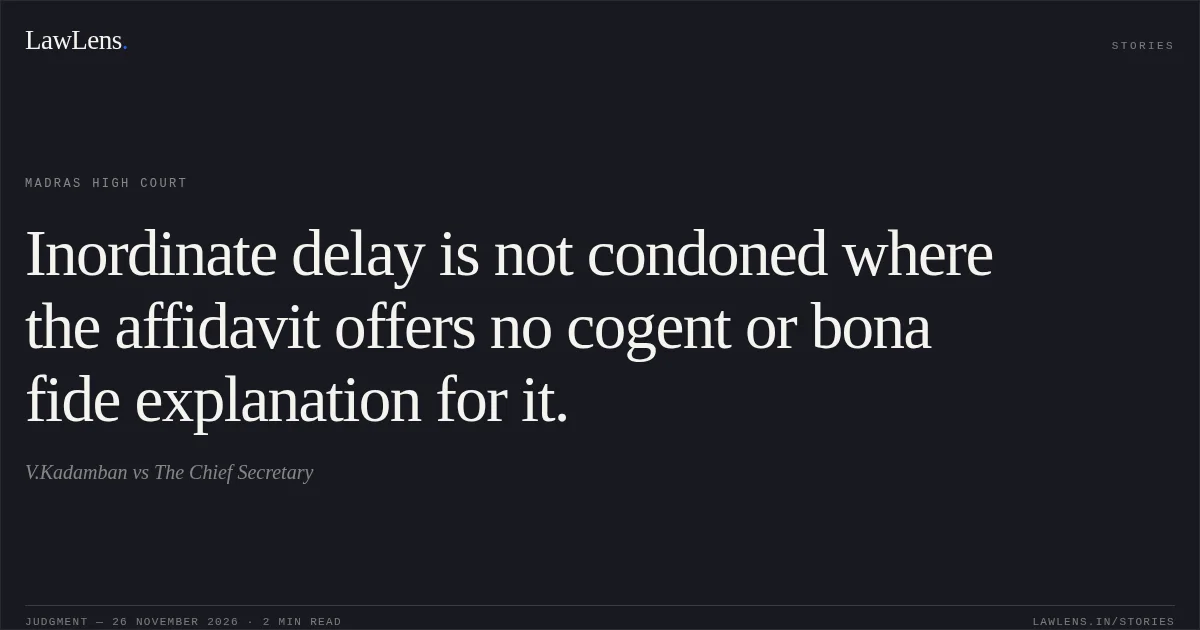
The Court held that the affidavit did not disclose sufficient cause for a 741-day delay, and it declined to condone the delay.
p. 6 · ¶ 4It dismissed CMP No. 29670 of 2026, rejected WA SR No. 130866 of 2026 as a consequence, and made no order as to costs. The order of the Single Judge dated 19.06.2024 therefore stands.
p. 7 · ¶ 5Original Court PDF
V.KadambanvsThe Chief Secretary
Click to open original judgment
Original judgment, available to read, download and summarize on LawLens.in