01Facts
Qualcomm Incorporated (appellant) filed Indian Patent Application No. 202147041228 through an agent acting under a general power of attorney (PoA) executed by the principal on 03.05.2021
¶ 8The PoA was executed on an Indian non-judicial e-stamp of Rs. 500, purchased in Delhi, and sent to the principal in the United States for signature
¶ 8An objection was raised that the e-stamp date preceded the execution date.
¶ 8The appellant filed an additional Rs. 100 stamp paper and a sworn affidavit stating that the annexed PoA was a true copy of the original already filed in Application No. 202147021533 on 12.05.2021
¶ 8The Controller rejected the application by order dated 10.12.2024.
¶ 8The Controller held that the PoA did not comply with Form 26, was neither notarized nor registered, and that the stamp-date discrepancy was unexplained.
¶ 8The respondent argued that the appellant could have filed an affidavit under Rule 126(3) but did not do so.
¶ 5The principal did not dispute the PoA or the agent's authority.
¶ 9, 11The appellant challenged the rejection under the present appeal.
¶ 1–402Issues
i.1. Whether the Controller may reject a patent application on the ground that the agent's PoA does not conform to Form 26 (Rule 135) or is not notarized or registered.
¶ 8–10, 12ii.2. Whether the invalidity or irregularity of a PoA is a ground for refusing a patent application, and whether such a defect is curable.
¶ 12–13iii.3. Whether Section 77(1)(c) of the Patents Act empowers the Controller to examine the validity of a PoA at the filing stage.
¶ 10–11iv.4. Whether Rule 126 of the Patents Rules or Section 84 of the Bharatiya Sakshya Adhiniyam, 2023 (BSA) requires a PoA to be authenticated or notarized.
¶ 14–1603Law Applied
The Patents Act, 1970 and Patents Rules, 2003 contain no requirement that a PoA be notarized or registered.
¶ 9Sections 127 and 132 and Rules 126 and 135, including the Form 26 requirement, were considered, and Rule 126 uses the disjunctive "or" between Form 26 and a PoA.
¶ 4, 10Section 77(1)(c) confers civil-court powers limited to receiving affidavits or evidence on factual issues, and does not extend to rejecting an application filed by an agent.
¶ 11Rule 126 governs affidavits filed before the Patent Office and cannot be extended to PoAs.
¶ 14Section 84 BSA creates only a presumption of authenticity for PoAs executed before a recognized authority, and does not apply absent a statutory requirement.
¶ 15Huawei Technologies Co. Ltd. v. Controller General of Patents (Calcutta HC, IPDPTA/6/2025, 22.04.2025) held that PoA invalidity is not a ground for refusing a patent.
¶ 12Amit Roy v. Jyothendrasinhji Viramshinhji, 2016 SCC OnLine Kar 8793, held that Chapter 10 of the Patents Act does not require notarization or registration of a PoA.
¶ 12Technical objections are generally curable.
¶ 13Provisions in the judgment · 5 · Linked ones open on LawLens
Patents Act, 1970 Section 127Section 132Section 77
Notaries Act, 1952 Section 14
Bharatiya Sakshya Adhiniyam, 2023 Section 84
04Reasoning
The principal did not dispute the PoA, and the statute and Rules impose no notarization or registration requirement, so the Controller's reliance on those absences was misplaced.
¶ 9The earlier date on the e-stamp was not illegal, since only a document dated before its stamp paper is defective, and no such defect existed here.
¶ 10Because Rule 126 is disjunctive ("or"), the PoA was not required to satisfy Form 26 in addition to the Rule 126(3) authentication standard, and the Controller's rejection on Form 26 grounds was erroneous.
¶ 10, 16Section 77(1)(c) could not justify rejecting the application at the filing stage.
¶ 10–11The Court treated the defect as a curable technical objection, found it "wholly without substance," and held that the agent was entitled to file and prosecute the application.
¶ 13Rule 126 and Section 84 BSA were held inapplicable to a PoA executed by the patentee.
¶ 14–16The Court characterised the rejection as a "hyper-technical approach" on "non-available grounds."
¶ 1605Holding
The Controller was not competent to reject the application on the basis of a PoA that is neither required to be notarized or registered nor required to conform to Form 26.
¶ 9–12Section 77(1)(c), Rule 126, and Section 84 BSA do not support the impugned rejection.
¶ 11, 14–16The Civil Miscellaneous Appeal (Patent) was allowed, and the Controller's order dated 10.12.2024 in Application No. 202147041228 was set aside. The matter was remitted to be heard by a different Patent Controller, who must afford the appellant a fair opportunity and pass final orders within four months of receipt of the order. No costs were awarded.
¶ 17Original Court PDF
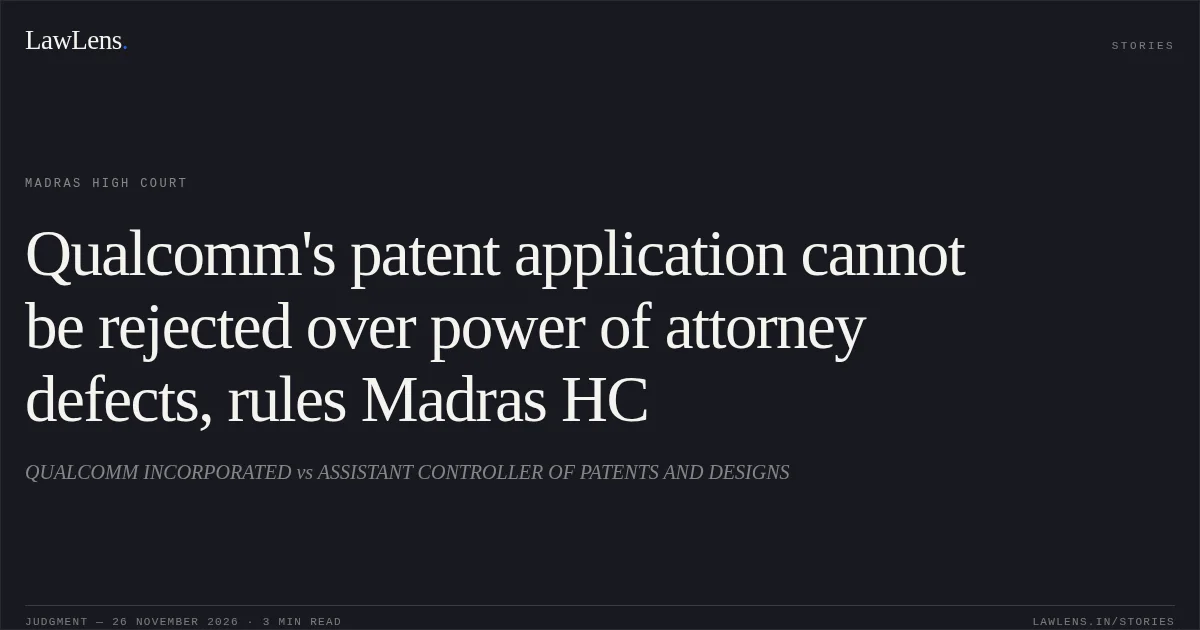
QUALCOMM INCORPORATEDvsASSISTANT CONTROLLER OF PATENTS AND DESIGNS
Click to open original judgment
Original judgment, available to read, download and summarize on LawLens.in