01Facts
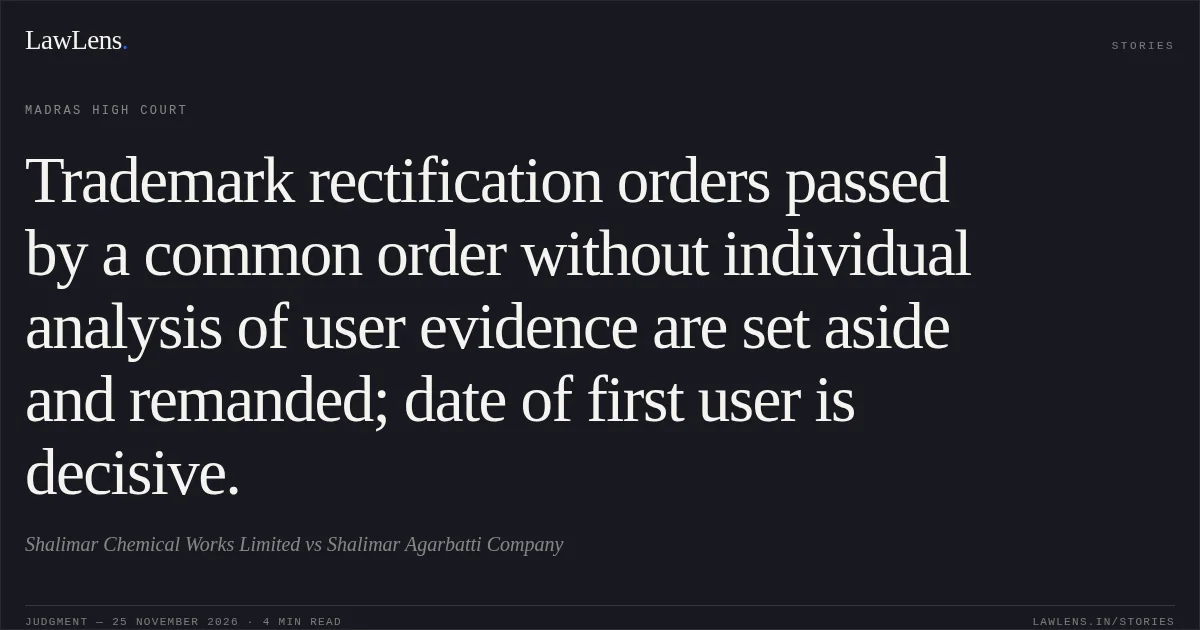
The appellant, Shalimar Chemical Works Ltd., challenged twelve orders of the Deputy Registrar of Trade Marks concerning registered trade marks in Class 3 held by the first respondent, Shalimar Agarbatti Company.
p. 1The impugned orders were dated 05.06.2013, and the appellant had filed rectification proceedings (No. MAS 259775) against Registered Trade Mark No. 886634.
p. 1 · ¶ 1The appeals were originally filed before the IPAB and transferred to the High Court on its abolition.
¶ 3 · p. 2The appellant contended that the orders were based on selective documents, that the appeals were not considered on their individual merits, and that user documents were not properly analysed. It sought remand to the Registry, submitting that no prejudice would result if expeditious disposal was directed.
¶ 4 · p. 3 · ¶ 4.1 · p. 3The first respondent opposed remand, contending that all relevant documents were before the Registry and that only the typed set filed before the Court omitted some of them.
¶ 5 · p. 3On the court's review, the impugned orders were a common order, did not discuss the facts of each case, and referred only to selective documents.
¶ 7 · p. 4The first respondent, on instructions, fairly conceded remand but sought leave to lead additional evidence, as the case turned on the actual date of first user.
¶ 8 · pp. 4–5The appellant objected to the first respondent enlarging the scope of the oppositions through additional documents.
¶ 9 · p. 5The parties agreed that the date of user would decide the matters.
¶ 11 · p. 502Issues
i.1. Whether the impugned common orders, passed without individual consideration of the record and without analysing documents on the date of user, warrant remand to the Registry for fresh consideration.
¶ 6–7 · p. 4ii.2. Whether the parties may be permitted to lead additional evidence on the date of user before the Registry.
¶ 8 · pp. 4–5 · ¶ 12 · pp. 5–6iii.3. Whether the first respondent may enlarge the scope of the oppositions by filing additional documents.
¶ 9 · p. 5 · ¶ 12 · p. 6iv.4. Whether the objective test for similarity of description of goods, as laid down by the Delhi High Court in Karan Rathore, must be applied in these appeals.
¶ 13–14 · pp. 6–703Law Applied
The court acted under Section 91 of the Trade Marks Act, 1999, the provision under which the appeals were preferred.
p. 1The court treated the date of user as the most relevant and decisive factor in oppositions and rectification proceedings, which the Registrar must determine on the record.
¶ 7 · p. 4 · ¶ 11 · p. 5The Registrar must independently assess the existing record before passing final orders.
¶ 12 · p. 5Additional documents touching the claims of use may be received by the Registry subject to proof and relevancy, after a fair opportunity of hearing to both sides.
¶ 12 · pp. 5–6The court referred to Karan Rathore v. Registrar of Trade Marks (Delhi HC), which applied Bombay High Court decisions to adopt an objective test for similarity of description of goods.
¶ 13 · p. 6Provisions in the judgment · 1 · Linked ones open on LawLens
Trade Marks Act, 1999 Section 91
04Reasoning
The court found that the impugned orders were a single common order that referred to selective documents and did not examine the facts of each opposition. This showed no proper application of mind.
¶ 7 · p. 4Because the date of user was the decisive question in every appeal, the Registrar's failure to address the user documents for each mark was a material defect.
¶ 7 · p. 4 · ¶ 12 · p. 5The first respondent's concession to remand removed the contest on that point.
¶ 8 · pp. 4–5The court held that remand caused no serious prejudice to either side, because the parties could lead evidence on the date of use.
¶ 12 · pp. 5–6The court limited the additional evidence to documents subject to proof and relevancy, and limited its scope to the claims of use of the impugned marks, which addressed the appellant's objection to the enlargement of the oppositions.
¶ 9 · p. 5 · ¶ 12 · pp. 5–6The court directed the Deputy Registrar to decide each opposition separately, so that each registration is assessed on its own record and the confusion caused by the common order is avoided.
¶ 12 · p. 6The Delhi High Court principles were not applied, since the matters were being remitted and the Registrar would decide the similarity questions on remand.
¶ 14 · pp. 6–705Holding
The judgment does not state a holding on the objective test for similarity of description of goods, and the court expressly declined to apply it.
¶ 14 · pp. 6–7The appeals are allowed without costs. The matters are remitted to the Deputy Registrar of Trade Marks for independent, mark-by-mark fresh consideration of each opposition. Both parties may lead additional evidence on the date of use, subject to proof and relevancy, after a fair hearing. The Deputy Registrar must pass final orders in all appeals within six months of receiving a copy of the order.
¶ 15 · p. 7 · ¶ 12 · pp. 5–6 · ¶ 14 · pp. 6–7The Registry is directed to incorporate the cause title for all cases and issue the order copy.
pp. 7–8The judgment does not expressly set aside the 05.06.2013 orders, though the remand has that effect in substance.
Original Court PDF
Shalimar Chemical Works LimitedvsShalimar Agarbatti Company
Click to open original judgment
Original judgment, available to read, download and summarize on LawLens.in