01Facts
The second respondent (defacto complainant) lodged a complaint with the police, which took no action. He then moved the Judicial Magistrate-II, Tindivanam, in C.M.P. No. 185 of 2026, which directed registration of a case
¶ 3 · p. 2Crime No. 82 of 2026 was registered on 14.05.2026 under Sections 296(b), 324(1) and 351(2) of the Bharatiya Nyaya Sanhita (BNS)
¶ 3 · p. 2The prosecution alleged that on 13.12.2025 at about 10 a.m. the petitioner destroyed a barbed wire fence around the complainant's land using a tractor. When questioned, he allegedly abused the complainant with filthy language and threatened him with dire consequences
¶ 3 · pp. 2–3The petitioner's counter-narrative is that he complained to the police on 19.06.2019 without action, petitioned the District Collector on 06.08.2025, alleged that the complainant fenced in his land and pressured him to sell, and alleged destruction of his electricity plant
¶ 4 · p. 3The petitioner filed O.S. No. 81 of 2025 seeking easement rights to transport goods
¶ 4 · p. 3The court treated the FIR as a retaliatory step
¶ 5 · p. 302Issues
i.1. Whether the utterance of allegedly obscene words, without proof that they annoyed others, satisfies the ingredients of Section 296(b) BNS.
¶ 5 · pp. 3–4ii.2. Whether the alleged threats satisfy the ingredients of criminal intimidation under Section 351(2) BNS, where the threats were not shown to have produced any effect on the complainant.
¶ 6 · p. 4iii.3. Whether the FIR is an abuse of process warranting quashing under the inherent jurisdiction of the High Court.
¶ 7–9 · pp. 5–603Law Applied
The court relied on Section 296(b) BNS, which requires obscene utterances that cause annoyance to others, and on Section 351(2) BNS, which requires a threat with intent to cause alarm and to compel a person to act or omit to act.
¶ 5–6 · pp. 3–4On the first point, the court applied K. Jeyaraman v. Janakaraj (1996) 1 CTC 470, which holds that mere utterance of obscene words is insufficient without proof that they annoyed others.
¶ 5 · p. 4On the second point, the court relied on Abdul Agis v. State (Crl.O.P. (MD) No. 11030 of 2014), which holds that a threat must be real, not a mere word, and that the offence fails where the person threatened does not actually feel threatened.
¶ 7 · p. 5On quashing, the court applied Bajanlal v. State of Haryana (as cited in the judgment, "(1992) SCC Crl. 426"), category 7, which permits quashing where proceedings are malafide or maliciously instituted to wreak vengeance or due to private grudge.
¶ 8 · pp. 5–6Provisions in the judgment · 6 · Linked ones open on LawLens
Bharatiya Nyaya Sanhita, 2023 Section 296Section 324Section 351
Indian Penal Code, 1860 Section 294Section 506
Code of Criminal Procedure, 1973 Section 161
04Reasoning
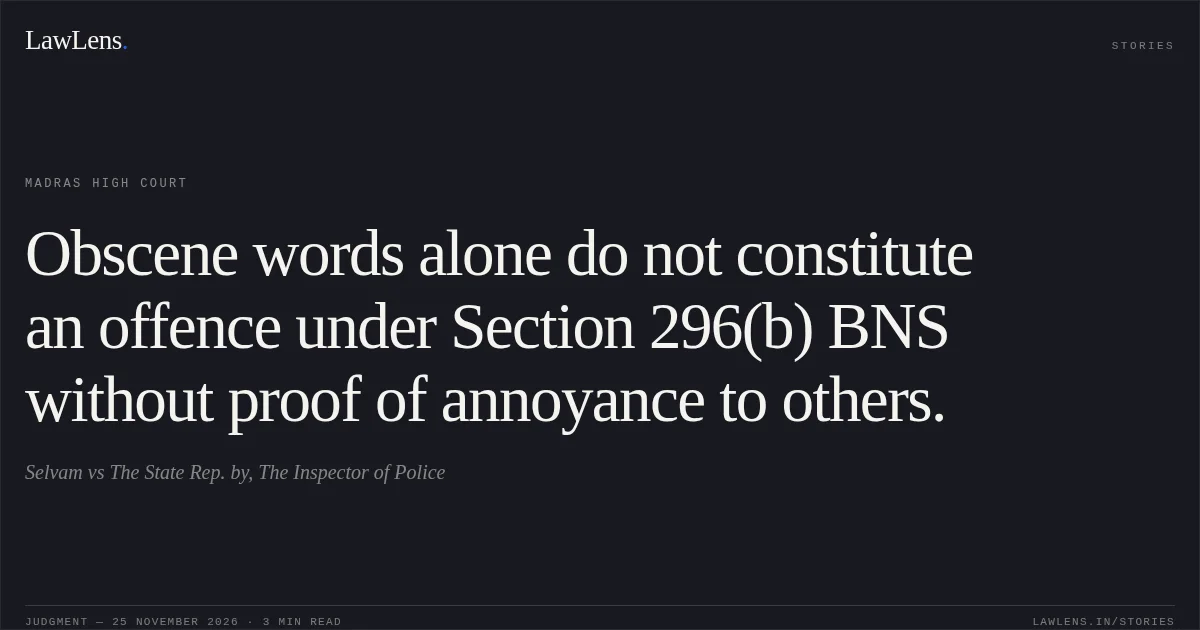
The court held that even accepting the prosecution's allegations, the complaint does not attribute specific words to the petitioner that constitute an offence. Nor does it state that any witness was annoyed by the words. Under K. Jeyaraman, the absence of such evidence defeats the Section 296(b) charge.
¶ 5 · pp. 3–4On Section 351(2), the court found that the alleged threats were, on the prosecution's own case, "empty threats" with no effect on the complainant. The statutory ingredients of threat and intent to alarm, followed by intent to compel action or inaction, were therefore not made out.
¶ 6 · p. 4The court drew support from Abdul Agis, where similarly trivial, word-only allegations were quashed.
¶ 7 · p. 5The court considered the petitioner's prior complaints, representation, fencing dispute and civil suit as indicating that the FIR was lodged to escape the petitioner's own grievances. It treated this as malicious prosecution within Bajanlal, category 7, and held the FIR an abuse of process.
¶ 5, 8 · p. 3, 605Holding
Section 296(b) BNS is not attracted because no obscene words annoying others were proved.
¶ 5 · p. 4Section 351(2) BNS is not made out because the threats were empty and had no effect on the complainant.
¶ 6 · p. 4Relying on Abdul Agis and Bajanlal, the court held the FIR to be a clear abuse of process.
¶ 7–8 · pp. 5–6The petition was allowed, FIR in Crime No. 82 of 2026 was quashed, and the connected miscellaneous petition was closed. No costs were awarded.
¶ 9 · p. 6Original Court PDF
SelvamvsThe State Rep. by, The Inspector of Police
Click to open original judgment
Original judgment, available to read, download and summarize on LawLens.in