Facts
The petitioner relied on a Hakku Pathra and revenue entries issued in respect of a 30 x 50-foot site at Pattandur Village, and sought an E-Khatha from the Greater Bengaluru Authority (GBA).
Source reference: p.3The GBA questioned the genuineness of the Hakku Pathra and submitted that Tahsildar verification was necessary.
Source reference: p.4The petitioner relied on an earlier order in W.P. No. 7063/2025, in which the Court had directed consideration of similar claims without insisting on Tahsildar verification unless legally warranted.
Source reference: p.3–4The petitioner also relied on revenue entries and a constructed house on the site.
Source reference: p.5Issues
1. Whether the petitioner’s request for an E-Khatha should be considered on the basis of the Hakku Pathra and Panchayath revenue entries, despite the GBA’s doubts about the document’s genuineness.
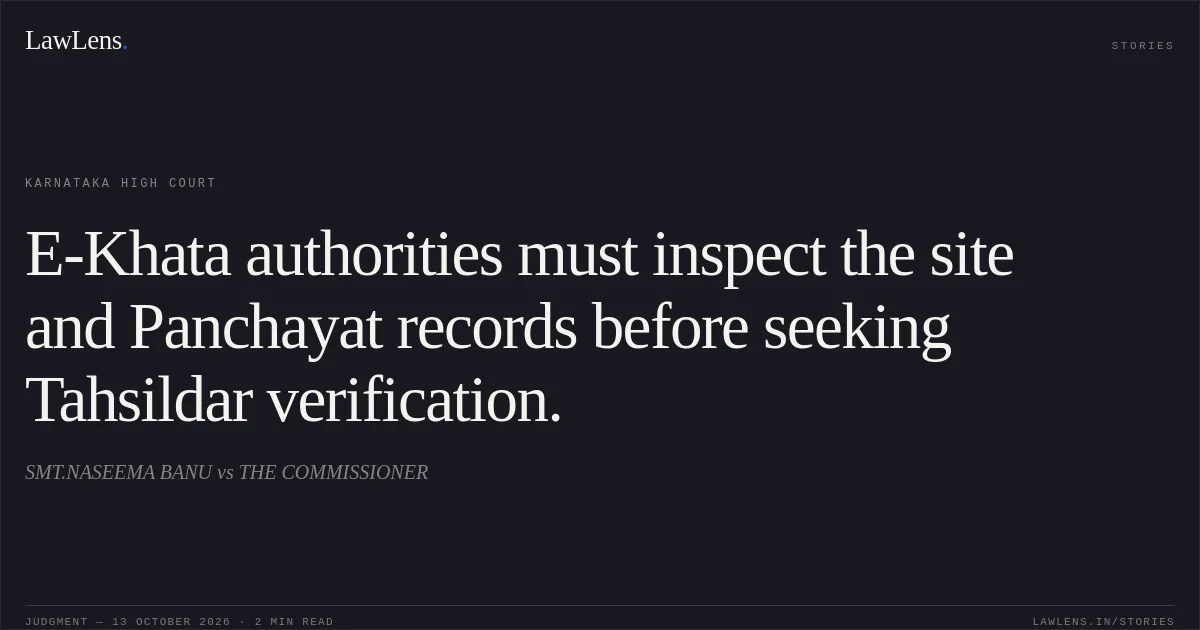
Source reference: p.4–52. Whether the jurisdictional Assistant Revenue Officer must undertake an inspection and verify the former Panchayath records before seeking verification from the jurisdictional Tahsildar.
Source reference: p.5–6Law Applied
The petition was brought under Article 226 of the Constitution of India, but the Court did not identify or apply a specific statutory provision governing E-Khatha issuance in the order.
Source reference: p.2It referred to its earlier order in W.P. No. 7063/2025, which contemplated that Tahsildar verification should not be insisted upon unless legally warranted.
Source reference: p.3–4The Court’s stated principle was that it should not endorse a claim where the authorities have expressed doubts, but must ensure that those doubts do not stifle rights that may have accrued; the authority should first inspect the site and verify the former Panchayath’s records, and may then seek Tahsildar verification if necessary.
Source reference: p.5–6Reasoning
Because the GBA disputed the Hakku Pathra’s genuineness, the Court declined to endorse the petitioner’s claim without verification.
Source reference: p.5–6At the same time, it considered the claimed construction and the former Panchayath’s revenue entries relevant to the assessment.
Source reference: p.5–6It therefore directed the Assistant Revenue Officer to inspect the site and examine the Panchayath records before deciding whether further Tahsildar verification was necessary.
Source reference: p.5–6Holding
The petition was disposed of without directing immediate issuance of an E-Khatha.
The petitioner may submit a certified copy of the order and supporting documents, including construction photographs, to the jurisdictional Assistant Revenue Officer within four weeks.
Source reference: p.6–7The officer must consider the material, undertake the verification described by the Court, and take the measures necessary to issue an E-Khatha if justified.
Source reference: p.6–7The exercise must be completed within eight weeks of receiving the order and the petitioner’s documents.
Source reference: p.6–7Original Court PDF
SMT.NASEEMA BANUvsTHE COMMISSIONER
Click to open original judgment
Original judgment, available to read, download and summarize on LawLens.in