Facts
The petitioner, a pattadar of land in Balakundi Village, challenged the charge sheet and the order dated 14 September 2020 taking cognizance in Special C.C. No. 679/2020.
Source reference: p. 2–5The prosecution alleged that he conducted ruby-red-granite quarrying without the required licence.
Source reference: p. 2–5The petitioner argued, among other grounds, that the land was his own, that an earlier case concerning the alleged quarrying was already pending, and that the complainant lacked authority to initiate the proceedings.
Source reference: p. 2–5, 11–12The High Court rejected the petition but left the petitioner’s contentions open for the pending trial.
Source reference: p. 18Issues
Whether the petitioner could rely on the Bombay Land Revenue Code to justify extracting granite from his land in the Bombay-Karnataka area.
Source reference: p. 12–16Whether the SIT proceedings were barred as parallel proceedings or double jeopardy because an earlier case relating to the alleged quarrying was pending.
Source reference: p. 12, 14–17Whether the complaint was invalid because the complainant was not authorised to file it.
Source reference: p. 12, 17–18Law Applied
The Court applied Section 300 of the Code of Criminal Procedure, which generally bars a second trial for the same offence where the accused has already been tried by a competent court and convicted or acquitted, subject to the provision’s stated exceptions.
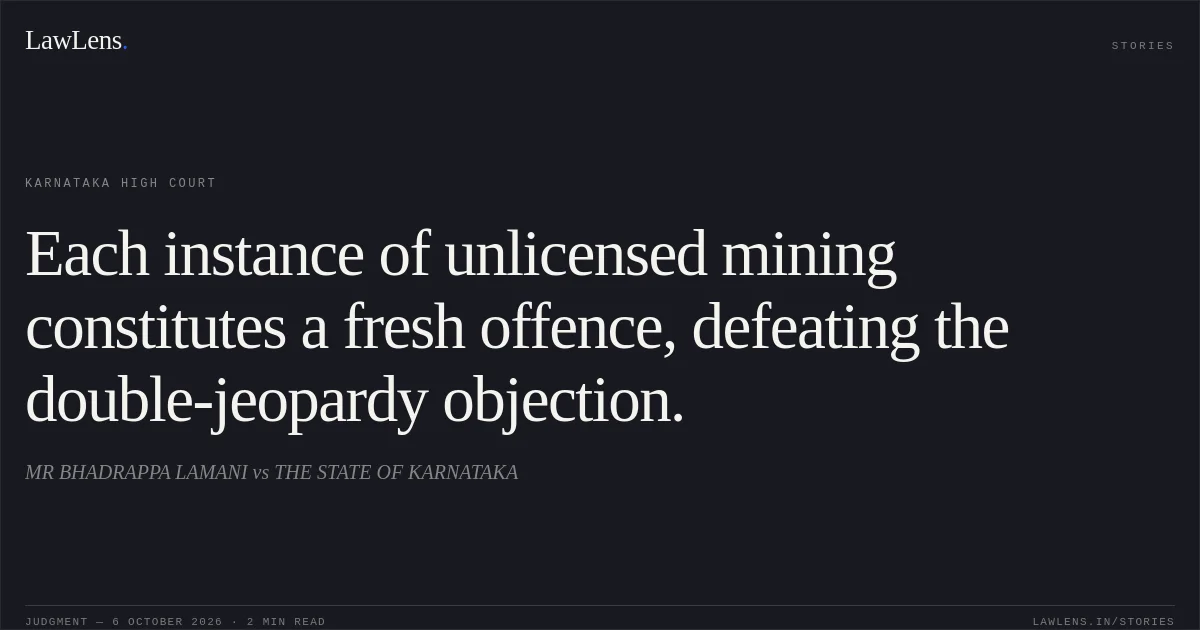
Source reference: p. 15–17It reasoned that repeated mining activity without permission could constitute a fresh offence on each occasion.
Source reference: p. 14–17The Court also held that, following State reorganisation, the law applicable in Karnataka governed the petitioner’s activities, notwithstanding the area’s description as Bombay-Karnataka.
Source reference: p. 13–16On authority to complain, it relied on the notification placed before it and considered the SIT Head entitled to act for the Government in relation to matters within the SIT’s remit.
Source reference: p. 17–18The petitioner invoked Article 20(3), but the Court rejected that contention; it did not separately analyse the distinction between that provision and the constitutional protection against double jeopardy.
Source reference: no citationReasoning
The Court rejected the Bombay Land Revenue Code argument because State reorganisation made Karnataka law applicable to the quarrying activity.
Source reference: p. 13–16It found no bar under Section 300 CrPC because the earlier matter had not resulted in a conviction or acquittal after trial and because each instance of unlicensed mining could amount to a fresh offence.
Source reference: p. 14–17It also accepted that the notification authorised the complainant and considered the SIT Head competent to file a complaint on the Government’s behalf.
Source reference: p. 17–18The Court declined to decide the remaining merits so as not to prejudice the pending trial.
Source reference: p. 18Holding
The High Court dismissed the writ petition, declining to quash the cognizance order or the proceedings in Special C.C. No. 679/2020.
It expressly kept all contentions open for the petitioner to raise at trial in accordance with law.
Source reference: p. 18Acts & Sections Cited
18 provisions across 5 statutes referred to in this judgment. Each provision opens on LawLens.
Code of Criminal Procedure, 19738
Indian Penal Code, 18605
Prevention of Corruption Act, 19881
Mines and Minerals (Development and Regulation) Act, 19573
General Clauses Act, 18971
Original Court PDF
MR BHADRAPPA LAMANIvsTHE STATE OF KARNATAKA
Click to open original judgment
Original judgment, available to read, download and summarize on LawLens.in