Facts
The appellant (plaintiff) filed a suit for permanent prohibitory and mandatory injunction to restrain the defendants from obstructing a 3-foot wide common passage leading to his property in Up Muhal Kaithu-1, Shimla
Source reference: para 2The plaintiff purchased the property in 1991 and claimed he had acquired a right of way by prescription under Section 15 of the Indian Easements Act through continuous use for over 20 years, and by necessity as no other convenient passage was available
Source reference: para 2The defendants contested the suit, asserting the existence of alternative passages and denying the existence of the disputed path on their land
Source reference: para 3The Trial Court decreed the suit in favor of the plaintiff
Source reference: para 7However, the First Appellate Court reversed this decision, holding that the passage was not properly identified and the plaintiff failed to establish easementary rights
Source reference: para 8The plaintiff then approached the High Court in the present second appeal
Source reference: para 9Issues
1. Whether the First Appellate Court committed an error of law by applying the requirements of easement of necessity when the plaintiff had claimed easement by prescription?
Source reference: para 92. Whether the suit path was properly identified in accordance with law?
Source reference: para 9Law Applied
The court applied Section 13 (Easement of Necessity) and Section 15 (Easement by Prescription) of the Indian Easements Act
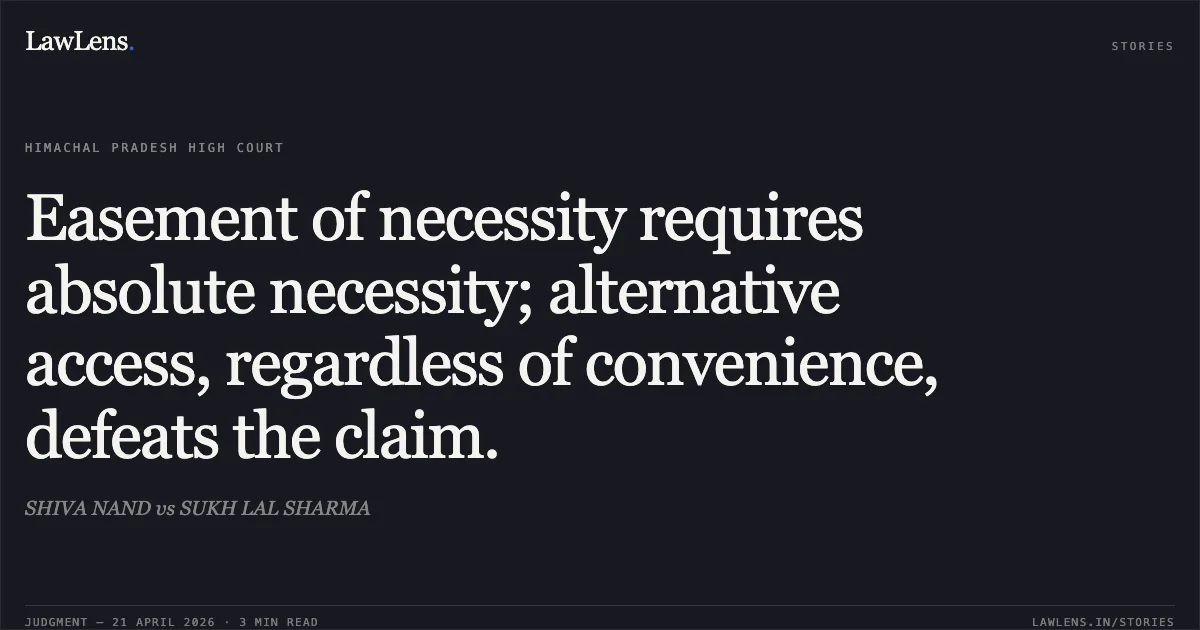
Source reference: para 2, 18It relied on the principle from Thulahalli Kotrabasappa v. Pujari Rangappa, which establishes that an easement of necessity requires absolute necessity (the property cannot be used at all without it) rather than mere convenience
Source reference: para 18Regarding identification, the court followed Savitri Devi v. Gauri Dutt, which mandates that a right of way cannot be claimed unless the path, its direction, and its width are specifically identified in the pleadings and evidence
Source reference: para 29Reasoning
The High Court found that the plaintiff had pleaded both prescription and necessity in his plaint, justifying the Appellate Court's examination of both doctrines
Source reference: para 15-16On the issue of necessity, the court noted the plaintiff's admission in cross-examination that he had an alternative passage through the land of third parties (Ram Prakash and Chauhan), supported by affidavits and his own building plan
Source reference: para 17Since an alternative route existed, the necessity was not "absolute" but merely "convenient," disqualifying the claim under Section 13
Source reference: para 18-19Regarding prescription, the court observed that the 1991 sale deed did not specifically describe the disputed passage
Source reference: para 20Furthermore, the plaintiff’s failure to mention this passage in the building plan submitted to the Municipal Corporation falsified his claim of continuous and open use as a matter of right
Source reference: para 21Finally, the court held the path was not properly identified because the site plans produced were either illegible, lacked the "red color" markings claimed in the pleadings, or did not show a connection to the plaintiff's house
Source reference: para 29-30Holding
The High Court answered both substantial questions of law against the appellant and dismissed the appeal
It held that the plaintiff failed to prove the essential ingredients of easement by prescription or absolute necessity
Source reference: para 25, 28The court further affirmed that the suit must fail due to the lack of specific identification of the passage in the evidence and site plans
Source reference: para 30The judgment and decree of the First Appellate Court, which dismissed the plaintiff's suit, were upheld
Source reference: para 31Acts & Sections Cited
2 provisions across 1 statute referred to in this judgment. Each provision opens on LawLens.
Indian Easements Act, 18822
Original Court PDF
SHIVA NANDvsSUKH LAL SHARMA
Click to open original judgment
Original judgment, available to read, download and summarize on LawLens.in