Facts
The first respondent (student) discontinued his dental course at the appellant’s self-financing college due to illness and subsequently joined an engineering college
Source reference: para. 10At the time of admission, the student had executed an agreement bond; Clause 6 of said bond required payment of discontinuation fees, while Clause 7 allowed for the recovery of dues as arrears of land revenue
Source reference: para. 3, 14The student filed a writ petition seeking to declare Clause 6 null and void and for the return of his original certificates
Source reference: para. 3The learned Single Judge rejected the prayer to declare the clause illegal but directed the college to return the original certificates within one week, allowing the college to recover dues through legal channels
Source reference: para. 3The college appealed, contending that as a self-financing institution, it should be permitted to retain certificates as security for the unpaid discontinuation fees
Source reference: para. 4, 6Issues
Whether an educational institution is entitled to withhold the original certificates of a student as security for the payment of discontinuation fees or bond amounts.
Source reference: para. 9Law Applied
The court relied on the principle that educational certificates are not "marketable commodities" and cannot be subject to a general lien under Section 171 of the Indian Contract Act
Source reference: para. 12It applied the Division Bench ruling in Nirmal M. v. The State of Tamil Nadu (W.A.No.2256 of 2022), which held that institutions must return certificates and seek recovery of damages through civil suits or other legal remedies
Source reference: para. 12The court further cited R.D. Saxena v. Balram Prasad Sharma (2000) and Islamic Academic Education v. State of Karnataka (2003), establishing that no institution is authorized to maintain custody of original documents solely to recover fees
Source reference: para. 12, 13the court noted that the University Grants Commission (Grievance Redressal) Regulations, 2018, classifies the withholding of documents as a 'grievance'
Source reference: para. 11Reasoning
The Court analyzed the appellant’s contention that mid-course discontinuation results in revenue loss for self-financing colleges
Source reference: para. 6the Court reasoned that the right to recover money is distinct from the right to possess original documents.
Source reference: para. 14It noted that Clause 7 of the parties' own agreement provided a specific mechanism for recovery—as arrears of land revenue
Source reference: para. 14Following established precedents, the Court observed that because certificates are not marketable goods, they cannot be retained as leverage for debt recovery
Source reference: para. 12The Court found that the learned Single Judge correctly balanced the interests of both parties by upholding the validity of the recovery clause while ensuring the student's progress in education was not stalled by the illegal withholding of documents
Source reference: para. 11, 14, 15Holding
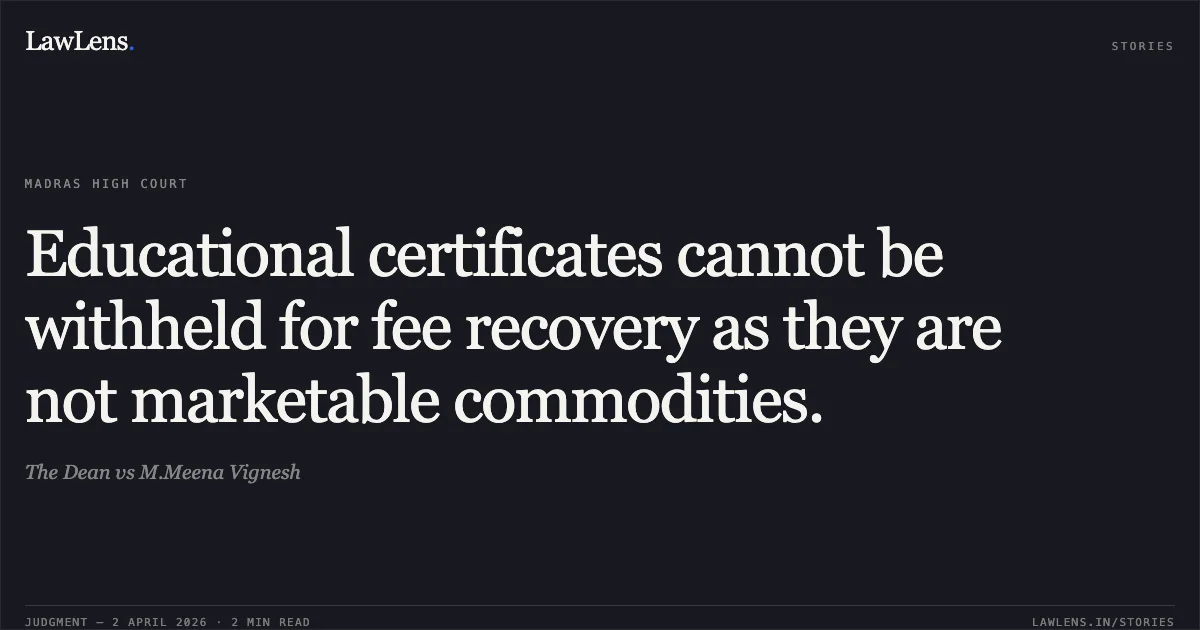
The Court held that educational institutions have no legal right to withhold original certificates to enforce fee payments or bond conditions
The High Court dismissed the writ appeal, affirming the Single Judge's order. The appellant college was directed to return the first respondent’s certificates and documents forthwith, while remaining at liberty to pursue the recovery of discontinuation fees as arrears of land revenue or through other appropriate legal remedies
Source reference: para. 14, 16Acts & Sections Cited
1 provisions across 1 statute referred to in this judgment. Each provision opens on LawLens.
Indian Contract Act, 18721
Original Court PDF
The DeanvsM.Meena Vignesh
Click to open original judgment
Original judgment, available to read, download and summarize on LawLens.in


