Facts
The appellant, an individual proprietor and owner of immovable property in Jaipur, had leased the premises under a deed dated 1 May 2004 to Ritnand Balved Education Foundation.
Source reference: pp. 1–3The Department received information from the Income Tax Department indicating that the appellant had income reported under sections 194(C) and 194(J) of the Income-tax Act but had not filed service-tax returns for 2012–13 or paid service tax.
Source reference: pp. 1–3A demand of ₹2,15,769, with interest and penalties under sections 70 and 78 of the Finance Act, 1994, was proposed by show-cause notice dated 25 April 2018.
Source reference: pp. 1–3The demand was confirmed by the adjudicating authority on 14 May 2019 and upheld by the Commissioner (Appeals) on 16 June 2020.
Source reference: pp. 1–3Before the Tribunal, the appellant claimed exemption under clause 9(b) of Notification No. 25/2012-ST on the ground that the premises were rented for imparting education.
Source reference: pp. 1–3The Department contended that the lease deed did not establish that the lessee was an educational institution and that the extended limitation period was validly invoked.
Source reference: pp. 1–3Issues
1. Whether the appellant was entitled to exemption under clause 9(b) of Notification No. 25/2012-ST for renting immovable property to Ritnand Balved Education Foundation for purposes connected with education.
Source reference: pp. 3–62. Whether the extended period of limitation could be invoked on the allegation that the appellant had suppressed relevant facts by not filing service-tax returns or paying service tax.
Source reference: pp. 6–73. What relief, if any, was payable to the appellant regarding the demand and penalties.
Source reference: p. 7Law Applied
Clause 9 of Notification No. 25/2012-ST exempted services provided to or by an educational institution in respect of education exempt from service tax, including renting of immovable property under clause 9(b).
Source reference: pp. 3–7The eligibility for an exemption notification rests on the assessee, and exemption notifications must be strictly construed, as held by the Supreme Court in Commissioner of Customs (Import), Mumbai v. Dilip Kumar and Company.
Source reference: pp. 3–7For invoking the extended limitation period, mere non-payment of tax is insufficient; there must be a positive act of suppression or intent to evade tax, consistent with Pushpam Pharmaceuticals Company v. Collector of Central Excise, Bombay.
Source reference: pp. 3–7The relevant service-tax liability, interest and penalties arose under the Finance Act, 1994, including sections 70 and 78.
Source reference: pp. 3–7Reasoning
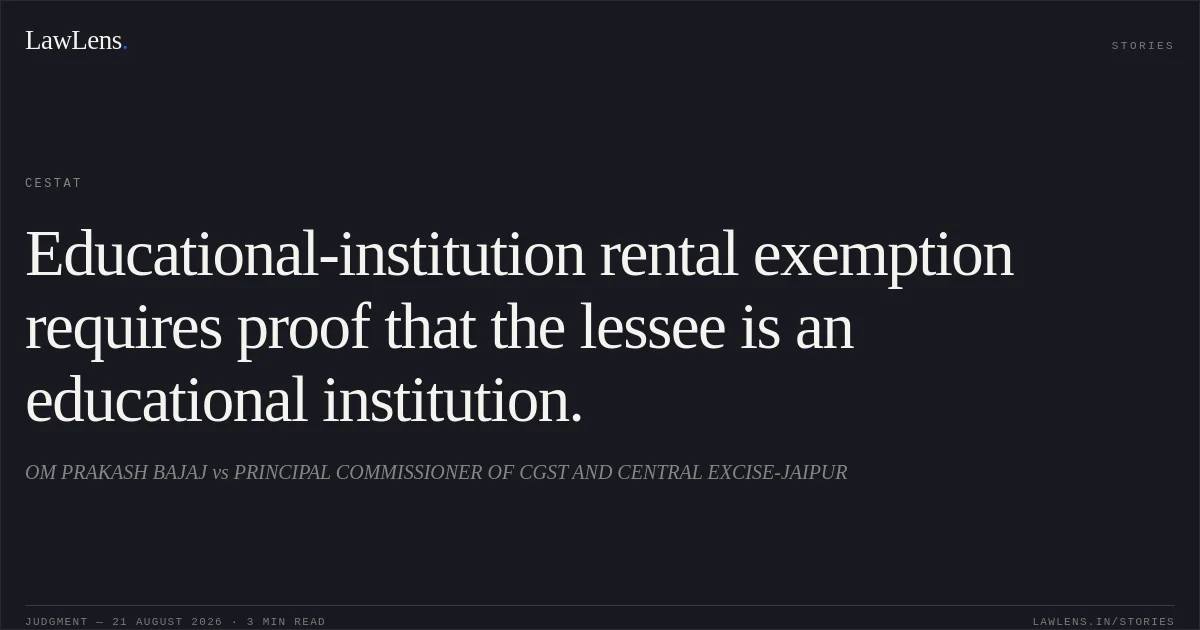
The Tribunal held that the service involved was renting of immovable property, but exemption under clause 9(b) was available only where the service was provided to or by an educational institution in respect of exempt education.
Source reference: pp. 4–7The lease deed identified the lessee as Ritnand Balved Education Foundation, a society, but did not establish that it was an educational institution.
Source reference: pp. 4–7Further, clause 4(a) permitted use of the premises for office or commercial purposes, education, counselling, research and student hostel facilities; therefore, education was not shown to be the exclusive or determinative purpose of the tenancy.
Source reference: pp. 4–7The certificate produced from Amity University, Rajasthan, could not cure the evidentiary deficiency because Amity was not the lessee, the certificate did not establish its legal relationship with the lessee, and it was issued after the Commissioner (Appeals)’ order.
Source reference: pp. 4–7Applying the strict-construction principle, the Tribunal concluded that the appellant had failed to discharge the burden of proving exemption eligibility.
Source reference: pp. 4–7On limitation, however, the Tribunal reiterated that non-payment alone does not establish suppression or intent to evade.
Source reference: pp. 4–7Holding
The Tribunal denied the benefit of exemption under clause 9(b) of Notification No. 25/2012-ST because the appellant failed to prove that the premises were rented to an educational institution for exempt educational purposes.
It nevertheless held that the demand could not be sustained in full on the extended limitation period: the portion falling beyond five years from the relevant date was set aside, while the demand for the remaining period, including the normal limitation period, was confirmed.
Source reference: p. 7The penalties were proportionately reduced.
Source reference: p. 7The appeal was accordingly partly allowed.
Source reference: p. 7Acts & Sections Cited
7 provisions across 3 statutes referred to in this judgment. Linked provisions open on LawLens.
Finance Act, 20121
Income Tax Act, 19612
Finance Act, 19944
Original Court PDF
OM PRAKASH BAJAJvsPRINCIPAL COMMISSIONER OF CGST AND CENTRAL EXCISE-JAIPUR
Click to open original judgment
Original judgment, available to read, download and summarize on LawLens.in