Facts
The Petitioners were elected as Sarpanch and Members of Grampanchayat Kshetra Mahuli in December 2022.
Source reference: para. 3, 6As they contested from reserved categories, Section 10-1A of the Maharashtra Village Panchayats Act, 1959 required them to submit caste validity certificates within 12 months of the election result.
Source reference: para. 4Although the Petitioners obtained their validity certificates between June and November 2023, they failed to produce documentary proof of submitting them to the Tahsildar within the stipulated 12-month period ending July 9, 2024.
Source reference: para. 7, 8, 10Consequently, the Collector, Satara, disqualified them via an order dated February 11, 2025.
Source reference: para. 2, 10During the pendency of proceedings, the State enacted the Maharashtra Temporary Extension Act, 2025, which extended the submission deadline for certain candidates.
Source reference: para. 14The Petitioners sought restoration of their posts based on this new legislation.
Source reference: para. 15Issues
1. Whether the Petitioners are entitled to the benefit of the Maharashtra Temporary Extension Acts of 2023 and 2025 for restoration of their seats despite the initial failure to submit validity certificates within the mandatory 12-month period.
Source reference: para. 182. Whether the extension of time under Section 3(1) of the Act of 2025 applies only to cases where applications are "pending" before the Scrutiny Committee, or also to those who have obtained the certificate but failed to submit it to the authority.
Source reference: para. 17, 33Law Applied
Section 10-1A of the Maharashtra Village Panchayats Act, 1959, which mandates the retrospective termination of election for failure to submit a validity certificate.
Source reference: para. 4, 31Full Bench decision in Anant H. Ulahalkar v. Chief Election Commissioner, holding the time limit to be mandatory.
Source reference: para. 25The non-obstante clause of Section 3 of the Maharashtra Temporary Extension Act, 2025, which serves as a curative and beneficial legislation to mitigate hardships caused by administrative delays.
Source reference: para. 22, 32"Purposive Construction" doctrine as elucidated in Vivek Narayan Sharma v. Union of India.
Source reference: para. 39Interpretive rules for provisos from S. Sundaram Pillai v. V.R. Pattabiraman.
Source reference: para. 36Reasoning
The Court reasoned that the Maharashtra Temporary Extension Act, 2025, being curative in nature, overrides the rigors of the parent statute.
Source reference: para. 31While Respondents argued the Act only applies to pending applications under Section 3(1)(a), the Court held that Section 3(1)(b) specifically protects those whose elections were already "terminated or deemed to have been terminated".
Source reference: para. 22, 33The Court observed that Section 3(2) carves out only two exceptions where the benefit is denied: (i) where bye-elections have already been held, and (ii) where the caste claim was rejected on merits.
Source reference: para. 22, 33, 37Since the Petitioners actually possessed validity certificates and no bye-elections had been conducted for their seats, they did not fall under the exceptions.
Source reference: para. 41, 42Denying protection to those who successfully proved their caste status but committed a procedural delay would defeat the legislative intent of maintaining democratic representation for reserved categories.
Source reference: para. 34, 40Holding
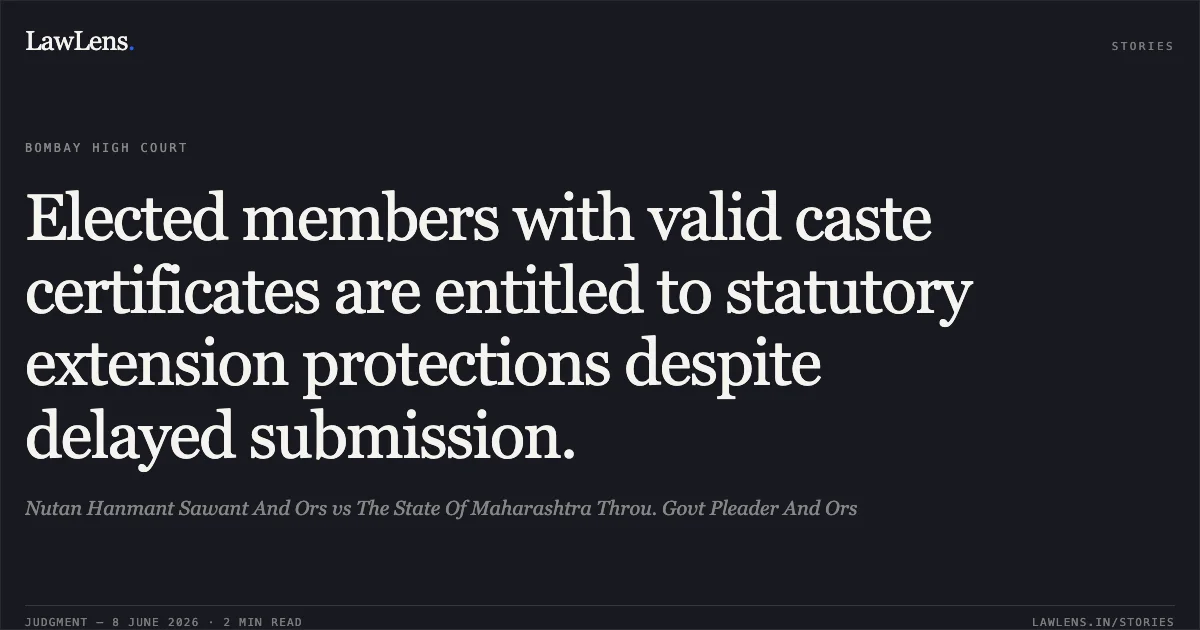
The Court answered the issues in the affirmative, holding that the Petitioners are entitled to the protection of the Maharashtra Temporary Extension Act, 2025.
The Court quashed the Collector’s disqualification order dated February 11, 2025. It directed that the Petitioners be restored to their respective positions as Sarpanch and Members of the Grampanchayat for the remainder of the 2022–2027 term.
Source reference: para. 43, 44, 45Acts & Sections Cited
2 provisions across 1 statute referred to in this judgment. Each provision opens on LawLens.
Maharashtra Zilla Parishads and Panchayat Samitis Act, 19612
Original Court PDF
Nutan Hanmant Sawant And OrsvsThe State Of Maharashtra Throu. Govt Pleader And Ors
Click to open original judgment
Original judgment, available to read, download and summarize on LawLens.in