Facts
During the 2014 Lok Sabha bye-election for the Bellary constituency, the Election Commission’s flying squad raided the respondent’s residence and business premises pursuant to an anonymous complaint alleging possession of counterfeit currency intended for bribing voters.
Source reference: pp. 3–5, paras 3–4The authorities seized a laptop, cheque books, loose cheque leaves, a pen drive and ₹20,48,355 in cash.
Source reference: pp. 3–5, paras 3–4An FIR, Crime No. 0107 of 2014, was registered under Sections 171-E and 188 of the IPC.
Source reference: pp. 3–5, paras 3–4The Karnataka High Court quashed the FIR on the ground that it did not specify the intended recipient of the bribe or the proposed mode of bribery.
Source reference: pp. 3–5, paras 3–4The State challenged that order before the Supreme Court.
Source reference: pp. 3–5, paras 3–4During the proceedings, the Court examined the Election Commission’s procedures for seizure, investigation and prosecution of election-related offences, including the use of black money and inducements during elections.
Source reference: pp. 3–5, paras 3–4Issues
1. Whether the Election Commission possesses constitutional authority under Article 324 to regulate and enforce measures against the use of cash, gifts, liquor and other inducements during elections, subject to existing legislation.
Source reference: pp. 12–17, paras 10–112. Whether the Election Commission’s procedures for seizure of cash and other assets adequately safeguard citizens against arbitrary seizure and require written reasons establishing a prima facie nexus with a suspected electoral offence.
Source reference: pp. 35–38, para 17.13. Whether election-related FIRs and investigations should be subject to prescribed reporting, investigation and prosecutorial safeguards to ensure timely and effective enforcement.
Source reference: pp. 39–40, para 17.34. Whether cases relating to electoral offences may be withdrawn by State authorities without enhanced judicial scrutiny, particularly where the accused are candidates, MPs or MLAs.
Source reference: pp. 41–44, para 17.45. What directions should be issued to secure free and fair elections and prevent the use of black money and other inducements in the electoral process.
Source reference: pp. 44–46, paras 18–19Law Applied
Free and fair elections are an essential component of democracy and the constitutional scheme, and the rule of law, democracy and electoral integrity are interdependent.
Source reference: pp. 6–12, paras 5–9Article 324(1) confers on the Election Commission wide powers of superintendence, direction and control over elections, including the power to act in legislative gaps, but those powers must conform to valid legislation enacted by Parliament or the State Legislature.
Source reference: pp. 12–17, paras 10–11The Court relied on Mohinder Singh Gill v. Chief Election Commissioner, (1978) 1 SCC 405; A.C. Jose v. Sivan Pillai, (1984) 2 SCC 656; and Union of India v. Association for Democratic Reforms, (2002) 5 SCC 294.
Source reference: pp. 12–17, paras 10–11The Court relied on Indira Nehru Gandhi v. Raj Narain, 1975 Supp SCC 1, and Rameshwar Prasad (6) v. Union of India, (2006) 2 SCC 1, for the principle that electoral choice must be free, fair and untainted by improper influence.
Source reference: pp. 8–12, paras 6–9For withdrawal of prosecutions, the Court applied Section 321 CrPC and the principles in State of Kerala v. K. Ajith, (2021) 17 SCC 318, requiring an independent prosecutorial decision and judicial satisfaction that withdrawal is bona fide, in the public interest and consistent with the administration of justice.
Source reference: pp. 41–44, para 17.4It also relied on Ashwini Kumar Upadhyay v. Union of India, (2021) 20 SCC 599, concerning High Court scrutiny of withdrawal of cases against MPs and MLAs.
Source reference: pp. 41–44, para 17.4Reasoning
The Court treated the use of black money and material inducements as a direct threat to the voter’s freedom of choice and, consequently, to the constitutional requirement of free and fair elections.
Source reference: pp. 2–3, paras 1–2; pp. 6–12, paras 5–9Since Article 324 gives the Election Commission responsibility for the superintendence and control of the electoral process, the Commission may deploy flying squads, static surveillance teams, seizure procedures and expenditure-monitoring mechanisms, provided they operate within statutory limits and follow procedural safeguards.
Source reference: pp. 12–17, paras 10–11On examining the existing SOPs, the Court found that seizure was linked to reasonable suspicion, video recording, preparation of a panchnama, the presence of an Executive Magistrate in relevant cases and prompt registration of an FIR; however, it held that the officer must expressly record the information and reasons showing the suspected nexus between the seized property and an electoral offence, thereby reducing arbitrary interference with ordinary citizens.
Source reference: pp. 35–38, para 17.1Given the substantial pendency of election-related cases and the possibility that prosecutions may be delayed or withdrawn after a change in political power, the Court considered timely investigation, periodic reporting and expeditious adjudication necessary to preserve both electoral accountability and the rights of persons falsely implicated.
Source reference: pp. 25–30, 39–44, paras 14 and 17.3–17.4Withdrawal of such prosecutions could therefore not be treated as a routine executive decision; it remained subject to the independent judgment of the Public Prosecutor and judicial approval, with High Court approval made mandatory for cases concerning candidates in a particular election cycle.
Source reference: pp. 41–44, para 17.4Holding
The Supreme Court recognised the Election Commission’s constitutional responsibility and authority to curb black money, cash distribution and other inducements that undermine electoral integrity.
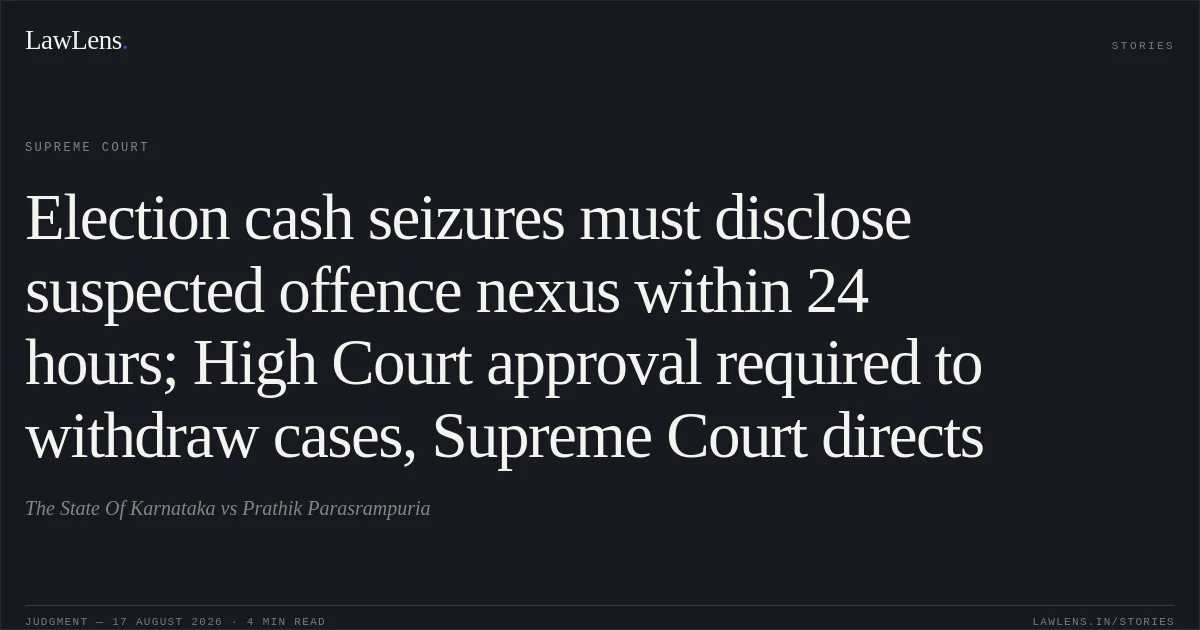
It directed that every seizure of cash or other assets be reported within 24 hours to the District Magistrate, Additional District Magistrate or competent court, together with written reasons disclosing the prima facie nexus with the suspected electoral offence.
Source reference: p. 44, para 18(a)Investigations into election-related FIRs should ordinarily be completed within one year; any delay must be reasoned and communicated to the Election Commission, and quarterly investigation-status reports must be submitted through the designated police nodal mechanism.
Source reference: pp. 44–45, para 18(b)–(c)Seizures exceeding ₹10 lakh by Static Surveillance Teams must be reported to the income-tax authorities.
Source reference: p. 45, para 18(d)High Courts were requested to designate courts for expeditious disposal of cases against candidates, MPs and MLAs.
Source reference: p. 45, para 18(e)Withdrawal of cases against candidates in a particular election cycle was held to require the approval of the concerned High Court.
Source reference: p. 45, para 18(f)The Election Commission and the respective State Governments were directed to file compliance reports by 18 November 2026.
Source reference: p. 46, para 19Acts & Sections Cited
5 provisions across 4 statutes referred to in this judgment. Each provision opens on LawLens.
Indian Penal Code, 18601
Bharatiya Nyaya Sanhita, 20232
Code of Criminal Procedure, 19731
Police-Forces (Restriction of Rights) Act, 19661
Original Court PDF
The State Of KarnatakavsPrathik Parasrampuria
Click to open original judgment
Original judgment, available to read, download and summarize on LawLens.in