Facts
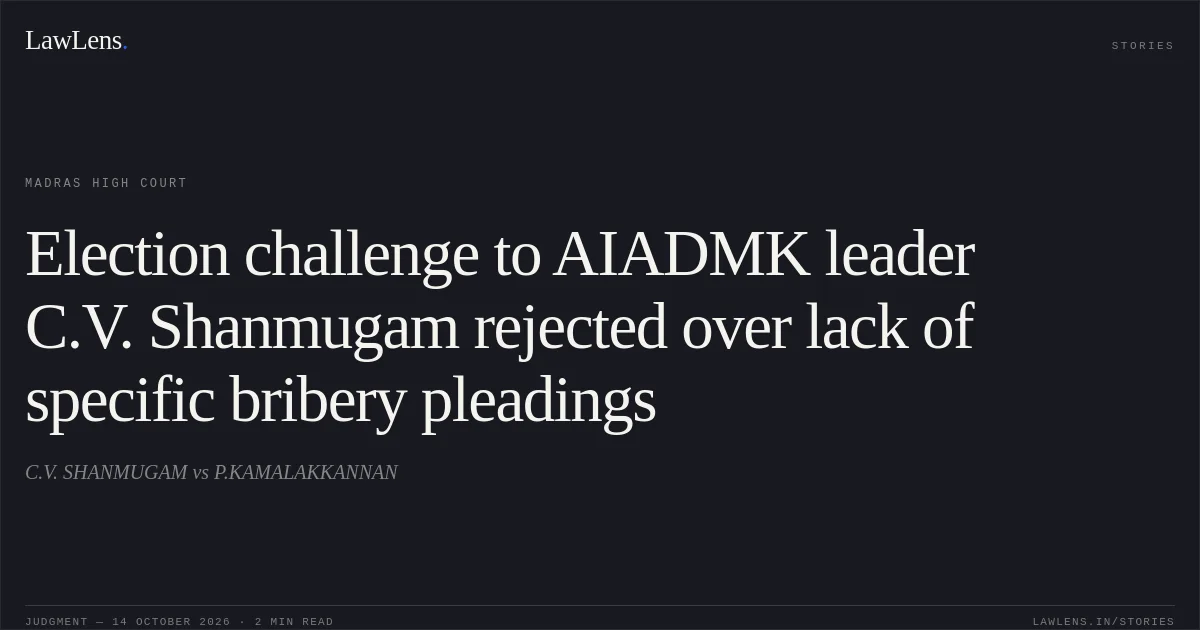
The election petitioner challenged the returned candidate’s election from the Mailam Assembly Constituency, alleging corrupt practice under Section 123(1) of the Representation of the People Act, 1951 (“the Act”).
Source reference: no citationThe petition alleged that, on 19 April 2026, party functionaries distributed ₹1,000 in cash and coupons promising ₹2,000 to voters at Kongarappattu, with the returned candidate’s knowledge and consent; it also relied on alleged eyewitnesses and video recordings
Source reference: pp. 3–4The returned candidate applied to reject the election petition, contending that it lacked the material facts and particulars required by Section 83 and did not disclose a cause of action
Source reference: pp. 5–8The election petitioner opposed the application, arguing that the pleadings disclosed a triable claim and that evidentiary disputes should be determined at trial.
Source reference: pp. 9–11Issues
Whether the election petition pleaded the material facts and full particulars necessary to constitute the alleged corrupt practice of bribery and disclose a complete cause of action under the Act
Source reference: pp. 12–17Whether the election petition should therefore be rejected at the threshold under Order VII Rule 11 of the Code of Civil Procedure
Source reference: pp. 19–23Law Applied
Section 83(1)(a) of the Act requires a concise statement of the material facts supporting an election petition; Section 83(1)(b) requires full particulars of any alleged corrupt practice.
Source reference: p. 12Material facts are the foundational facts necessary to establish the cause of action, and their omission is not cured by later evidence or by adding particulars after limitation.
Source reference: p. 22In C.P. John v. Babu M. Palissery, (2014) 10 SCC 547, the Supreme Court held that a corrupt-practice pleading must identify, with sufficient specificity, the persons involved and the nature, date, time and place of the alleged acts.
Source reference: pp. 18–20Senthilbalaji v. A.P. Geetha, (2023) 16 SCC 279, reiterates that, given the quasi-criminal character and serious consequences of a corrupt-practice allegation, omission of material facts may warrant rejection at the threshold.
Source reference: p. 21The petition invoked Sections 100(1)(b), 100(1)(d)(ii) and 123(1) of the Act.
Source reference: pp. 2–4Reasoning
The Court held that the petition did not adequately identify who distributed the cash or coupons, the voters who received them or their approximate number, or the amount and number of coupons distributed.
Source reference: pp. 15–17It also found insufficient pleaded facts connecting the alleged distributors to the returned candidate or establishing his knowledge, consent or authorisation.
Source reference: pp. 15–17The allegations concerning distribution in other villages were also considered insufficiently specific, and the video material did not supply the missing foundational pleadings.
Source reference: pp. 16–17The Court further noted that the petitioner had not personally witnessed the events and relied on information from others and an internet-sourced video; it also referred to the petitioner’s political-party role and the returned candidate’s victory margin.
Source reference: pp. 14–15Concluding that the petition lacked essential material facts, including a sufficient factual basis for the pleaded statutory grounds, the Court found that it disclosed no complete cause of action.
Source reference: pp. 22–23Holding
The Court answered that the election petition did not plead the material facts necessary to sustain the alleged corrupt practice or disclose a complete cause of action.
It allowed the returned candidate’s Original Application and rejected E.L.P. No. 35 of 2026.
Source reference: p. 23Acts & Sections Cited
7 provisions across 2 statutes referred to in this judgment. Each provision opens on LawLens.
Representation of the People Act, 19516
Bharatiya Sakshya Adhiniyam, 20231
Original Court PDF
C.V. SHANMUGAMvsP.KAMALAKKANNAN
Click to open original judgment
Original judgment, available to read, download and summarize on LawLens.in