Facts
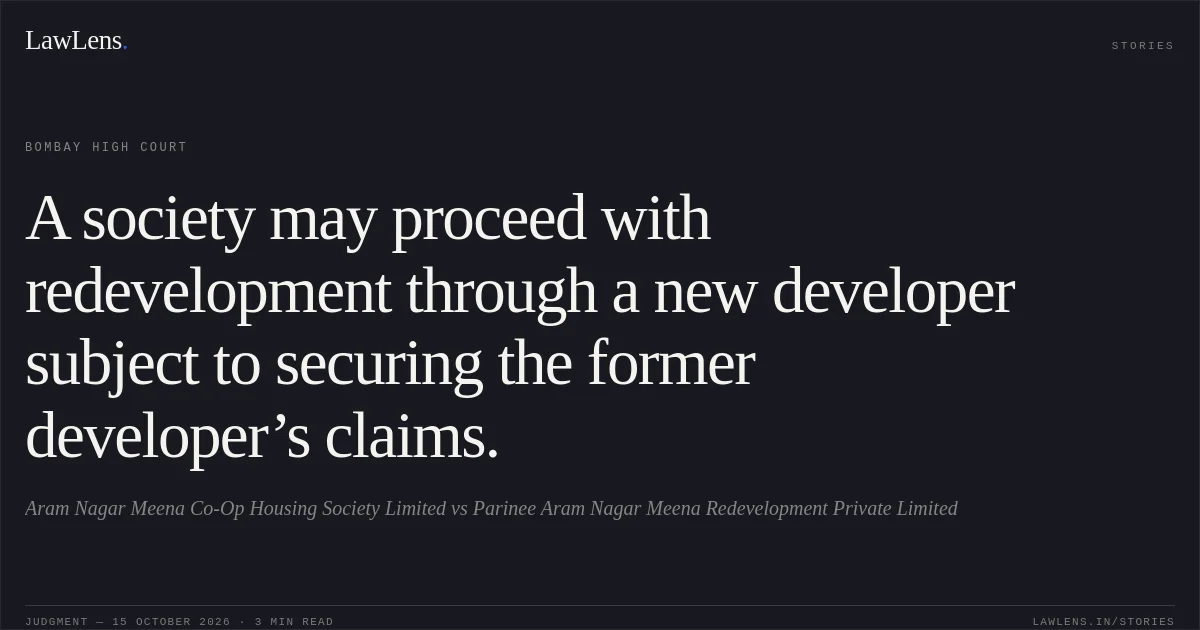
The dispute arose from a development agreement dated 10 December 2021 between the Society and the Developer for redevelopment of the Society’s property.
Source reference: no citationAfter seeking additional FSI from MHADA, the Society terminated the agreement by notice dated 23 November 2024.
Source reference: no citationThe Society sued for a declaration that the agreement and power of attorney had been validly terminated; the Developer sued for declarations that they remained binding and for specific performance or, alternatively, damages of ₹350 crore.
Source reference: no citationThe Society subsequently entered a development agreement with a new developer.
Source reference: no citationThe Court considered together the Developer’s application to restrain the Society from engaging another developer, the Society’s application for redevelopment-related relief, and the new developer’s application to modify an earlier interim order.
Source reference: paras. 1–7, pp. 4–7Issues
Whether, at the interim stage, the Society’s termination of the 2021 development agreement appeared valid, having regard to the parties’ contractual termination procedure, the Society’s requests for additional FSI, and the subsequent extension of timelines.
Source reference: paras. 25–32, pp. 19–24Whether the Society could proceed with redevelopment through the new developer while the Developer’s challenge to termination remained pending, and, if so, on what conditions.
Source reference: paras. 36–40, pp. 26–31Law Applied
Sections 51 and 52 of the Indian Contract Act, 1872 govern reciprocal promises: where contractual performance depends on reciprocal conditions, delay cannot necessarily be attributed to one party without considering whether the other party performed or was ready to perform its corresponding obligation.
Source reference: para. 29, p. 22Section 63 permits a promisee to extend the time for performance; the Court considered the Society’s communications, including its letter of 10 September 2024, as prima facie extending the Developer’s time.
Source reference: para. 31, pp. 23–24The parties’ agreed termination procedure in clause 21 required a cure notice before termination; the Court considered whether the Society had followed that procedure.
Source reference: paras. 31–32, pp. 23–24Interim relief required assessment of the prima facie case and balance of convenience, while the competing hardship arising from the members’ displacement and the Developer’s monetary claim informed the terms of relief.
Source reference: paras. 35–39, pp. 25–29The Court distinguished Swashray Co-op Housing Society v. Shanti Enterprises, finding it of no assistance to the Society on the facts before it.
Source reference: para. 30, p. 23Reasoning
The Society continued to seek additional FSI after executing the agreement, and the Court considered it plausible that uncertainty over the FSI to be used had delayed finalising plans and obtaining the IOD.
Source reference: paras. 26–32, pp. 19–24It also noted that the Developer had shown willingness to make premium payments within the period specified by MHADA, that the Society had communicated revised timelines, and that the termination notice did not address those timelines.
Source reference: paras. 26–32, pp. 19–24The Society had not issued the cure notice contemplated by clause 21.
Source reference: paras. 26–32, pp. 19–24These circumstances supported a strong prima facie case that termination was not valid and that the later development agreement had been executed while the earlier agreement remained subsisting.
Source reference: paras. 26–32, pp. 19–24Nevertheless, because the Society’s members were dishoused and redevelopment was needed, the Court permitted redevelopment through the new developer, while requiring safeguards for the Developer’s pleaded monetary claim and expenditures.
Source reference: paras. 36–39, pp. 26–29Holding
The Court did not finally determine the validity of the termination; it held only that the Developer had a strong prima facie case and that the Society had not established a prima facie basis for its requested blanket relief.
It permitted the Society to complete redevelopment through the new developer, subject to the Society and new developer depositing ₹3,38,81,888 within four weeks; filing undertakings concerning the approved plans and area statement; and the new developer depositing 25% of consideration received from the free-sale component within four weeks of receipt.
Source reference: paras. 40–41, pp. 30–32Deposited amounts are to be invested in fixed deposits, remain subject to the outcome of the suits, and be held until their disposal or further order.
Source reference: paras. 40–41, pp. 30–32Failure to comply with the conditions automatically cancels the permission to proceed with redevelopment.
Source reference: paras. 40–41, pp. 30–32All three interim applications were disposed of without an order as to costs.
Source reference: paras. 40–41, pp. 30–32Acts & Sections Cited
3 provisions across 1 statute referred to in this judgment. Each provision opens on LawLens.
Indian Contract Act, 18723
Original Court PDF
Aram Nagar Meena Co-Op Housing Society LimitedvsParinee Aram Nagar Meena Redevelopment Private Limited
Click to open original judgment
Original judgment, available to read, download and summarize on LawLens.in