Facts
The petitioner allotted shares on four occasions between 2006 and 2008 but did not pay the requisite stamp duty at the time. On 22 June 2016, it applied under Section 31 of the Indian Stamp Act, 1899, for determination of the duty payable.
Source reference: pp. 1–3, paras. 1–8The Collector directed payment of ₹1,90,430 in stamp duty and imposed a penalty of ₹14,00,000. On appeal, the penalty was reduced to ₹12,00,000.
Source reference: pp. 1–3, paras. 1–8The petitioner challenged that penalty, submitting that no notice had preceded its application and that it would accept a penalty up to twice the duty.
Source reference: pp. 1–3, paras. 1–8Issues
Whether the penalty imposed under Section 40(1)(b) of the Indian Stamp Act, 1899, was a proper exercise of the Collector’s discretion, given the delay and the absence of mala fides or an intention to evade stamp duty.
Source reference: pp. 3–4, paras. 8–10Whether the penalty should be reduced to twice the amount of stamp duty payable.
Source reference: pp. 3–4, paras. 7, 11Law Applied
Section 31 of the Indian Stamp Act, 1899, provides for an application to the Collector for determination of the proper duty. Under Section 40(1)(b), the Collector has discretion to impose a penalty of up to ten times the proper duty.
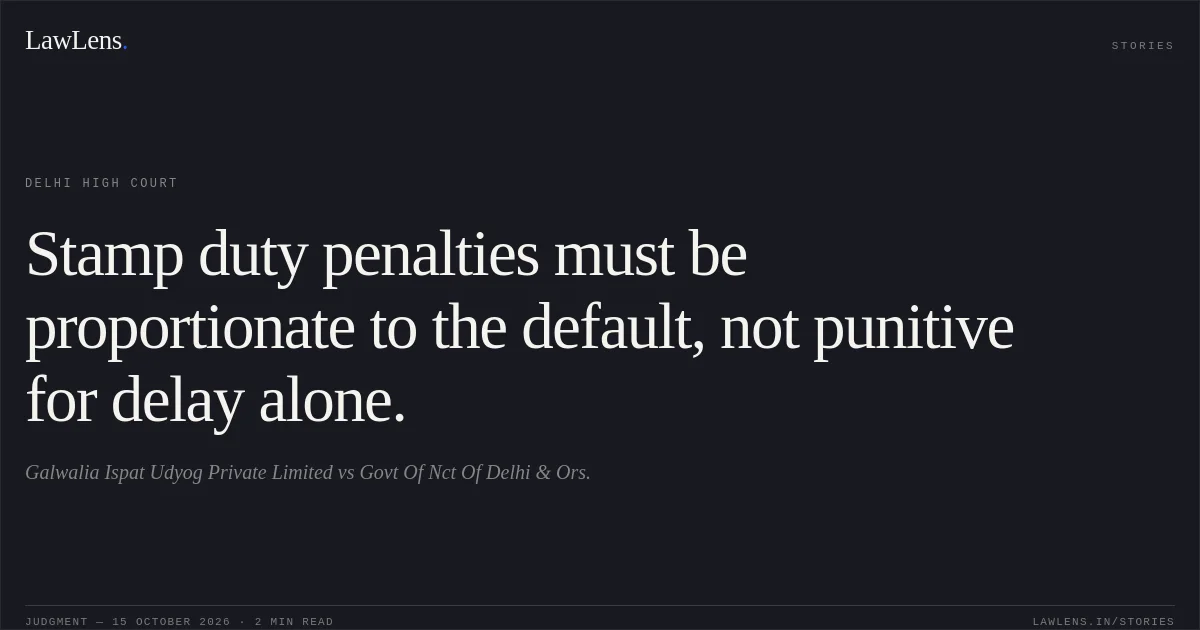
Source reference: p. 3, para. 9That discretion must be exercised judiciously and reasonably, not arbitrarily or oppressively; the penalty should be proportionate to the default and should account for aggravating circumstances such as fraud, deceit, or intentional deprivation of State revenue.
Source reference: p. 3, para. 9Relying on Trustees of H.C. Dhanda Trust v. State of Madhya Pradesh & Ors., Civil Appeal Nos. 3195–3196 of 2020, the Court noted that a penalty is intended to deter, not to exact retribution.
Source reference: p. 3, para. 9Reasoning
Although the petitioner’s application was delayed, it had itself approached the authority to have the duty determined, and the record showed that no notice had been issued before it did so.
Source reference: pp. 3–4, paras. 9–11The Court found no mala fides or intention to deceive or evade payment. In those circumstances, a penalty of ₹12,00,000 was not justified merely by the fact of delay; the appropriate penalty had to reflect a proportionate exercise of the statutory discretion.
Source reference: pp. 3–4, paras. 9–11Holding
The Court modified the impugned order and directed the petitioner to pay ₹1,90,430 in stamp duty and ₹3,80,860 in penalty—twice the duty—within four weeks.
The petition and pending applications were disposed of accordingly.
Source reference: p. 4, paras. 11–12Acts & Sections Cited
2 provisions across 1 statute referred to in this judgment. Each provision opens on LawLens.
Indian Stamp Act, 18992
Original Court PDF
Galwalia Ispat Udyog Private LimitedvsGovt Of Nct Of Delhi & Ors.
Click to open original judgment
Original judgment, available to read, download and summarize on LawLens.in