Facts
The petitioner and Respondent No. 1 entered into dealership agreements concerning agricultural equipment, including an agreement dated 21 April 2022.
Source reference: p.2The petitioner alleged that the respondents breached that agreement, leading to arbitration.
Source reference: p.2In the arbitration, the petitioner sought, under Section 27 of the Arbitration and Conciliation Act, 1996 (“A&C Act”), to summon witnesses and was also seeking examination of a handwriting expert.
Source reference: p.2The Sole Arbitrator dismissed the application and closed the petitioner’s evidence, reasoning that the 2022 agreement was the only agreement on record and that the petitioner could not introduce a new defence that it was unsigned or summon the respondent’s officers or documents to prove its case.
Source reference: p.2The petitioner challenged that order under Articles 226 and 227 of the Constitution, asserting that the witnesses were necessary to prove additional documents and that no alternative remedy was available under the A&C Act.
Source reference: p.3Issues
1. Whether the High Court should entertain a writ petition challenging an arbitral tribunal’s procedural order refusing to summon witnesses and closing a party’s evidence.
Source reference: pp.3–52. Whether the petitioner’s grievance could instead be raised in a challenge under Section 34 of the A&C Act after the arbitral award was made.
Source reference: p.5Law Applied
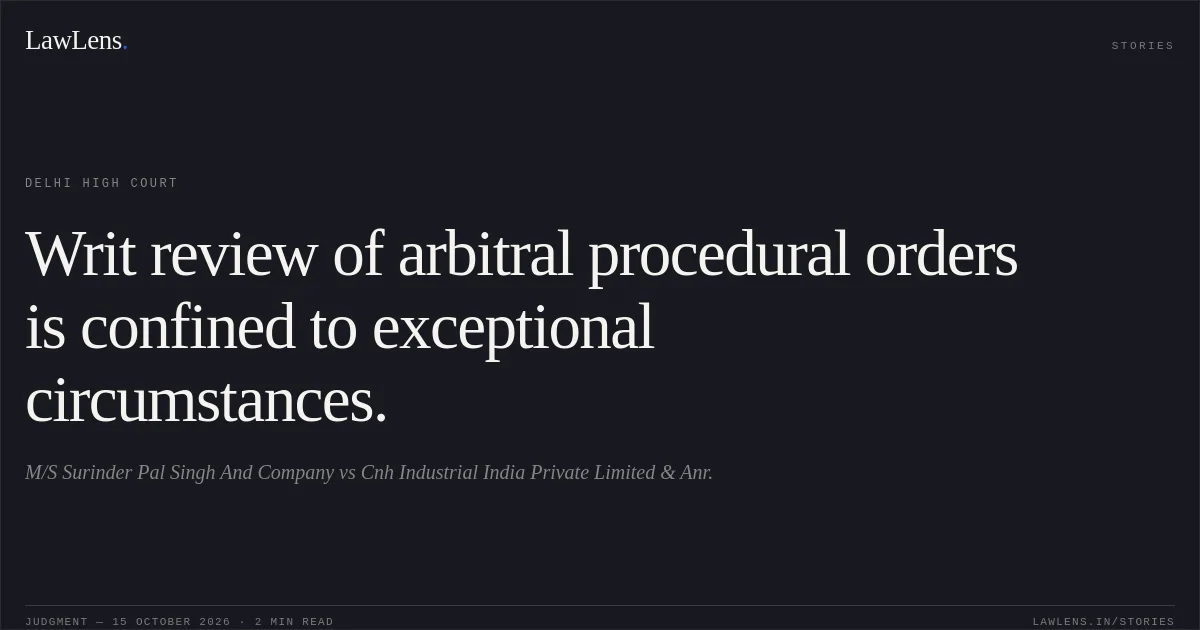
Under Articles 226 and 227 of the Constitution, the High Court’s power to review arbitral tribunal orders is not excluded, but its exercise is exceptionally narrow and requires utmost judicial restraint. Bhaven Construction v. Sardar Sarovar Narmada Nigam Ltd., (2022) 1 SCC 75, recognises that intervention may be warranted in exceptional circumstances, including where a party is left remediless under the statute or clear bad faith is shown.
Source reference: pp.3–4Section 5 of the A&C Act limits judicial intervention to circumstances contemplated by the Act; Section 37 identifies appealable orders, while Section 34 provides a route to challenge an arbitral award. Procedural decisions concerning the conduct of arbitration ordinarily fall within the tribunal’s domain and discretion.
Source reference: pp.4–5Reasoning
The impugned order concerned the conduct of the arbitration: the tribunal had refused the requested summons and closed the petitioner’s evidence. The Court held that such procedural decisions lay within the tribunal’s domain and did not, on the circumstances presented, justify exceptional constitutional intervention.
Source reference: p.5The petitioner could challenge the consequences of the order in proceedings under Section 34 after the award, so the Court was not persuaded that the petitioner was left without a statutory remedy. Intervening before the award, the Court reasoned, risked frustrating the A&C Act’s objective of efficient dispute resolution and minimal judicial intervention.
Source reference: pp.4–5Holding
The Court declined to entertain the writ petition, finding no ground for exceptional intervention in the tribunal’s procedural order. It held that the petitioner could raise its grievance in a challenge under Section 34 after the award.
The petition was dismissed, and the pending applications were disposed of.
Source reference: p.5Acts & Sections Cited
4 provisions across 1 statute referred to in this judgment. Each provision opens on LawLens.
Arbitration and Conciliation Act, 19964
Original Court PDF
M/S Surinder Pal Singh And CompanyvsCnh Industrial India Private Limited & Anr.
Click to open original judgment
Original judgment, available to read, download and summarize on LawLens.in