Facts
The petitioner filed a Writ Petition under Article 226 of the Constitution of India challenging an order dated 23.01.2023 passed by the Sub-Divisional Officer (Respondent No. 9) in an election petition
Source reference: p.1The petitioner sought a recount of votes, but the SDO dismissed the petition
Source reference: p.1The procedural history indicates that the SDO passed the final order based solely on the reply filed by the respondents, without framing issues or allowing the parties to adduce evidence
Source reference: p.2The petitioner approached the High Court seeking to set aside the order and for a direction to conduct a recount
Source reference: p.1Issues
1. Whether the procedure prescribed under Rule 11 of The M.P. Panchayats (Election Petitions, Corrupt Practices and Disqualification for Membership) Rules, 1995, is mandatory for the adjudication of an election petition
Source reference: p.22. Whether the failure to frame issues and record evidence in an election petition trial vitiates the final order
Source reference: p.4Law Applied
Rule 11 of The M.P. Panchayats (Election Petitions, Corrupt Practices and Disqualification for Membership) Rules, 1995, which mandates that every election petition must be enquired into as nearly as possible in accordance with the procedure applicable to the trial of suits under the Code of Civil Procedure (CPC), 1908
Source reference: p.2The court also relied on Section 122 of the M.P. Panchayat Rajya Adhiniyam, 1993, and established precedents including Vadivelu v. Sundaram and Ors. (2000) and Rameshchandra Bhilala vs. Bashir and Ors. (2011), which emphasize that election petitions must be tried as suits
Source reference: p.3-4This includes powers related to discovery, inspection, and the examination of witnesses on oath
Source reference: p.2-3Reasoning
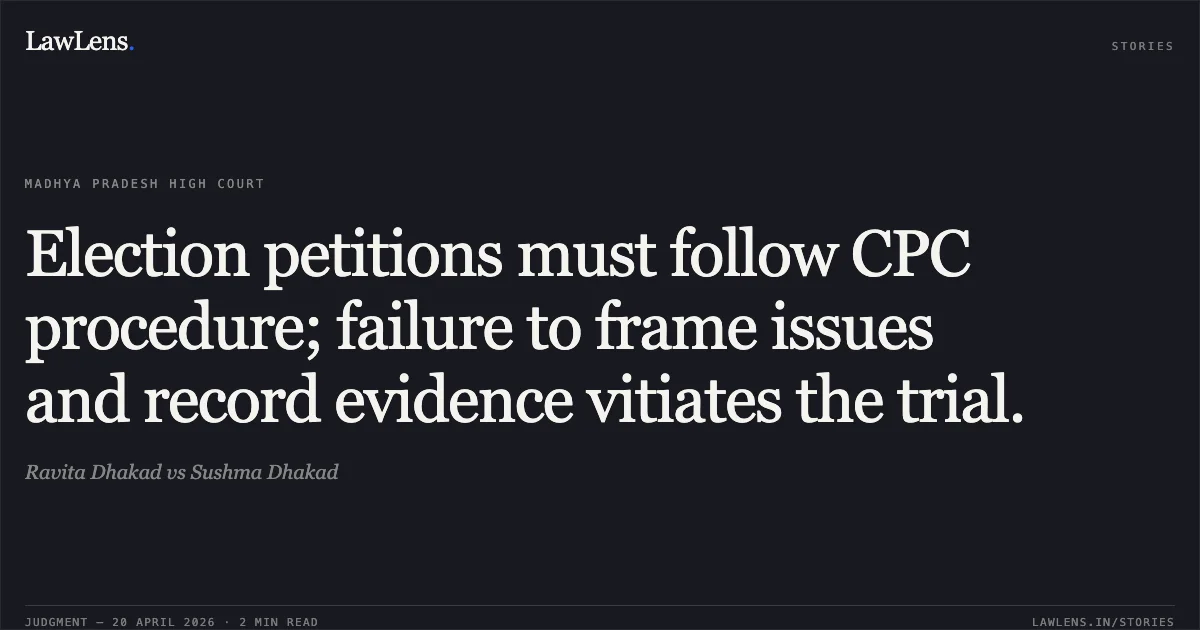
The court observed that under Rule 11, the Specified Officer is required to follow the trial procedure of a civil suit, which necessitates the framing of issues and the recording of evidence
Source reference: p.4In the present case, the SDO passed the final order without performing these mandatory steps, relying only on the pleadings
Source reference: p.2, 4The court determined that the absence of issues and evidence meant the trial was not conducted in accordance with law, thus vitiating the entire proceeding
Source reference: p.4The court further dismissed the respondent's reliance on Hukum Singh Karada vs. Arun Bhimavad, noting it was factually distinguishable and did not override the mandatory procedural requirements of Rule 11 in this context
Source reference: p.5Holding
The court held that the impugned order dated 23.01.2023 was unsustainable and set it aside
The court answered that the procedural requirements of Rule 11 are mandatory
Source reference: p.4The matter was remitted to the Sub-Divisional Officer for fresh adjudication. The SDO was directed to frame proper issues based on the existing pleadings, afford parties an opportunity to lead evidence, and decide the matter within eight weeks from the parties' appearance on 30.04.2026
Source reference: p.4-5The petition was disposed of with these directions
Source reference: p.5Acts & Sections Cited
1 provisions across 1 statute referred to in this judgment. Each provision opens on LawLens.
Representation of the People Act, 19511
Original Court PDF
Ravita DhakadvsSushma Dhakad
Click to open original judgment
Original judgment, available to read, download and summarize on LawLens.in


