01Facts
The District Election Officer, Hooghly, filed G.A. No. 2 of 2026 seeking leave to intervene and directions regarding EVMs and VVPATs connected with the 29-Arambagh (SC) Parliamentary Constituency.
¶ 1–2The application sought release of VVPATs stored at the designated warehouse at Arambagh and defective, including pre-poll, EVMs stored at District Warehouse-II, Chinsurah, for repair, reconditioning and subsequent electoral use; it also sought permission to segregate and transfer the machines to another designated warehouse.
¶ 1–2The Court noted that E.P. No. 1 of 2019 concerned the separate 28-Hooghly Parliamentary Constituency, whereas the present election petition, E.P. No. 4 of 2024, concerned the 29-Arambagh (SC) Parliamentary Constituency.
¶ 4–6Since the respondents filed no affidavit-in-opposition despite repeated opportunities, the applicant’s factual assertions regarding the machines’ location and proposed administrative treatment remained substantially uncontroverted.
¶ 13–1402Issues
i.1. Whether the EVMs and VVPATs relating to the 29-Arambagh (SC) Parliamentary Constituency could be released, repaired, reconditioned or deployed in subsequent elections while E.P. No. 4 of 2024 concerning that election remained pending.
¶ 6–7, 16–17, 26ii.2. Whether the pendency of E.P. No. 1 of 2019 concerning the distinct 28-Hooghly Parliamentary Constituency required preservation of all EVMs and VVPATs stored within the district or together with the Arambagh equipment.
¶ 4–5, 10–11, 18–19iii.3. Whether the District Election Officer could identify, segregate and transfer electoral equipment, without treating such transfer as a release, while preserving the identity, seals, custody and evidentiary integrity of machines connected with pending election proceedings.
¶ 20–2503Law Applied
The Court applied Section 20A of the Representation of the People Act, 1951, under which the District Election Officer coordinates and supervises election-related work subject to the superintendence, direction and control of the Chief Electoral Officer, and Section 13CC of the Representation of the People Act, 1950, under which officers engaged in electoral work remain subject to the control, superintendence and discipline of the Election Commission during the relevant period.
¶ 8The Court further applied the principle that electoral material connected with an election under challenge must be preserved because it may constitute evidence; however, preservation must be confined to identified material having a connection with the relevant election or proceeding and cannot extend indefinitely to unrelated equipment merely because it is stored nearby.
¶ 7, 10–11, 18–19The Court also recognised that a transfer between designated storage facilities for proper custody is not a release, provided prescribed safeguards and evidentiary integrity are maintained.
¶ 23The preservation orders in E.P. No. 1 of 2019 were treated as applying to material concerning 28-Hooghly, while the preservation requirement in E.P. No. 4 of 2024 applied to material concerning 29-Arambagh (SC).
¶ 21–23Provisions in the judgment · 2
Representation of the People Act, 1951 Section 20A
Representation Of The People Act, 1950 Section 13CC
04Reasoning
The Court balanced the District Election Officer’s administrative responsibility against the judicial need to preserve evidence relevant to E.P. No. 4 of 2024.
It rejected the proposition that machines could be released merely because they were defective, holding that a defect might itself be relevant to the election dispute.
¶ 16Likewise, VVPATs used in the Arambagh election could not be deployed in a subsequent election while they remained potentially material to the pending petition.
¶ 17At the same time, the Court held that neither the pendency of E.P. No. 1 of 2019 nor the physical co-storage of machines justified retaining equipment unrelated to either proceeding.
¶ 18–19The appropriate course was therefore identification and segregation: the District Election Officer was required to prepare a complete inventory recording each machine’s particulars, constituency, polling station, election, and storage location, while maintaining seals, custody and prescribed procedural safeguards.
¶ 20, 23, 25Machines connected with either pending proceeding were to remain preserved; unrelated machines could thereafter be dealt with under applicable Election Commission instructions.
¶ 21–2405Holding
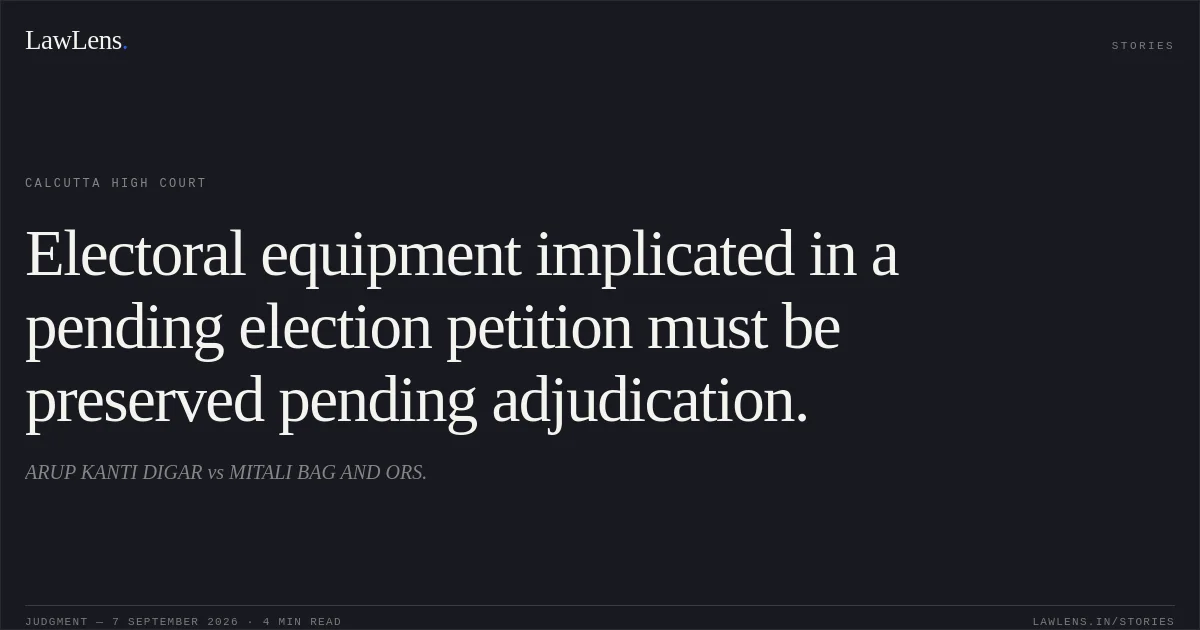
The Court refused the blanket release of EVMs and VVPATs pertaining to the 29-Arambagh (SC) Parliamentary Constituency.
¶ 21, 26Machines forming part of the electoral material of the election challenged in E.P. No. 4 of 2024 were directed to remain preserved and could not be opened, repaired, altered, substituted, dismantled or deployed without further order.
¶ 21, 26Material covered by the preservation directions in E.P. No. 1 of 2019 was likewise to remain preserved.
¶ 22The District Election Officer was permitted to identify and segregate the machines, prepare a documented inventory, and transfer preserved material between designated warehouses if necessary, provided its identity, seals, custody and evidentiary integrity remained intact.
¶ 20, 23–25Leave was granted to the District Election Officer, Hooghly, to intervene for the limited purpose of seeking and implementing directions concerning the EVMs and VVPATs, and G.A. No. 2 of 2026 was disposed of with those directions; there was no order as to costs.
¶ 28–31Original Court PDF
ARUP KANTI DIGARvsMITALI BAG AND ORS.
Click to open original judgment
Original judgment, available to read, download and summarize on LawLens.in