Facts
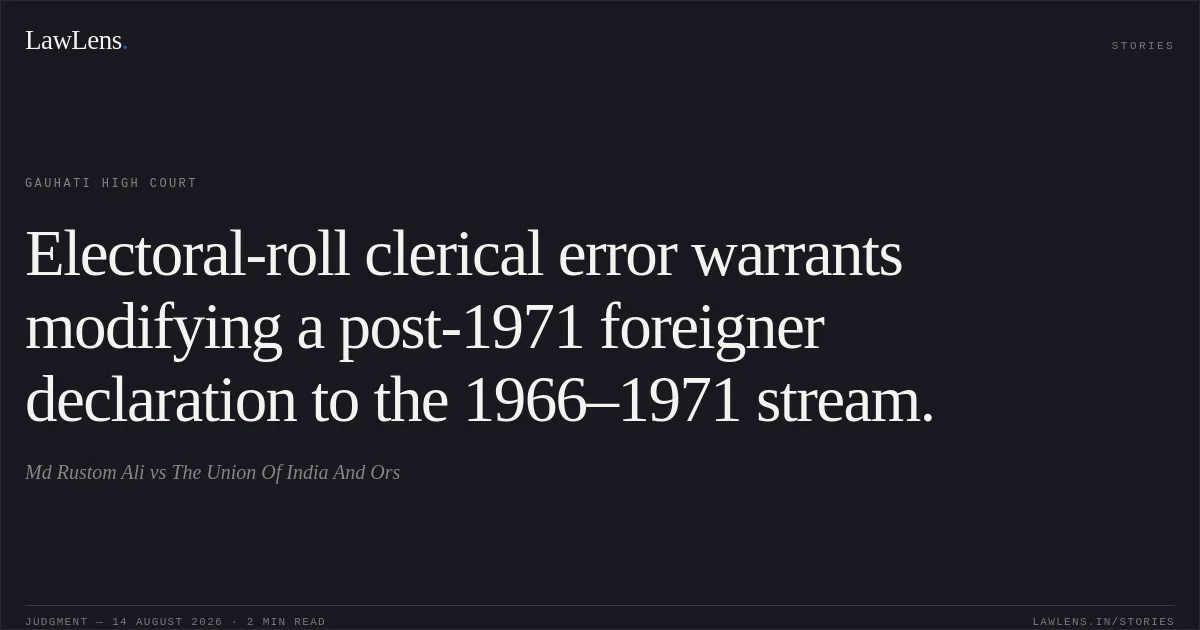
The petitioner challenged, under Article 226 of the Constitution, the opinion dated 13 March 2025 of the Foreigners’ Tribunal, 2nd Morigaon, in F.T. Case No. 1274/2012, declaring him a foreigner in the post-1971 stream.
Source reference: p.2, para. 2An earlier adverse opinion dated 31 August 2020 had been challenged in WP(C)/5238/2020. By order dated 26 June 2023, the High Court remanded the matter for examination of the 1966 and 1970 electoral rolls because the village name appeared as “Kupatimari” in the 1966 roll and “Kuratimari” in the 1970 roll.
Source reference: p.2, para. 3On remand, the Tribunal reiterated its earlier conclusion. During the present proceedings, the Election Commission of India clarified that “Kuratimari” was a clerical error and that the correct village name in the 1970 electoral roll was “Kupatimari”.
Source reference: pp.3–4, paras. 4–5The State nevertheless relied on other alleged discrepancies, including the age of the petitioner’s mother and entries in the Jamabandi.
Source reference: p.4, para. 6Issues
1. Whether the Tribunal’s declaration of the petitioner as a post-1971 foreigner could stand when the discrepancy between the 1966 and 1970 electoral rolls had been clarified by the Election Commission as a clerical error.
Source reference: pp.3–5, paras. 3–72. Whether, notwithstanding that clarification, the other documentary discrepancies relied upon by the Tribunal warranted interference under Article 226 of the Constitution.
Source reference: p.4, para. 6; p.5, paras. 8–9Law Applied
The Court exercised its power of judicial review under Article 226 of the Constitution over the opinion of the Foreigners’ Tribunal.
Source reference: p.2, para. 2The applicable principle was that a material factual discrepancy forming the basis of the Tribunal’s conclusion must be assessed in light of reliable official evidence, and a Tribunal’s finding may be modified where the foundational discrepancy is subsequently clarified by the competent electoral authority.
Source reference: pp.3–5, paras. 4–7The Court did not cite any specific precedent or statutory provision beyond the constitutional writ jurisdiction and the Foreigners’ Tribunal framework.
Source reference: no citationReasoning
The Court found that the Tribunal’s conclusion regarding the absence of “cogent, trustworthy and reliable evidence” was substantially founded on the apparent difference between the village names in the 1966 and 1970 electoral rolls.
Source reference: p.5, para. 7The Election Commission’s affidavit conclusively clarified that the 1970 entry “Kuratimari” resulted from a clerical error and that the correct name was “Kupatimari,” thereby removing the principal discrepancy that had undermined the petitioner’s documentary chain.
Source reference: p.4, para. 5; p.5, para. 7However, the Court declined to interfere with the Tribunal’s findings concerning the remaining materials, including the alleged inconsistencies relating to the petitioner’s mother’s age and the Jamabandi.
Source reference: p.4, para. 6; p.5, para. 8On the corrected electoral-roll evidence, the Court held that the petitioner was entitled to be treated as a foreigner belonging to the 1966–1971 stream, rather than the post-1971 stream.
Source reference: p.5, paras. 7–9Holding
The writ petition was allowed in part.
The impugned opinion dated 13 March 2025 was modified to the extent that the petitioner’s declaration as a foreigner would not operate under the post-1971 stream; instead, he was held to fall within the 1966–1971 stream.
Source reference: p.5, para. 9The petitioner was directed to take all necessary steps in accordance with law to obtain the consequential benefit, and the authorities were directed to process those steps expeditiously and in accordance with law.
Source reference: p.5, para. 9The records were directed to be returned forthwith.
Source reference: p.5, para. 10Original Court PDF
Md Rustom AlivsThe Union Of India And Ors
Click to open original judgment
Original judgment, available to read, download and summarize on LawLens.in