Facts
The deceased, Rambhai Ramsibhai, was walking near a road in Sutrapada taluka during light rain on June 6, 2001. Due to a technical fault in a Gujarat Electricity Board (GEB) transformer near the road, the deceased was electrocuted and died.
Source reference: p. 2The heirs of the deceased filed a suit (Special Civil Suit No. 16 of 2004) alleging absolute negligence by the appellant company (PGVCL) and seeking compensation of Rs. 7,00,000.
Source reference: p. 2The appellant contended that the deceased was negligent himself and had illegally tried to join a transformer fuse.
Source reference: p. 3The Trial Court partly decreed the suit, awarding Rs. 3,41,400 with 7% interest.
Source reference: p. 1PGVCL appealed this judgment under Section 96 of the CPC.
Source reference: p. 1Issues
1. Whether the deceased died due to the negligence of the appellant or due to his own self-negligence/contributory negligence?
Source reference: p. 4, para 72. Whether the principles of strict and absolute liability apply to electricity distribution companies in cases of electrocution?
Source reference: p. 8, para 13Law Applied
The Court applied the doctrine of Strict and Absolute Liability, as expanded by the Supreme Court in M.C. Mehta v. Union of India, which established that enterprises engaged in hazardous activities are liable for harm regardless of exceptions under the rule in Rylands v. Fletcher.
Source reference: p. 5, para 9The Court also relied on H.S.E.B. v. Ram Nath, affirming that power companies must ensure no injury results from their inherently dangerous activities.
Source reference: p. 6, para 10The Court relied on M.P. Electricity Board v. Shailkumar, which held that the "onus is on the licensee" to take precautions to prevent accidents.
Source reference: p. 7, para 11Reasoning
The Court rejected the appellant's argument that the deceased was negligent by allegedly attempting to fix a fuse. It reasoned that since PGVCL is engaged in the hazardous business of supplying electricity, it maintains a primary and absolute duty to prevent the escape of energy and ensure safety measures.
Source reference: p. 9, para 14The Court noted that the transformer was not hermetically sealed and was kept open, leading to the accident.
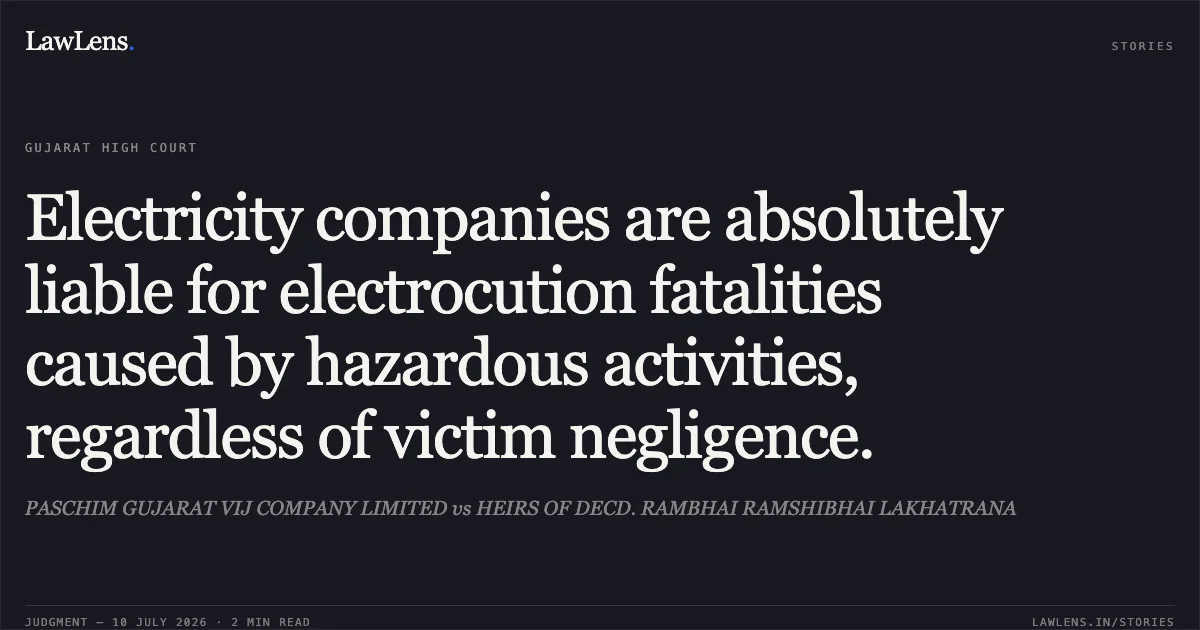
Source reference: p. 10, para 15Under the principle of absolute liability, the court found that PGVCL is liable for foreseeable risks inherent in its activity, irrespective of any alleged carelessness by the victim.
Source reference: p. 9, para 14The court held that no prudent person would intentionally invite electrocution and that maintaining the transformer was the sole responsibility of the company.
Source reference: p. 10, para 15Holding
The High Court dismissed the appeal and upheld the Trial Court's judgment, holding that the appellant is liable under the principle of absolute liability for the electrocution death.
The Court directed that the compensation amount deposited with the Trial Court be disbursed to the plaintiffs (claimants) along with accrued interest. All connected civil applications were disposed of.
Source reference: p. 11, para 17, 18Acts & Sections Cited
1 provisions across 1 statute referred to in this judgment. Each provision opens on LawLens.
Code of Civil Procedure, 19081
Original Court PDF
PASCHIM GUJARAT VIJ COMPANY LIMITEDvsHEIRS OF DECD. RAMBHAI RAMSHIBHAI LAKHATRANA
Click to open original judgment
Original judgment, available to read, download and summarize on LawLens.in