Facts
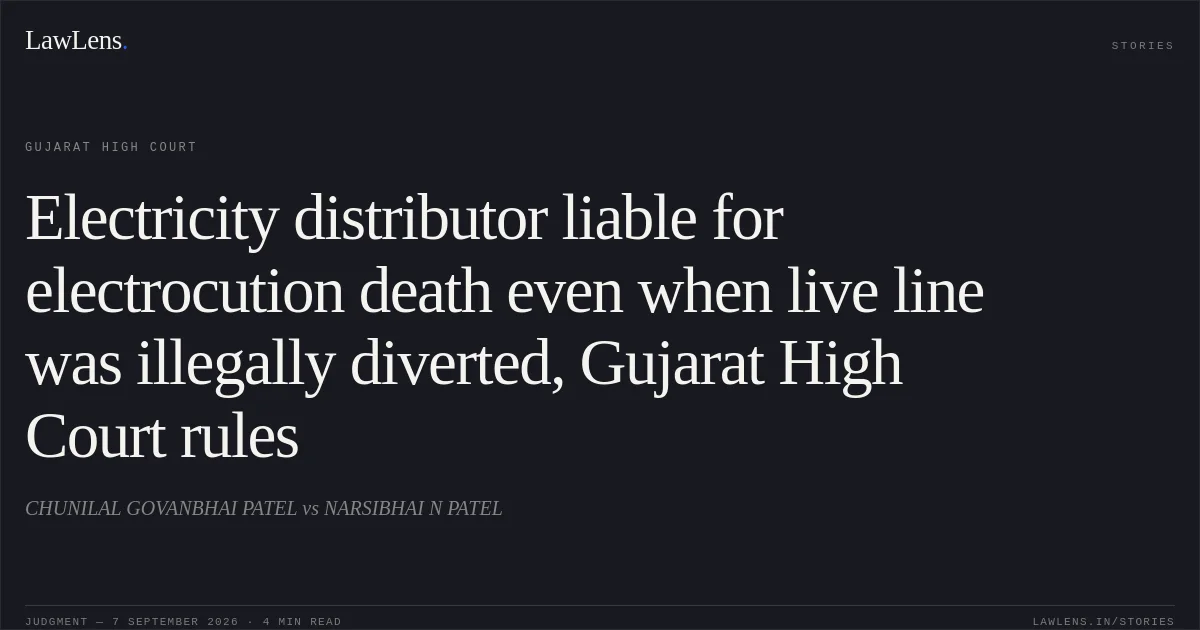
Hitesh, aged approximately 23–24 years, died by electrocution during the marriage ceremony of the appellant’s daughter on 20 May 2000. The plaintiffs alleged that the appellant had illegally drawn electricity by placing a hook on an electricity line and extending a temporary wire to the marriage premises, causing the fatal accident. They also alleged negligence on the part of the electricity distribution companies for failing to prevent unauthorised electricity use and maintain safety of the lines.
Source reference: paras. 2.1–2.2; pp. 2–3The Civil Court partly decreed the suit and directed the appellant alone to pay ₹3,70,000 with interest at 7.5% per annum from the date of the suit. The award comprised ₹2,70,000 towards loss of dependency and ₹1,00,000 towards mental agony and shock.
Source reference: para. 2.4; p. 3The appellant challenged the decree under Section 96 of the Code of Civil Procedure, 1908.
Source reference: para. 1; p. 1The High Court noted that the Electrical Inspector’s reports attributed the unauthorised connection to “some unknown person” and did not specifically name the appellant. The reports recorded that a hook had been placed on the Board’s LT line near Mansingbhai’s well and that a PVC wire had been extended towards the appellant’s premises.
Source reference: paras. 9–15; pp. 10–13The appellant had also been acquitted in the connected criminal proceedings, although the High Court treated that acquittal as relevant but not binding in the civil case.
Source reference: para. 18.3; p. 16Issues
Whether the appellant was proved to have installed or authorised the unauthorised electrical connection and could therefore be held liable for Hitesh’s death?
Source reference: paras. 19–22, 27–29, 33–34; pp. 17–18, 20, 24–25Whether the electricity distribution company was liable on the principle of strict liability for the death caused by electrocution, notwithstanding the alleged intervention of a private person or unauthorised diversion of electricity?
Source reference: paras. 25, 30–32, 34–41; pp. 19, 21–28Whether the compensation awarded by the Civil Court was required to be maintained, modified, or recovered from a party other than the appellant?
Source reference: paras. 24–26, 36–45; pp. 18–20, 26–30Law Applied
The Court applied the law of torts concerning strict liability for hazardous electrical activities, including the rule in Rylands v. Fletcher, under which liability may arise without proof of negligence where a dangerous substance or energy escapes and causes harm.
Source reference: paras. 25, 30–32; pp. 19, 21–24Relying principally on M.P. Electricity Board v. Shail Kumari, (2002) 2 SCC 162, Parvati Devi v. Commissioner of Police, Delhi, (2000) 3 SCC 754, and H.S.E.B. v. Ram Nath, (2004) 5 SCC 793, the Court held that an electricity supplier has a primary duty to prevent the escape or diversion of dangerous electrical energy and cannot ordinarily avoid liability merely by alleging that a stranger siphoned electricity.
Source reference: paras. 31–32, 38–41; pp. 21–28The Court also referred to Sections 63 and 68 of the Electricity Act, 2003 concerning safety of supply and overhead lines.
Source reference: para. 41; p. 28It further held that compensation in electrocution cases is to be just, fair, and reasonable; the multiplier method under the Motor Vehicles Act is not to be applied mechanically, particularly where income is not proved.
Source reference: para. 26; p. 20Reasoning
The High Court found that the evidence did not establish the appellant’s specific involvement in placing the hook or drawing the temporary wire. The Electrical Inspector’s reports and site sketch described the person responsible as unknown, showed that the connection originated near Mansingbhai’s well, and did not identify the appellant as the person who created the unauthorised connection.
Source reference: paras. 9–17; pp. 10–14The oral evidence was largely hearsay, and the appellant’s denial could not be rejected solely because the accident occurred near his property or during his daughter’s marriage.
Source reference: paras. 18–18.3, 27–29; pp. 15–20Accordingly, the Civil Court had proceeded on assumptions rather than cogent proof in fastening exclusive liability on the appellant.
Source reference: paras. 33, 40–43; pp. 24–29However, the Court held that the electricity distribution company could not rely on the unauthorised diversion of electricity as a complete defence. Electricity is inherently hazardous, and the supplier bears a strict liability to take safety measures and prevent the escape, diversion, or continued transmission of dangerous electrical energy.
Source reference: paras. 34–41; pp. 25–28The fact that the fatal wire may have been connected by an unidentified private person did not, by itself, absolve the electricity company of its statutory and tortious responsibility.
Source reference: paras. 34–41; pp. 25–28The Court therefore shifted responsibility from the appellant to Dakshin Gujarat Vij Company Ltd. The compensation figure awarded by the Civil Court was retained, as the assessment of ₹2,70,000 for dependency and ₹1,00,000 for mental agony was considered reasonable in the context of the 2000 accident and the evidence available.
Source reference: paras. 24–26, 36–39; pp. 18–20, 26–27Holding
The appeal was allowed. The High Court set aside the finding that the appellant was exclusively liable and held that the electricity distribution company, Dakshin Gujarat Vij Company Ltd., was responsible under the principle of strict liability for the electrocution death.
The company was directed to deposit ₹3,70,000 with accrued interest before the Civil Court within one month.
Source reference: para. 44; p. 29The judgment also stated that, since the decretal amount had already been deposited, the appellant was entitled to withdraw it after due verification by the Registry.
Source reference: para. 45; p. 29The record and proceedings were directed to be remitted to the concerned court.
Source reference: paras. 46–47; p. 30Acts & Sections Cited
3 provisions across 2 statutes referred to in this judgment. Each provision opens on LawLens.
Code of Civil Procedure, 19081
Electricity Act, 20032
Original Court PDF
CHUNILAL GOVANBHAI PATELvsNARSIBHAI N PATEL
Click to open original judgment
Original judgment, available to read, download and summarize on LawLens.in