Facts
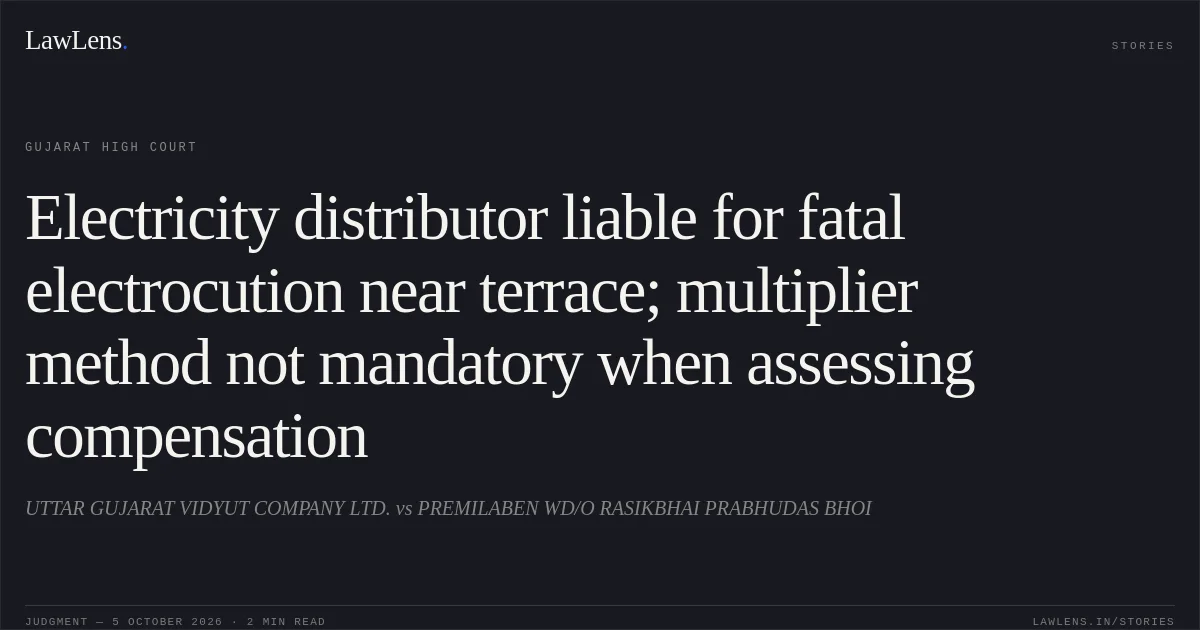
The plaintiffs, heirs of Rasikbhai Prabhudas Bhoi, claimed damages after he died by electrocution while on the terrace of a shop near an 11 kV electricity line.
Source reference: paras. 4.1–6; pp. 2–9The trial court found the electricity company negligent in maintaining the line and awarded ₹18,65,972 with interest at 6% from the date of suit. The first appellate court affirmed that decree. The company’s second appeal challenged both the concurrent finding of negligence and the method and amount of compensation.
Source reference: paras. 4.1–6, 7.1–7.5; pp. 2–9Issues
Whether the concurrent finding that the electricity company was negligent involved perversity or another error warranting interference under Section 100 CPC.
Source reference: paras. 8–13; pp. 10–17Whether the compensation awarded in the tort claim was legally erroneous, including because the trial court applied the multiplier method and awarded amounts for future loss and conventional heads.
Source reference: paras. 14–16; pp. 17–23Law Applied
Section 100 CPC limits a second appeal to substantial questions of law; concurrent findings of fact are not to be disturbed unless, for example, they are perverse, contrary to mandatory law or settled legal principles, based on inadmissible evidence, or unsupported by evidence (Russi Fisheries (P) Ltd. v. Bhavna Seth, 2026 SCC OnLine SC 555; Jaichand (Dead) through LRs v. Sahnulal, 2024 SCC OnLine SC 3864).
Source reference: paras. 8.1.1–8.1.2; pp. 10–12Rules 29 and 50(1)(f) of the Indian Electricity Rules, 1956, were relied on in connection with inspection, maintenance and safety obligations.
Source reference: paras. 9.2–10; pp. 13–15In a tort claim arising from electrocution, compensation must be just, fair and reasonable; the multiplier method is not obligatory, and the court may assess compensation by reference to the circumstances and principles of tort damages, including restitutio in integrum (Raman v. Uttar Haryana Bijli Nigam Ltd., (2014) 15 SCC 1).
Source reference: paras. 14.1–14.2; pp. 17–22Reasoning
The trial court’s negligence finding rested on the evidence that the 11 kV line passed close to the terrace, a wire was loose and hanging, and the company’s witness admitted that the wires were exposed and that no investigation or notice concerning the nearby construction had been undertaken. The maintenance report did not establish when or what maintenance had been performed at the site.
Source reference: paras. 9.2–13; pp. 13–17The High Court found no basis to treat the concurrent finding as perverse or otherwise reviewable under Section 100 CPC.
Source reference: paras. 9.2–13; pp. 13–17On compensation, it held that the governing test in this tort claim was whether the award was just, fair and reasonable, not whether a particular motor-accident formula had been followed. It found the award supported by the evidence concerning income, age, occupation and dependants; it also noted that the challenge to use of the motor-accident principles had not been raised below.
Source reference: paras. 14–16; pp. 17–23Holding
The High Court held that the appeal raised no substantial question of law and disclosed no ground to disturb either the concurrent finding of negligence or the compensation award.
It dismissed the second appeal in limine, confirmed the judgments and decrees of the courts below, and made no order as to costs.
Source reference: paras. 17–18; p. 24Acts & Sections Cited
2 provisions across 2 statutes referred to in this judgment. Each provision opens on LawLens.
Code of Civil Procedure, 19081
Code of Criminal Procedure, 19731
Original Court PDF
UTTAR GUJARAT VIDYUT COMPANY LTD.vsPREMILABEN WD/O RASIKBHAI PRABHUDAS BHOI
Click to open original judgment
Original judgment, available to read, download and summarize on LawLens.in