Facts
On 28 June 2007, Maheshbhai was walking towards work when a live electric wire allegedly snapped from an electric pole and fell on him, causing electrocution and serious injuries, resulting in his death.
Source reference: p.2; paras 3–3.1His legal heirs instituted Special Civil Suit No. 64 of 2008 against Paschim Gujarat Vij Company Limited (PGVCL), claiming ₹10,00,000 as compensation on the basis of the company’s negligence.
Source reference: p.2; paras 3.1–3.2PGVCL denied liability and contended that the deceased’s own negligence caused the incident.
Source reference: p.2; para 3.2The trial court held that the death was caused by electrocution, partly decreed the suit, and awarded ₹2,86,800 with interest at 9% per annum from the date of filing until realization.
Source reference: p.1; paras 1, 3.3–3.4PGVCL challenged the decree under Section 96 of the Code of Civil Procedure, 1908.
Source reference: p.1; para 1Issues
Whether the deceased died as a result of electrocution caused by the snapping and falling of PGVCL’s live electric wire, notwithstanding the post-mortem reference to a head injury.
Source reference: p.3; paras 5–8Whether PGVCL could avoid liability by alleging negligence or carelessness on the part of the deceased.
Source reference: p.3; para 5; pp.8–9; paras 13–16Whether the trial court’s award of ₹2,86,800 with interest required interference in appeal.
Source reference: p.1; paras 1, 8 and 17–19Law Applied
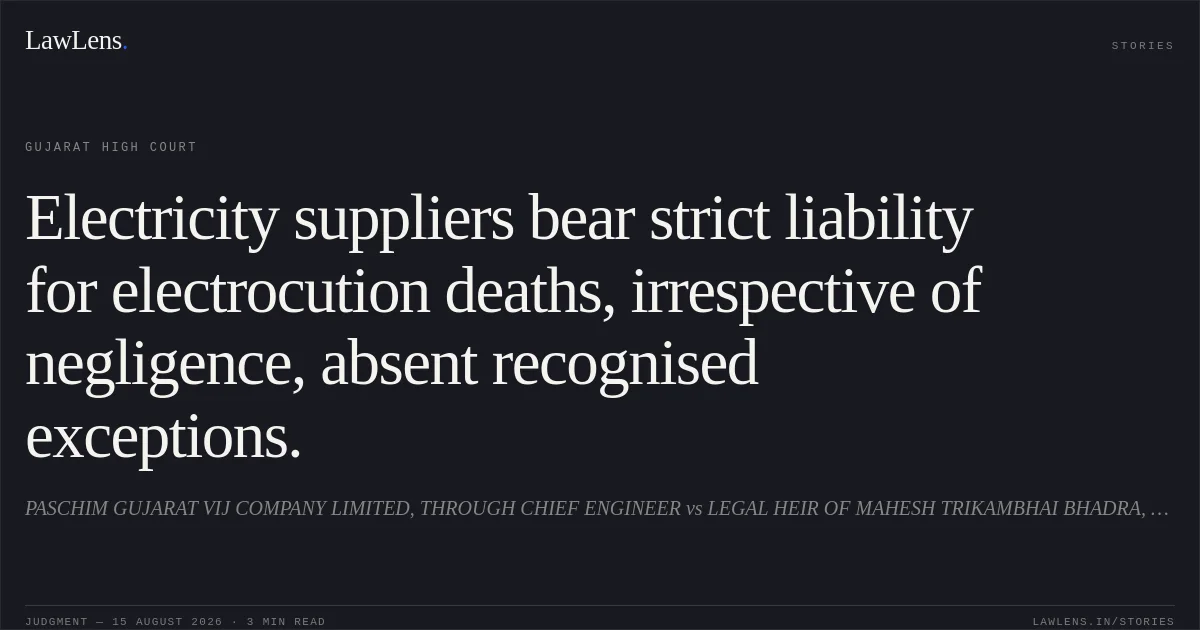
The Court applied the principle of strict liability applicable to inherently dangerous activities, including the transmission and supply of electricity.
Source reference: pp.5–8, 10–15; paras 9–15It relied on Rylands v. Fletcher, which imposes liability for damage caused by the escape of a dangerous thing; M.C. Mehta v. Union of India, which developed the doctrine of absolute liability for hazardous activities; H.S.E.B. v. Ram Nath, which held electricity suppliers responsible for injuries caused by dangerous electric lines; and M.P. Electricity Board v. Shail Kumari, which recognised the primary liability of electricity authorities when live wires cause injury or death, irrespective of negligence.
Source reference: pp.5–8, 10–15; paras 9–15The Court also relied on P.G.V.C.L. v. Heirs of Chandrikaben Harpalsinh, holding that installation, maintenance and safety of electrical lines are the supplier’s responsibility.
Source reference: pp.6–8; para 11Following Karnataka Power Transmission Corporation Ltd. v. Rekha, 2026 INSC 847, the Court held that strict liability, rather than absolute liability, applies to electricity authorities, subject to recognised exceptions such as consent, act of a stranger, act of God, statutory authority, plaintiff’s default, and remoteness of consequences.
Source reference: pp.10–15; paras 12–14The appeal was maintainable under Section 96 CPC.
Source reference: p.1; para 1Reasoning
The post-mortem report recorded multiple electrical marks and burns on the deceased’s forearms, flank and hand, including blackening, reddening, eroded skin and parchment-like floors.
Source reference: p.4; para 6The charge-sheet also stated that the live wire fell on the deceased’s head while he was walking on the road, causing both head injuries and electrocution.
Source reference: p.4; para 7The Court therefore rejected PGVCL’s attempt to distinguish between death by head injury and death by electrocution, holding that the evidence established electrocution as a substantial cause of death and applying the principle of res ipsa loquitur.
Source reference: p.4; para 8Since PGVCL was engaged in the inherently hazardous activity of supplying electricity, it had a continuing duty to maintain the wires, prevent their exposure, and ensure that a snapped live wire did not remain energised on a public road.
Source reference: pp.8–9, 13–15; paras 13–15The allegation of contributory or sole negligence by the deceased could not defeat liability because PGVCL neither established any recognised exception to strict liability nor demonstrated that the case fell outside the foreseeable risks of electrical transmission.
Source reference: pp.14–16; paras 13–16The Court further observed that the trial court’s award was already modest for the death of a 40-year-old person.
Source reference: p.4; para 8Holding
The Court held that the deceased’s death was attributable to electrocution from PGVCL’s snapped live wire and that PGVCL was strictly liable to compensate his legal heirs.
The defence based on the deceased’s alleged negligence was rejected in the absence of proof of any applicable exception to strict liability.
Source reference: pp.4, 15–16; paras 8, 14–17The First Appeal was dismissed, and the trial court’s decree awarding ₹2,86,800 with interest at 9% per annum from the date of filing of the suit until realization was affirmed.
Source reference: p.16; para 17Any amount deposited with the trial court was directed to be disbursed to the plaintiffs along with accrued interest; pending civil applications, if any, were disposed of, and the record and proceedings were directed to be returned to the concerned court.
Source reference: p.16; paras 18–20Acts & Sections Cited
1 provisions across 1 statute referred to in this judgment. Each provision opens on LawLens.
Code of Civil Procedure, 19081
Original Court PDF
PASCHIM GUJARAT VIJ COMPANY LIMITED, THROUGH CHIEF ENGINEERvsLEGAL HEIR OF MAHESH TRIKAMBHAI BHADRA, USHABEN WD/O MAHESH
Click to open original judgment
Original judgment, available to read, download and summarize on LawLens.in