Facts
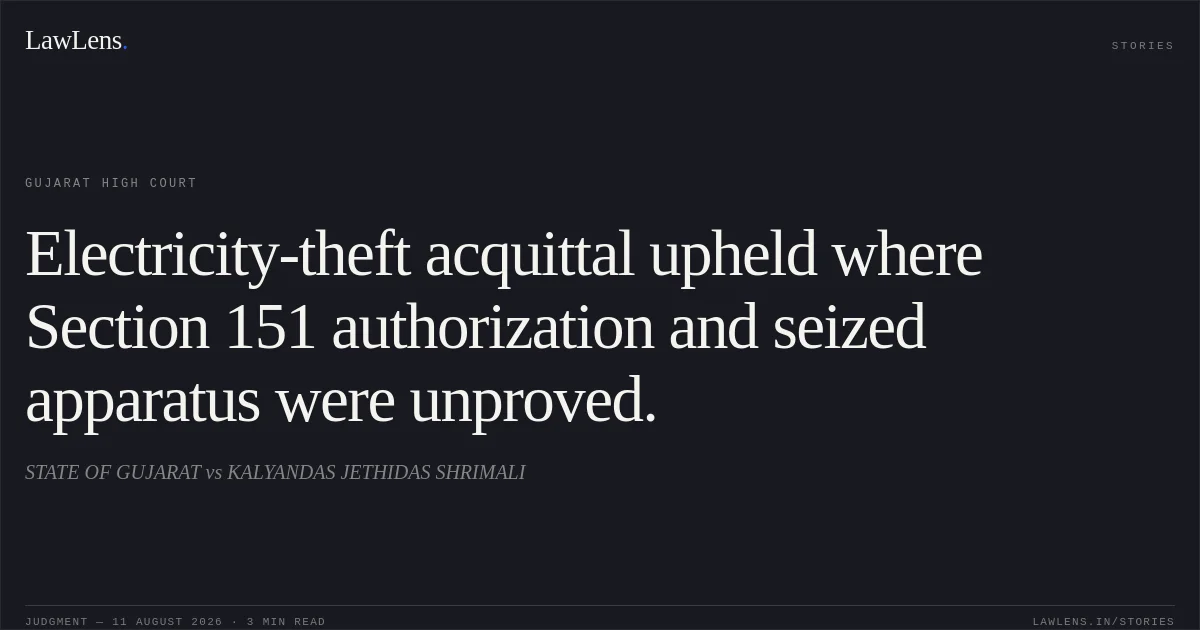
On 10 June 2008, officers of the Jamjodhpur (East) Sub-Division inspected the respondent’s alleged puncture shop at Village Sadodar, Jamjodhpur, and alleged that he was bypassing the electricity meter through a cable and other apparatus, thereby dishonestly abstracting electricity.
Source reference: pp.1–3A supplementary bill of ₹37,081.77 was prepared and the alleged apparatus was stated to have been seized. The respondent did not pay the bill, and an FIR was registered on 7 July 2009 for an offence under Section 135 of the Electricity Act, 2003.
Source reference: pp.1–3Following investigation, a charge-sheet was filed and the matter was committed to the Special Court, Khambhalia, as Special (G.E.B.) Case No. 1 of 2011. The trial court acquitted the respondent on 26 July 2012.
Source reference: pp.1–3The State challenged the acquittal under Section 378(1) and (3) of the Code of Criminal Procedure, 1973.
Source reference: pp.1–3The High Court noted that the alleged seized cable and other apparatus were not produced before the Investigating Officer or the trial court, that the prosecution did not establish the respondent’s ownership or occupation of the premises, and that a material witness’s statement was recorded nearly two years after the inspection.
Source reference: pp.6–7Issues
1. Whether the trial court was justified in acquitting the respondent of the offence under Section 135 of the Electricity Act, 2003.
Source reference: para. 9(1)2. Whether the trial court properly appreciated the oral and documentary evidence led by the prosecution.
Source reference: para. 9(2)3. Whether the impugned acquittal suffered from any illegality, irregularity, perversity, or other infirmity warranting appellate interference.
Source reference: para. 9(3)4. Whether the prosecution was legally maintainable in the absence of proof of the authorization contemplated by Section 151 of the Electricity Act, 2003.
Source reference: pp.7–10Law Applied
The court applied Section 135 of the Electricity Act, 2003, which criminalizes dishonest abstraction, consumption, or use of electricity through unauthorized connections, tampered meters, or artificial means; where an artificial or unauthorized means exists, dishonesty may be presumed against the consumer until rebutted.
Source reference: pp.8–10Section 151 restricts cognizance of offences under the Act to complaints by the Appropriate Government, authorized officers, specified electrical inspectors, licensees, generating companies, or, under its proviso, a police report under Section 173 CrPC.
Source reference: p.8The court relied on State of Gujarat v. Mohamad Nathabhai Sumara, Criminal Appeal No. 9 of 2009, concerning compliance with Section 151.
Source reference: pp.7, 10In appeals against acquittal, the principles in Chandrappa v. State of Karnataka, (2007) 4 SCC 415; Rajesh Prasad v. State of Bihar, (2022) 3 SCC 471; Babu Sahebagouda Rudragoudar v. State of Karnataka, (2024) 8 SCC 149; and Ramesh v. State of Karnataka, (2024) 9 SCC 169, establish that although an appellate court may fully reappreciate the evidence, the accused benefits from a reinforced double presumption of innocence, and an acquittal should not be disturbed where two reasonable views are possible.
Source reference: pp.11–13Reasoning
The High Court held that the prosecution failed to prove the essential circumstances connecting the respondent with electricity theft.
Source reference: no citationAlthough the inspection team alleged that an unauthorized cable and apparatus had been used, the alleged muddamal was never produced or proved, creating a serious evidentiary lacuna.
Source reference: pp.6–7The prosecution also failed to establish that the respondent owned or occupied the inspected premises, weakening the statutory presumption under Section 135.
Source reference: no citationThe unexplained delay between the inspection, registration of the FIR, and recording of the checking witness’s statement further impaired the reliability of the prosecution case.
Source reference: pp.5, 7Additionally, following Mohamad Nathabhai Sumara, the court accepted the trial court’s finding that the prosecution had not established the authorization required under Section 151, rendering the prosecution unsustainable in law.
Source reference: pp.7–10Applying the restrictive principles governing appellate interference with acquittals, the High Court found that the trial court’s view was reasonable and neither perverse nor manifestly illegal.
Source reference: pp.10–13Holding
The High Court answered the issues in favour of the respondent. It held that the prosecution had failed to prove the charge under Section 135 of the Electricity Act beyond reasonable doubt and that the trial court had committed no error in acquitting him.
The State’s appeal was dismissed, the judgment and order of acquittal dated 26 July 2012 were confirmed, the respondent’s bail bond was cancelled, and the record and proceedings were directed to be returned to the trial court.
Source reference: para.21Acts & Sections Cited
6 provisions across 2 statutes referred to in this judgment. Each provision opens on LawLens.
Code of Criminal Procedure, 19733
Electricity Act, 20033
Original Court PDF
STATE OF GUJARATvsKALYANDAS JETHIDAS SHRIMALI
Click to open original judgment
Original judgment, available to read, download and summarize on LawLens.in