Facts
On 31 May 2008, a Gujarat Electricity Board/PGVCL checking squad allegedly found the respondent abstracting electricity illegally by connecting an electric cable directly to an electric pole near his business premises, “Modi Traders,” at Village Ranjitpara, Taluka Bhanvad. A supplementary bill of ₹1,55,091.01 was issued, which was not paid. The Deputy Engineer thereafter lodged a complaint, leading to registration of C.R. No. II-1035 of 2008 and filing of a charge-sheet for an offence under Section 135 of the Electricity Act, 2003.
Source reference: p.5The trial court acquitted the respondent in Special (GEB) Case No. 35 of 2010. The State challenged the acquittal under Section 378(1)(3) of the Code of Criminal Procedure, 1973.
Source reference: p.1The trial court found that the complainant lacked the requisite authorization under Section 151 read with Section 50 of the Electricity Act, that no panchnama had been prepared, and that no alleged cable, apparatus, or other material had been seized or produced before the court.
Source reference: p.6It also found that the prosecution had not established that the respondent owned or occupied the premises or was responsible for the alleged abstraction of electricity.
Source reference: p.6Issues
1. Whether the trial court was justified in acquitting the respondent of the offence punishable under Section 135 of the Electricity Act, 2003?
Source reference: para. 92. Whether the trial court properly appreciated the oral and documentary evidence adduced by the prosecution?
Source reference: para. 93. Whether the impugned acquittal suffered from any illegality, irregularity, perversity, or manifest error warranting appellate interference?
Source reference: para. 94. Whether the complaint was legally maintainable in the absence of valid authorization under Section 151 read with Section 50 of the Electricity Act, 2003?
Source reference: pp.6–7Law Applied
The court applied Section 135 of the Electricity Act, 2003, which criminalizes dishonest abstraction, consumption, or use of electricity through unauthorized means; Sections 135(2) and 135(3), concerning the consequences and evidentiary aspects of electricity theft; and Section 151, read with Section 50, which restricts cognizance of offences under the Act to a written complaint by a person duly authorized in the prescribed manner.
Source reference: pp.6–7The court held that the prosecution must prove the ingredients of the offence beyond reasonable doubt through cogent and reliable evidence.
Source reference: pp.6–7In an appeal against acquittal, the appellate court may review and reappreciate the evidence, but must account for the double presumption of innocence; where two reasonable views are possible, the acquittal should not be disturbed.
Source reference: pp.8–10These principles were drawn from Chandrappa v. State of Karnataka , (2007) 4 SCC 415; Rajesh Prasad v. State of Bihar , (2022) 3 SCC 471; Babu Sahebagouda Rudragoudar v. State of Karnataka , (2024) 8 SCC 149; and Ramesh v. State of Karnataka , (2024) 9 SCC 169.
Source reference: pp.9–10Reasoning
The High Court found no basis to interfere with the acquittal. The prosecution’s case was materially weakened because no panchnama was prepared and no cable, apparatus, or other incriminating article allegedly used for direct abstraction of electricity was seized or produced.
Source reference: p.6The evidence also failed to establish that the respondent was the owner, occupier, or person in possession of the premises at the relevant time.
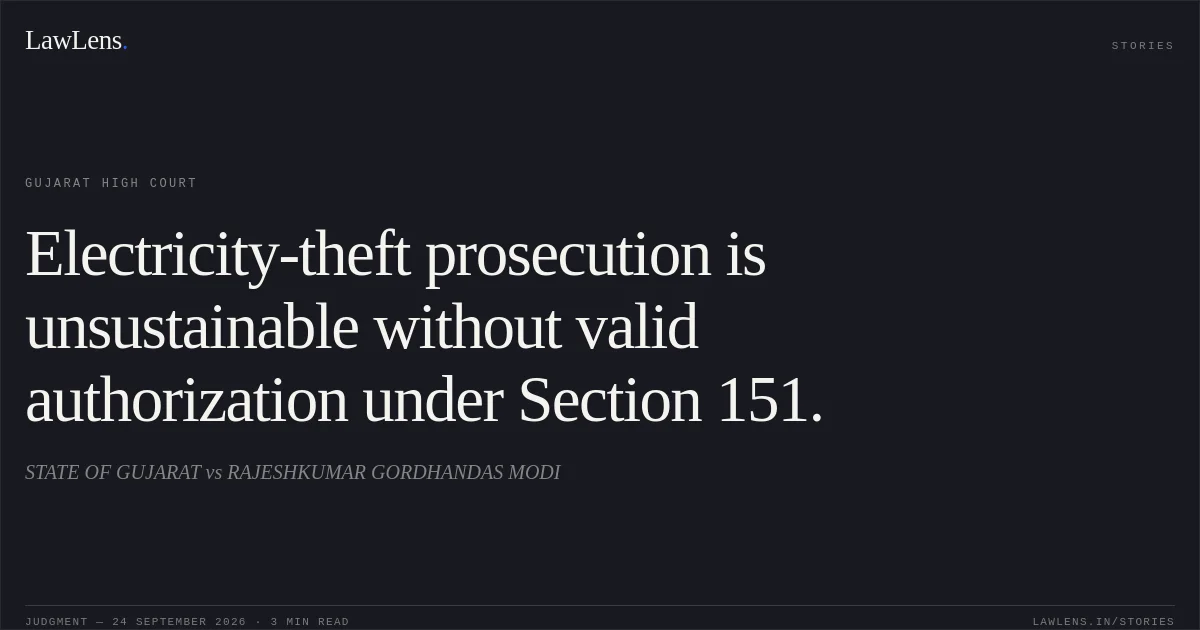
Source reference: p.6Further, the authorization relied upon by the complainant had been issued under the repealed Electricity Act, 1910 and the corresponding earlier procedure, rather than under the statutory scheme of the Electricity Act, 2003; consequently, the trial court was justified in treating the complaint as legally unsustainable under Section 151.
Source reference: p.7Even upon independent reappreciation, the High Court held that the evidence did not establish the respondent’s involvement in the alleged theft beyond reasonable doubt. Since the trial court’s view was a reasonable one and was not perverse or manifestly illegal, the appellate principles governing acquittal required its preservation.
Source reference: pp.8–11Holding
The High Court answered the issues in favour of the respondent. It held that the prosecution failed to prove the offence under Section 135 of the Electricity Act, 2003 beyond reasonable doubt and that the complaint was additionally vulnerable for want of valid authorization under Section 151.
The State’s appeal was dismissed, the trial court’s judgment of acquittal was confirmed, the respondent’s bail bond was cancelled, and the record and proceedings were directed to be returned to the trial court.
Source reference: p.12Acts & Sections Cited
5 provisions across 2 statutes referred to in this judgment. Each provision opens on LawLens.
Code of Criminal Procedure, 19732
Electricity Act, 20033
Original Court PDF
STATE OF GUJARATvsRAJESHKUMAR GORDHANDAS MODI
Click to open original judgment
Original judgment, available to read, download and summarize on LawLens.in