Facts
The petitioner was accused of assault and causing fracture injuries to a complainant on January 15, 2025, resulting in FIR No. 69/2025 under Sections 115(2), 117(2), 296, 351(3) read with 3(5) of the Bharatiya Nyaya Sanhita (BNSS).
Source reference: p. 1-2The petitioner asserted a plea of alibi, claiming he was in Auraiya, U.P., for wedding preparations on the date of the incident.
Source reference: p. 2Despite making multiple representations to investigating authorities between March and May 2025 to verify his location via electronic records, no action was taken.
Source reference: p. 2On September 24, 2025, the petitioner filed an application under Section 94 of the BNSS before the Chief Judicial Magistrate (CJM), Bhind, seeking the preservation of Call Detail Records (CDR), mobile tower locations, and online payment receipts.
Source reference: p. 2On November 7, 2025, the CJM postponed the hearing of said application until the stage of defense evidence.
Source reference: p. 1-2The petitioner challenged this postponement under Section 528 of the BNSS.
Source reference: p. 1Issues
1. Whether the Trial Court’s postponement of an application for the preservation of electronic evidence until the defense stage is legally sustainable under Section 94 of the BNSS.
Source reference: p. 4-52. Whether the potential loss of perishable electronic data (CDR/tower location) due to judicial delay violates the accused's right to a fair trial under Article 21 of the Constitution.
Source reference: p. 4-5Law Applied
The court primarily applied Section 94 of the BNSS, which grants the power to summon or preserve documents "necessary or desirable" for a trial.
Source reference: p. 4It exercised inherent powers under Section 528 of the BNSS to prevent the abuse of the court's process.
Source reference: p. 5The court relied on State of Uttar Pradesh v. Raj Narain (1975) regarding the discovery of truth.
Source reference: p. 4Manu Sharma v. State (NCT of Delhi) (2010), which framed fair investigation and trial as facets of Article 21.
Source reference: p. 4-5The court applied Tomaso Bruno v. State of Uttar Pradesh (2015) and Anvar P.V. v. P.K. Basheer (2014) to emphasize the evidentiary sanctity and the necessity of preserving electronic records before they are overwritten or deleted.
Source reference: p. 5Reasoning
The Court reasoned that the power under Section 94 of the BNSS must be exercised to advance the cause of justice, particularly regarding evidence that is "susceptible to overwriting or deletion with passage of time".
Source reference: p. 4It noted that CDR and tower location data are retained by service providers for a limited duration; thus, postponing their preservation until the defense stage—which occurs late in the trial—risks the permanent destruction of evidence.
Source reference: p. 3-4The Court found that such a delay causes "irreparable prejudice" to the petitioner's plea of alibi and constitutes a failure of justice.
Source reference: p. 4By connecting the facts to the principles of Article 21, the Court held that the Trial Court's failure to act immediately ignored the necessity of bringing all relevant material before the court to ensure a fair adjudication.
Source reference: p. 5Holding
The High Court allowed the petition and set aside the CJM’s order dated November 7, 2025.
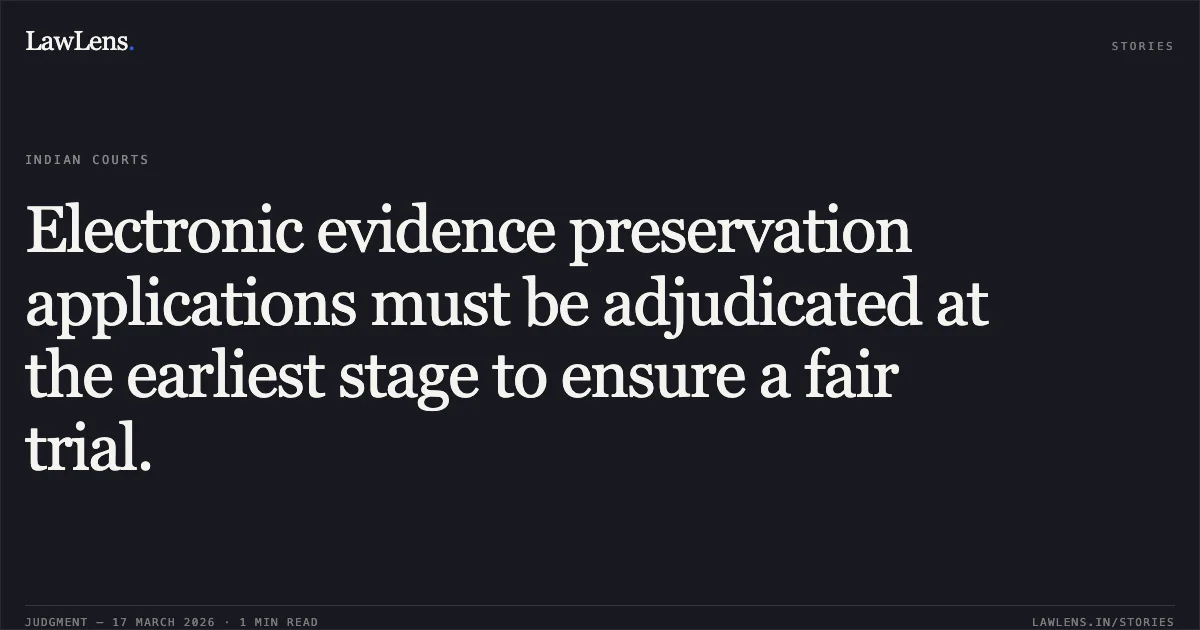
The Court held that preservation of electronic evidence must be considered at the earliest stage to prevent the loss of relevant material.
Source reference: p. 5The Trial Court was directed to decide the Section 94 BNSS application expeditiously, preferably within four weeks of the order, and the concerned authorities were commanded to ensure the preservation of the records in accordance with law.
Source reference: p. 6Acts & Sections Cited
13 provisions across 4 statutes referred to in this judgment. Each provision opens on LawLens.
Bharatiya Nagarik Suraksha Sanhita, 20232
Code of Criminal Procedure, 19731
Bharatiya Nyaya Sanhita, 20235
Indian Penal Code, 18605
Original Court PDF
Siyasharan GuptavsThe State Of Madhya Pradesh
Click to open original judgment
Original judgment, available to read, download and summarize on LawLens.in