Facts
The Petitioner, an advocate, filed a writ petition challenging the residence-based eligibility criteria stipulated in the allotment rules for lawyers’ chambers at the Shahdara (Karkardooma), Dwarka, and Rohini District Courts.
Source reference: p. 1-2The existing rules restrict eligibility for chamber allotment to advocates residing within the National Capital Territory (NCT) of Delhi, excluding those residing in the National Capital Region (NCR).
Source reference: p. 2The Petitioner sought a writ of mandamus to quash these restrictions and amend the rules to harmonize them with the Delhi High Court Lawyers’ Chambers (Allotment & Occupancy) Rules, 1980, which are more inclusive.
Source reference: p. 2Issues
Whether the residence-based eligibility condition restricting chamber allotment to residents of the NCT of Delhi is unconstitutional or necessitates amendment to include residents of the NCR.
Source reference: p. 2Whether the District Court allotment rules should be harmonized with the Delhi High Court rules to establish a uniform framework across all District Court complexes.
Source reference: p. 2Law Applied
The court primarily relied on the legal principles and observations laid down by the Supreme Court of India in Gopal Jha v. Hon’ble Supreme Court of India (2019) 13 SCC 161.
Source reference: p. 3In that precedent, the Supreme Court acknowledged that due to urban expansion, many advocates commute from neighboring states (NCR) and suggested that residence-based eligibility rules should be reconsidered by fixing a radial distance or extending the definition of "resident" to include suburbs.
Source reference: para 39-40; p. 3-4Reasoning
The Court did not adjudicate on the merits of the eligibility criteria but instead adopted the procedural approach suggested by the Respondent's counsel.
Source reference: p. 4Drawing parity from the Gopal Jha decision, the Court noted that changed circumstances and regional development necessitated a re-evaluation of the "residence in Delhi" requirement.
Source reference: p. 4The Bench observed that since the Supreme Court had previously referred such administrative policy matters to its own Judges' Allotment Committee, a similar referral to the Portfolio Committees of the Delhi High Court was appropriate.
Source reference: p. 4-5This ensures that the administrative bodies governing the specific District Courts (Shahdara, Dwarka, and Rohini) can consider all relevant factors, including the Petitioner’s reference to the Supreme Court Bar Association's inclusive rules for NCR residents.
Source reference: p. 4-5Holding
The Court disposed of the writ petition by directing that the issues raised regarding territorial eligibility be referred to the respective Portfolio Committees of the Delhi High Court for the concerned District Courts.
The Committees are tasked with taking a decision on the amendment of the rules, which must then be communicated to the Petitioner.
Source reference: p. 5Regarding the specific advocates whose applications were already rejected, the Court noted they may seek independent legal remedies.
Source reference: p. 5All pending applications were closed.
Source reference: p. 5Original Court PDF
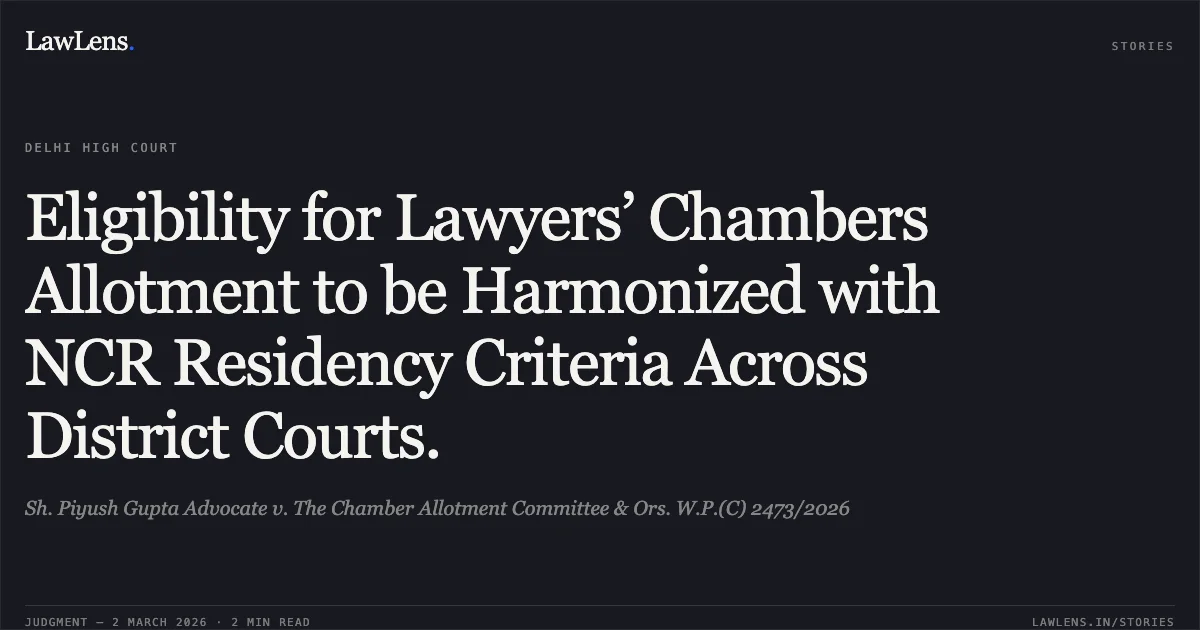
Sh. Piyush Gupta Advocate v. The Chamber Allotment Committee & Ors. W.P.(C) 2473/2026
Click to open original judgment
Original judgment, available to read, download and summarize on LawLens.in