Facts
The petitioner had worked as a Guest Teacher during the 2024–25 academic session, including for 29 days in April 2025.
Source reference: no citationFor 2025–26, Guest Teacher vacancies were to be filled through GFMS/Education Portal 3.0. The petitioner alleged that, although she was on the relevant panel, the vacancy at Government Primary School, Pawaiyapura was not uploaded, preventing her from submitting an online request.
Source reference: paras. 2–3, 7–8She pursued complaints with the authorities; respondent No. 5 later applied for disclosure of the vacancy, and respondent No. 3 requested that the portal be opened for that purpose.
Source reference: paras. 2–3, 7–8The State opposed relief, relying on the school’s enrolment of 24 students, the asserted absence of need for an additional Guest Teacher, and the expiry of the 2025–26 academic session.
Source reference: para. 4Issues
1. Whether the petitioner was prevented from submitting her request for engagement because the vacancy was not disclosed on Portal 3.0
Source reference: para. 92. Whether, in light of the alleged non-disclosure and the subsequent expiry of the academic session, the petitioner was entitled to engagement and consideration of consequential benefits
Source reference: paras. 19–233. Whether an enquiry and disciplinary action were warranted concerning responsibility for the vacancy’s non-disclosure
Source reference: paras. 24–25Law Applied
The Court relied on the Guest Teacher engagement process under the instructions dated 26.06.2025, which required a vacancy to be disclosed on the portal before an eligible panelled candidate could submit a request.
Source reference: paras. 2, 7It considered the applicable staffing norm, reflected in the material before it, prescribing two teachers for a primary school with up to 60 students; student strength alone did not establish that there could be no need for a second teacher, though actual teaching strength, teacher availability, and applicable instructions remained relevant.
Source reference: paras. 11–13The Court also applied the principles of fairness and non-arbitrariness in State action, relying on Food Corporation of India v. Kamdhenu Cattle Feed Industries, (1993) 1 SCC 71.
Source reference: paras. 17–18It further held that a person should not suffer for an authority’s act or omission where the person took timely steps but was prevented from completing the process for reasons beyond their control.
Source reference: para. 16Reasoning
The petitioner’s repeated complaints, respondent No. 5’s later application seeking disclosure of the vacancy, and respondent No. 3’s request to open the portal supported her contention that the vacancy had not been disclosed and that the issue was subsequently recognised by the authorities.
Source reference: paras. 10, 15The Court held that an enrolment of 24 students, by itself, did not rule out a requirement for a second teacher, while clarifying that the staffing norm did not automatically require engagement of a Guest Teacher.
Source reference: paras. 11–13Given the petitioner’s prior engagement, panel status, and efforts to pursue her claim, the Court concluded that she could not be denied consideration solely because she had been unable to submit an online request after the vacancy was not uploaded; the session’s expiry did not erase the consequences of the alleged omission.
Source reference: paras. 14–16, 19–22Holding
The petition was allowed.
The respondents were directed to issue an engagement order to the petitioner as a Guest Teacher against the available vacancy at Government Primary School, Pawaiyapura, subject to her satisfying the prescribed eligibility conditions, and to permit her to join and discharge duties.
Source reference: paras. 22–23, 26–27The respondents were also directed to consider her claim for consequential benefits relating to service and experience, to the extent permissible under the applicable rules.
Source reference: para. 23The competent authority was directed to enquire into responsibility for non-disclosure and, if deliberate or negligent wrongdoing was established, take appropriate disciplinary action in accordance with law.
Source reference: paras. 24–25The directions were to be acted upon forthwith, with a decision on consequential benefits preferably within 30 days of receipt of a certified copy of the order.
Source reference: para. 26Original Court PDF
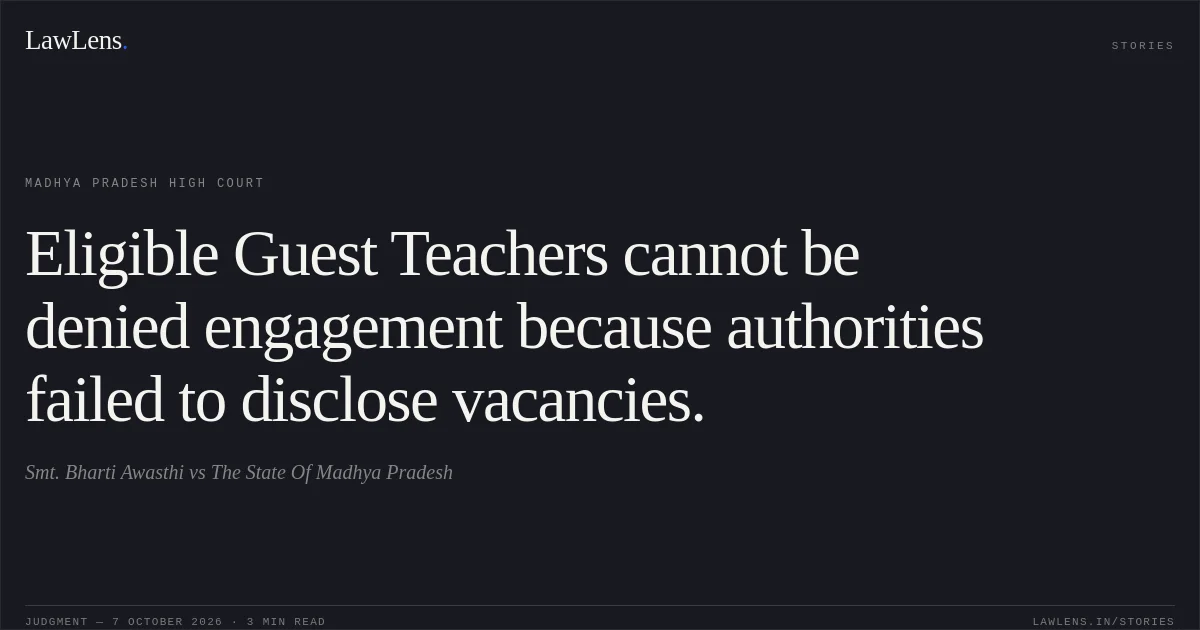
Smt. Bharti AwasthivsThe State Of Madhya Pradesh
Click to open original judgment
Original judgment, available to read, download and summarize on LawLens.in