Facts
The respondent’s wife, Beena Kashmiri, a chronic heart patient, was admitted to Max Hospital from 9–16 February 2016 and was subsequently referred by the Railway Hospital to Delhi Heart & Lung Institute for emergency treatment, during which treatment she died on 5 December 2018.
Source reference: p.6, para.3The Union of India admitted before the Central Administrative Tribunal that her admission and treatment were emergent.
Source reference: p.6, para.4The respondent claimed ₹1,88,687 as the actual medical expenses incurred, but the petitioners reimbursed only ₹75,399.
Source reference: p.6, para.5The Central Administrative Tribunal, in OA No. 319/2025, allowed the respondent’s claim by judgment dated 24 March 2026.
Source reference: p.6, para.6The Union of India challenged that order before the Delhi High Court, relying on its policy and the Supreme Court’s judgment in Shiva Kant Jha v. Union of India.
Source reference: p.7, para.7Issues
Whether a CGHS beneficiary who undergoes medical treatment in an emergency is entitled to reimbursement of the actual medical expenses incurred, notwithstanding the applicable policy or the status of the hospital?
Source reference: pp.1–6, paras.1–2Whether the Tribunal erred in directing reimbursement of the balance medical expenses incurred by the respondent for his wife’s emergency treatment?
Source reference: pp.6–8, paras.5–10Whether the principle of full reimbursement applies where the treatment is elective rather than emergent?
Source reference: p.8, para.9Law Applied
The Court applied the constitutional guarantee of the right to life under Article 21, which includes the right to timely and adequate medical treatment.
Source reference: pp.2–6, paras.14–16Relying on Shiva Kant Jha v. Union of India, (2018) 16 SCC 187, and the Division Bench decisions in Union of India v. Joginder Singh, 2023 SCC OnLine Del 2707; Jasbir Singh v. Union of India, 2024 SCC OnLine Del 9; Jagir Kaur v. Union of India, 2024 SCC OnLine Del 4698; and Hira Lal Bhat v. BSNL, 2024 SCC OnLine Del 9065, the Court held that where emergency treatment is actually undergone and supported by medical records, reimbursement cannot be denied or restricted on technical grounds such as treatment at a non-empanelled hospital or the applicable CGHS rates.
Source reference: pp.2–6, paras.14–16 and para.26 of Hira Lal BhatIn emergency situations, preservation of life takes precedence over prior approval, empanelment, or administrative restrictions; however, the principle does not necessarily apply to elective treatment.
Source reference: p.8, para.9Reasoning
The Court found the case squarely covered by the established line of authority requiring full reimbursement for genuine emergency treatment.
Source reference: p.6, para.3The respondent’s wife was a chronic heart patient, had been referred for emergency treatment, and the petitioners themselves admitted the emergent nature of the admission.
Source reference: p.6, paras.3–4Since the respondent had actually incurred ₹1,88,687 in medical expenses but had received only ₹75,399, restricting reimbursement was inconsistent with the governing legal principle.
Source reference: p.6, para.5The Court rejected the petitioners’ reliance on their policy and Shiva Kant Jha, noting that those very principles had already been interpreted in favour of full reimbursement in the subsequent Division Bench decisions cited by the Court.
Source reference: p.7, para.7As the treatment was emergent and genuine, the hospital’s empanelment and policy-based reimbursement limits could not justify denial of the balance amount.
Source reference: p.7, para.8Holding
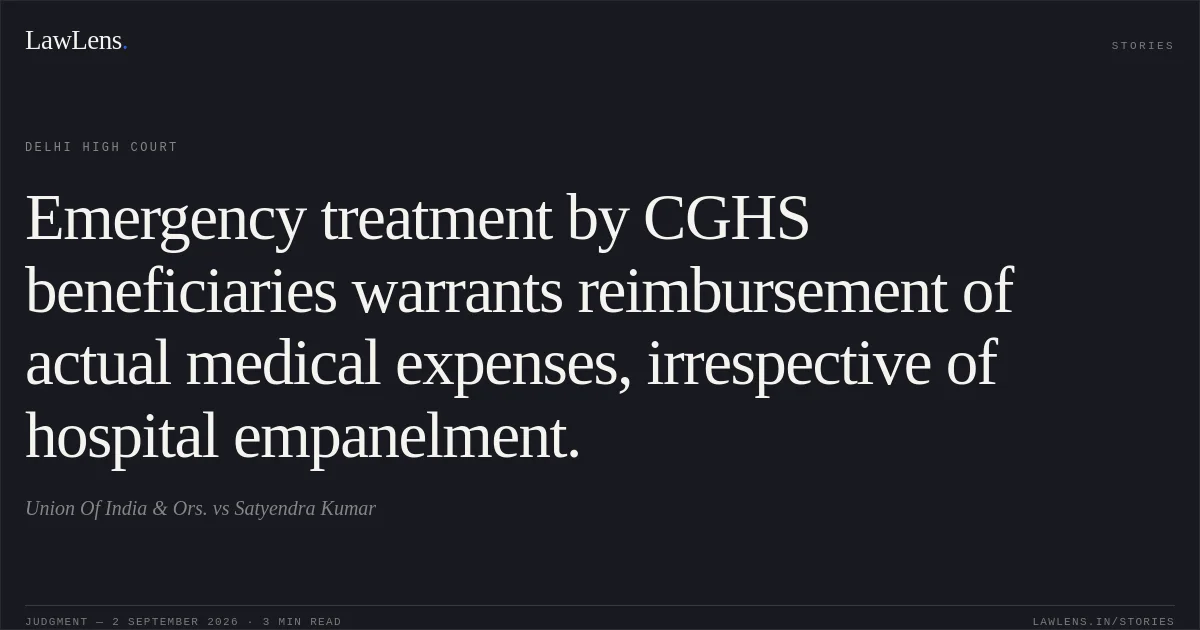
The Court answered the principal issues in favour of the respondent and held that emergency medical expenses incurred by a CGHS beneficiary must be reimbursed in full.
It found no error in the Tribunal’s judgment dated 24 March 2026 and dismissed the writ petition in limine.
Source reference: p.8, para.10The petitioners were directed to comply with the Tribunal’s order positively within six weeks from 31 August 2026.
Source reference: p.8, para.11The Court clarified that the rule may not apply where the treatment is elective rather than emergent.
Source reference: p.8, para.9Original Court PDF
Union Of India & Ors.vsSatyendra Kumar
Click to open original judgment
Original judgment, available to read, download and summarize on LawLens.in