Facts
The 14 applicants applied for Group ‘D’ posts in the North Eastern Railway (NER) under Advertisement No. NER/RRC/D/2007/1 dated 06.12.2007.
Source reference: no citationAfter clearing the Physical Efficiency Test and written examination, they were included in a pool of 20% extra candidates for document verification and medical examination.
Source reference: p. 10However, they were not empanelled or offered appointment because their merit was lower than the last selected candidate.
Source reference: p. 3The respondents issued orders on 09.05.2013 and 17.06.2013 stating that their cases would be considered only if vacancies arose due to non-joining or medical unfitness of selected candidates.
Source reference: p. 3The applicants alleged that the respondents illegally reduced the number of vacancies from 4549 to 4049 midway through the process.
Source reference: p. 6-7After an initial round of litigation, the Hon’ble High Court of Allahabad remanded the matter to the Tribunal on 17.05.2024 to decide the legality of surrendering 500 posts and the applicability of the Dinesh Kumar Kashyap precedent.
Source reference: p. 13-16Issues
1. Whether the ratio laid down in Dinesh Kumar Kashyap v. South East Central Railway (2019) 12 SCC 798 regarding the mandatory utilization of the 20% replacement panel is applicable to the current 2007 recruitment cycle.
Source reference: p. 262. Whether the respondents acted arbitrarily or illegally by reducing/surrendering 500 vacancies (Trackman posts) during the selection process.
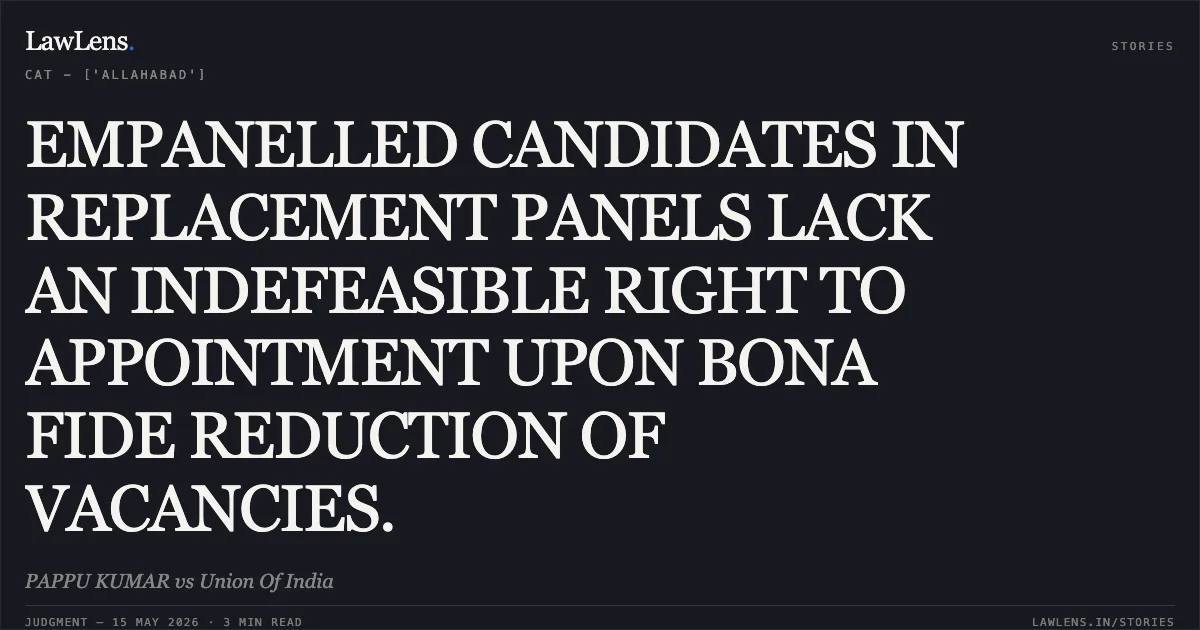
Source reference: p. 283. Whether the inclusion of a candidate's name in a replacement panel creates an indefeasible right to appointment.
Source reference: p. 29Law Applied
The Court primarily applied the principle from Shankarsan Dash v. Union of India (1991) 3 SCC 47, which establishes that successful candidates do not acquire an indefeasible right to appointment and the State is not legally bound to fill all vacancies unless rules indicate otherwise.
Source reference: p. 22, 29It relied on Tej Prakash Pathak v. Rajasthan High Court, holding that eligibility criteria cannot be changed midway, but vacancies can be increased or decreased if the advertisement specifically permits.
Source reference: p. 21-22, 28It further distinguished Dinesh Kumar Kashyap v. South East Central Railway, noting that its relief was restricted to specific recruitment years and to "vigilant" litigants who approached the court in time.
Source reference: p. 18-20, 26-27Finally, it applied the doctrine from Ashish Kumar v. Union of India (Delhi High Court) stating that a select list is not a permanent reservoir and no relief can be granted after the list's life expires.
Source reference: p. 25, 30Reasoning
The Court examined Paragraph 14.1 of the 2007 advertisement, which explicitly stated that vacancies were provisional and liable to increase or decrease.
Source reference: p. 28Consequently, the abolition of 500 Trackman posts by the Construction Division was deemed a valid exercise of administrative discretion, not an illegal change in conditions.
Source reference: p. 29The Court found that the respondents did not act arbitrarily as no candidate with lower merit than the applicants was appointed.
Source reference: p. 11Regarding the Dinesh Kumar Kashyap precedent, the Tribunal noted that the Supreme Court had restricted that relief to the 2010 recruitment cycle and to specific petitioners; therefore, it could not be extended to a different recruitment cycle (2007).
Source reference: p. 26-27The Tribunal further observed that the "assurance" given in the impugned orders was conditional upon the future demand from divisions, which never materialized.
Source reference: p. 14, 30Since the life of the 2007 panel had long expired, the applicants, as "extra" candidates, could not claim a vested right to appointment against abolished posts.
Source reference: p. 31Holding
The Tribunal dismissed the Original Application, holding that the applicants had no indefeasible right to appointment.
The Court answered that: (1) The Dinesh Kumar Kashyap ratio does not apply to the 2007 recruitment [p. 27]; (2) The reduction of vacancies was legally permissible under the terms of the advertisement [p. 28-29]; and (3) No relief can be granted as the selection panel has outlived its utility and expired.
Source reference: p. 31The impugned orders of the respondents were upheld. No costs were awarded.
Source reference: p. 31Acts & Sections Cited
3 provisions across 1 statute referred to in this judgment. Linked provisions open on LawLens.
Appropriation (Railways) No3
Original Court PDF
PAPPU KUMARvsUnion Of India
Click to open original judgment
Original judgment, available to read, download and summarize on LawLens.in