Facts
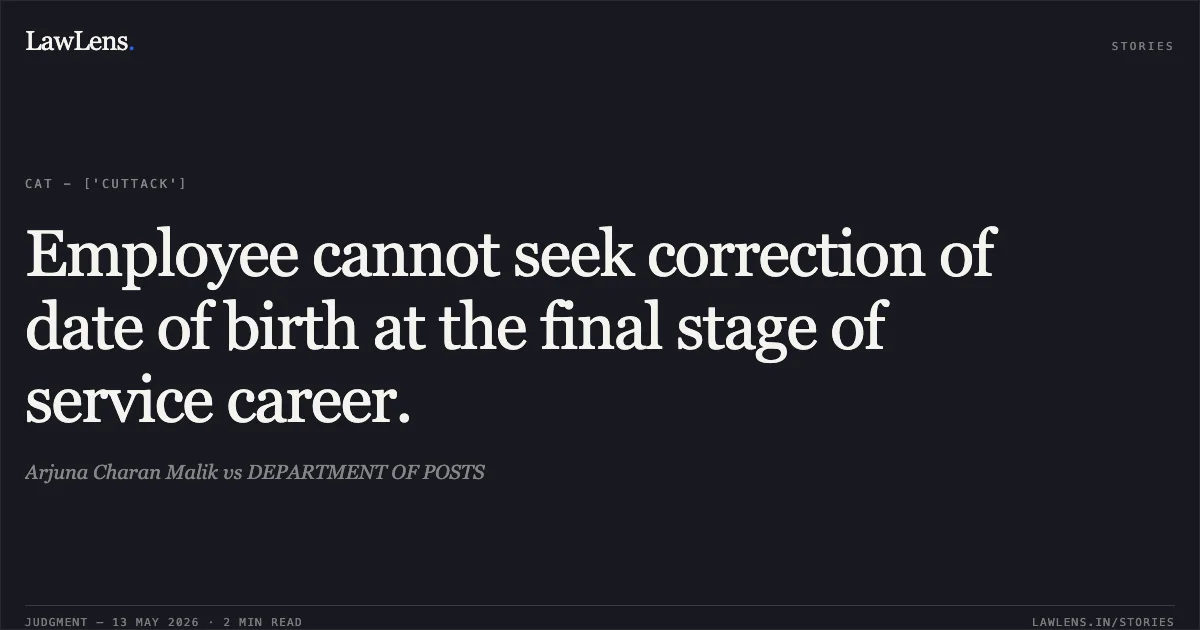
The applicant, a Dak Sevak (DSMD) who joined service in April 1982, challenged a retirement notice dated 03.09.2024, which directed his superannuation on 04.09.2024 based on a recorded date of birth (DOB) of 05.09.1959.
Source reference: p. 2, 3, 4The applicant contended his actual DOB was 16.09.1965, supported by a school transfer certificate, PAN/Aadhar cards, and two internal inspection reports from 2021 and 2022 that reflected the 1965 date.
Source reference: p. 3The Respondents argued that official records (seniority lists from 2002/2004 and SAP software) consistently recorded the 1959 date.
Source reference: p. 3-4They further noted that if the applicant's 1965 claim were true, he would have been only 16 years old at the time of appointment in 1982, violating the minimum age requirement of 18.
Source reference: p. 4Issues
1. Whether the applicant is entitled to a correction of his date of birth in the service records at the time of superannuation based on external documents and inspection reports.
Source reference: p. 2, 52. Whether the retirement order dated 03.09.2024 is legally sustainable.
Source reference: p. 2, 8Law Applied
The court primarily applied the principle that a government servant cannot seek correction of their date of birth at the "fag end" of their career.
Source reference: p. 6It relied on Union of India v. Harnam Singh (1993), which establishes that inordinate delay in seeking DOB correction precludes relief.
Source reference: p. 6It further cited State of Tamil Nadu v. T.V. Venugopalan (1994) and Secretary and Commissioner, Home Dept. v. R. Kirubakaran (1994), emphasizing that courts must be extremely cautious with DOB claims filed on the eve of retirement to prevent the fabrication of records to prolong service.
Source reference: p. 6, 7The court also referenced Rule 3 A of the Gramin Dak Sevak (Conduct Engagement) Rules, 2020 regarding superannuation.
Source reference: p. 4Reasoning
The Tribunal found that the applicant’s date of birth had been recorded as 05.09.1959 in the gradation/seniority lists as far back as 2002, yet the applicant failed to take any steps to rectify it for over two decades.
Source reference: p. 5, 8The court dismissed the reliance on the inspection reports (2021-2022), agreeing with the Respondents that these were erroneous field reflections rather than official departmental changes.
Source reference: p. 4, 5Furthermore, the court noted the logical inconsistency in the applicant's claim: if born in 1965, he would have been underage at the time of his 1982 appointment.
Source reference: p. 4Applying the Harnam Singh precedent, the Tribunal determined that the applicant's silence for the majority of his career acted as an estoppel against challenging the entry just before retirement.
Source reference: p. 6, 8Holding
The Tribunal answered both issues in the negative.
It held that there was no illegality in the Respondents' actions as the applicant failed to challenge the service records in a timely manner.
Source reference: p. 8The Tribunal distinguished the High Court of Orissa's decision in Rajkishore Patra v. State of Odisha because, in that case, the employee had acted immediately upon the opening of his service book, unlike the present applicant.
Source reference: p. 8The Original Application (OA) was dismissed as devoid of merit.
Source reference: p. 9Original Court PDF
Arjuna Charan MalikvsDEPARTMENT OF POSTS
Click to open original judgment
Original judgment, available to read, download and summarize on LawLens.in