01Facts
The petitioners are retired employees of various cooperative banks and federations in Chhattisgarh who superannuated prior to September 1, 2014.
¶ 5, 12During their service, they contributed to the Employees’ Provident Fund on wages exceeding the then-statutory ceiling of ₹6,500/-.
¶ 10Following the Supreme Court's decision in R.C. Gupta v. Regional Provident Fund Commissioner (2018), the EPFO issued a circular dated March 23, 2017, allowing eligible employees to submit joint options for higher pension.
¶ 5(d)The petitioners submitted these options, deposited the differential contribution amounts, and were subsequently granted higher pensions.
¶ 5(e), 5(g)However, following the judgment in EPFO v. Sunil Kumar B. (2023), the respondent-EPFO issued orders (e.g., dated March 22, 2023) discontinuing the higher pension and restoring the lower original pension, claiming that employees who retired prior to September 1, 2014, without exercising an option under Para 11(3) were ineligible.
¶ 2, 6(c)The petitioners challenged these reduction orders.
¶ 202Issues
i.1. Whether the petitioners, having retired prior to September 1, 2014, but having exercised an option under Para 11(3) of the pre-amended Scheme, are entitled to the continued benefit of higher pension.
¶ 19, 27ii.2. Whether the EPFO’s action in reducing the pension based on a retrospective interpretation of the Sunil Kumar B. judgment is legally sustainable.
¶ 19, 2803Law Applied
The court primarily applied Paragraph 11(3) of the unamended Employees’ Pension Scheme, 1995, and Paragraph 26(6) of the Employees' Provident Fund Scheme, 1952.
¶ 20-22It relied on the precedent of R.C. Gupta v. Regional Provident Fund Commissioner (2018), which established that there was no cut-off date for exercising the option under Para 11(3) so long as the employer and employee contributed on actual higher wages.
¶ 5(c), 8It further interpreted the categorization established in EPFO v. Sunil Kumar B. (2023), specifically the distinction between Paragraph 50.7 (ineligible retirees who never opted) and Paragraph 50.8 (eligible retirees who did opt under Para 11(3) of the pre-amended scheme).
¶ 25-27Provisions in the judgment · 6
Employees Provident Funds and Miscellaneous Provisions Act, 1952 Section 2Section 6A
Income-tax Act, 1961 Section 194BSection 115OSection 276BSection 278B
04Reasoning
The court reasoned that the EPFO’s reliance on Paragraph 50.7 of the Sunil Kumar B. judgment to disqualify the petitioners was misplaced.
¶ 27Paragraph 50.7 applies only to those who "never" exercised an option; however, the court found as a fact that the petitioners had indeed submitted joint options and deposited differential amounts in accordance with the law existing at the time and the EPFO's own 2017 circular.
¶ 24, 27The court emphasized that the term "any" in the phrase "without exercising any option" implies a total absence of an option, which was not the case here.
¶ 26Consequently, the petitioners fall under Paragraph 50.8 of the Sunil Kumar B. ruling, which protects those who retired before 2014 having exercised the option under the 1995 Scheme.
¶ 27The court rejected the EPFO's "rectification of mistake" argument, noting that the grant of higher pension was not a mistake but a lawful implementation of the R.C. Gupta mandate, which was affirmed rather than overruled by Sunil Kumar B.
¶ 28, 3305Holding
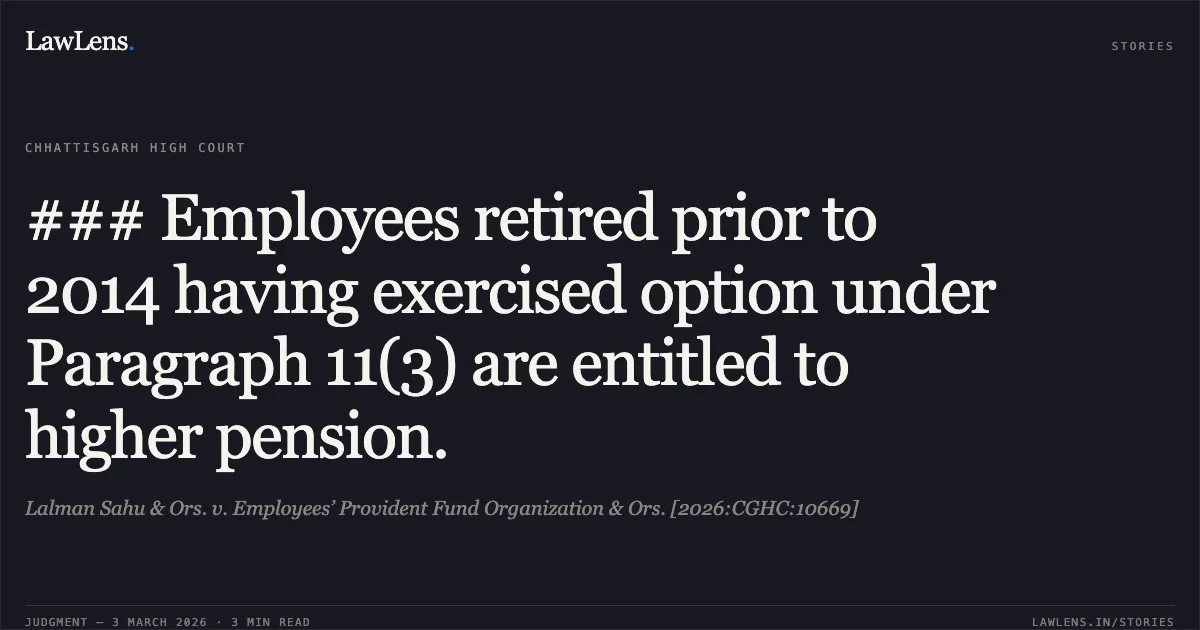
The court held that the petitioners are eligible for higher pension as they had exercised their options under Para 11(3) of the pre-amended Scheme.
¶ 27, 33The court quashed the impugned orders that reduced the petitioners' pensions.
¶ 35The respondents were directed to restore the higher pension immediately and release all arrears within 90 days, failing which the amount would carry interest at 6% per annum.
¶ 34The writ petitions were allowed.
¶ 35Original Court PDF
Lalman Sahu & Ors. v. Employees’ Provident Fund Organization & Ors. [2026:CGHC:10669]
Click to open original judgment
Original judgment, available to read, download and summarize on LawLens.in